Note from the Translator
I am simply a practitioner who wishes only to preserve the teachings of Thailand’s noble monks. I have chosen a literal translation so that international readers receive the same essence and full content of every sentence as Thai readers do, without summarizing or adding personal interpretations. Regardless of whether the doctrines herein are "right" or "wrong" in your view, I kindly ask you to use your own wisdom and judgment to reflect upon them.
If you have any suggestions or find any errors where the translation does not match the original Thai text, please let me know. I would be most grateful for your feedback and will update the text to be as accurate as possible. Thank you.
A Spanish version of this article is available here: ESPAÑOL
Karma does not come from the sky... Quickly recite 'Buddho' to cut it off. Do not leave it be. Old karma is not yet exhausted, new karma keeps continuing endlessly.
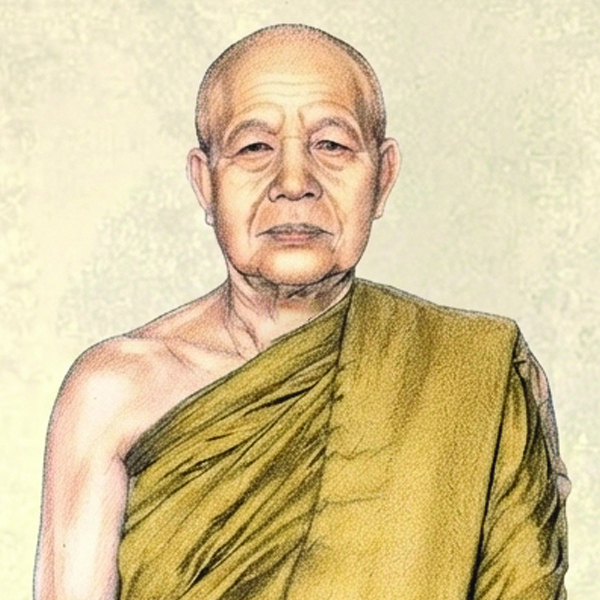
In this episode, we will take you back to 1975, at Wat Tham Kham, Sakon Nakhon Province, to listen to a Dhamma talk by Ajahn Funn Ācāro on the topic of "Accessing Inner Ease." How do we find 'comfort' when our mind is shaking? How do we exhaust our karma while sitting right here? And where is the 'person' hiding in this bag of skin and bones?
Chapter 1: Virtue: The Foundation of a Beautiful Life
For our coming here, the purpose of all of us, every monk and every person, has no other point. We want happiness, we want prosperity, we only want goodness. Now... by what method will we reach happiness and comfort? The Buddha laid down the religion and teachings. He taught Generosity (Dāna), Virtue (Sīla), Concentration (Samādhi), Wisdom (Paññā); these are the core principles of Buddhism. All of us... also want goodness. This goodness is nowhere else; one is good through Virtue, good through Concentration, good through Wisdom.
As for that beauty... in the Pali language, it is stated as Beautiful in the beginning (Ādikalyāṇaṃ), Beautiful in the middle (Majjhekalyāṇaṃ), Beautiful in the end (Pariyosānakalyāṇaṃ). Beautiful (Kalyāṇa) translates to beauty. Beautiful in the beginning, melodic in the beginning, refers to one who has Virtue. Let us all come to know Virtue. What is Virtue? The sky and weather are not Virtue. Trees and mountains are not Virtue. The city is not Virtue. Monks' quarters, pavilions, Dhamma halls, ordination halls, and viharas are not Virtue. Virtue is simply our own body, speech, and mind.
Let us compose our body, compose our speech, and compose our mind to be orderly. When we do not commit offenses, whether minor or major, through both our body and our mind, then no matter what existence or birth we are born into, we will be orderly people, beautiful people. An unorderly person... is one who does not compose and restrain our body, our speech, and our mind. And so, they are not beautiful. If anyone restrains and composes their body, speech, and mind to be orderly, and has no minor or major offenses by way of body, speech, and mind, then that person is a beautiful person. Here, understand this beauty in the beginning.
Right now, our body is orderly, our speech is orderly. What remains is only the mind; it is still wandering around. It is not yet orderly. Look and see what an orderly mind is like. That is, it does not send itself to the left, to the right, to the front, to the back, upwards, or downwards. It establishes itself exclusively in the center of our chest, exclusively in the center of our mind. A normal body and a normal mind are called "Virtue." It is like this. For this reason, let us know, let us see, let us understand. Here, we... have come to train our character and habits. We come to practice. We desire goodness. It is not for any other reason, it is because of this very reason.
Beautiful in the middle refers to one who has Concentration. Concentration... the masters did not say anything else is Concentration. They said "the mind firmly established." Look and see if our mind is firmly established or not. What is it like to be firmly established? It is established like a pillar or a pavilion like this. Giving an analogy to see it like this, it can be relied upon. If it is not firmly established, it collapses and breaks like this. Then it cannot be relied upon.
Now, our mind does not stay. It sends itself over there, it sends itself over here. Sends itself forward, sends itself backward, left, right, up, down. Being like that, it certainly cannot be relied upon. We must make it firmly established. That is, do not send it forward, backward, left, right, up, or down. Let it be firmly established exclusively in the center of our chest. When our mind is firmly established within ourselves, it is Concentration. Right now, people are all staring to find something permanent, a refuge of their own. But all these things are impermanent. Therefore, the Buddha laid down the religion. He said they are impermanent. Whatever is impermanent is suffering. Whatever is suffering is not-self. Know this... here we are trying to make it permanent. If our mind is permanent, not altering and shifting back and forth, then it can be relied upon. Here, it cannot be relied upon. Tell our mind to establish itself here, and it goes over there. Tell it to establish itself over there, and it goes here. It exists like this. Wavering, unsteady, shaking. This right here... the Buddha laid it down to practice Concentration.
Beautiful in the end refers to one who has Wisdom. Wisdom is not speaking about this or that. It is being one who has comprehensive knowledge of the mass of Formations (Saṅkhāra). Knowing in Formations, understanding Formations. Bodily formations (Kāyasaṅkhāra), Mental formations (Cittasaṅkhāra), Formations; the concocting and the fabricating. Is it concocted as Wholesome (Kusala) or Unwholesome (Akusala)? Here, we must know it in time. To know in time with our consciousness (Viññāṇa). This is called Wisdom. Right now, are we Meritorious formations (Puññābhisaṅkhāra) or Demeritorious formations (Apuññābhisaṅkhāra)? Is it Wholesome or Unwholesome? What is Wholesome like? That Wholesome is our mind being good. Having happiness and comfort, not concocting anything else. And what is Unwholesome like? Unwholesome is... our mind not being good. Suffering, hardship, turmoil, and distress. Therefore, he laid these down for all of us, which are: Tranquillity meditation (Samathakammaṭṭhāna) and Insight meditation (Vipassanākammaṭṭhāna). It is a teaching method to bring about knowing, to clarify and demonstrate the reasons for knowing good and knowing evil. He laid down both Tranquillity meditation and Insight meditation. The action that is performed, the base where it is established. What does Tranquillity (Samatha) translate to? Tranquillity is making the heart peaceful. Peaceful from Object (Ārammaṇa) and all Perception (Saññā). When our mind is peaceful, as an analogy... it is like still water. Still water is clear. Our mind... if it is peaceful, it is clear. Clear and clean. Free from suffering, free from fault, free from danger, free from enmity, free from wickedness and vileness. Free from suffering, poverty, starvation, craving, hardship. Annoyance does not exist. It is peaceful. Peaceful water allows one to see oneself, see one's body, see good, see evil.
When the mind can become peaceful, it will arise as Insight meditation. It is not that you "enter" meditation, "enter" Insight (Vipassanā). It is not entering a monk's quarters, entering a room, and closing the door like that. They tell us to develop the mind to know the peaceful mind, whether the mind is good or not good. When it is peaceful, it is clear. Insight knowledge (Vipassanāñāṇa) arises. How does it know? It knows the birthplace of Formations. It knows the cessation place of Formations. This is why it is Insight. Knowing the birthplace and the cessation place of Formations. Knowing the suffering and the fault in Formations. When one sees the suffering and fault of Formations, the danger of Formations, it cuts it off. It does not want to receive suffering. It does not want to receive fault. Do you see? Where does it arise from? That is, knowing the birthplace, not knowing the cessation place. Where does it arise from? All Formations, they arise from our mind. The concocting, the fabricating, the thinking, the pondering.
Chapter 2: Investigating the Body to Abandon Self-Delusion
Where does the pondering come from? Right now, having heard and listened, Inviting to come and see (Ehipassiko). Cry out and call all beings to come and see the Dhamma. Where do we look at the Dhamma? Look at our Corporeality (Rūpadhamma) and Mentality (Nāmadhamma) right here. Corporeality is our physical body, Individuality (Attabhāva). Come and look. Two arms, two legs, one head. Come and see, for what reason? We hold that... this right here is a self, is an ego. That it is a being, a person, an 'us', a 'them'. Let us come and see. Is it truly a self and ego? Is it truly a person? Where is the 'person'? Is this hair a person? Or is body hair a person? Or are nails a person? Or are teeth a person? Or is skin a person? Or flesh and skin, or bones? Or liver, kidneys, small intestine, large intestine? These are just names. Where is the 'person' in any of that? Know it, see it. This very point is what we must come to know in meditation. This right here... look at Corporeality and Mentality.
The concocter, the fabricator is thinking, pondering, Object, Perception. This is Mentality. It is merely thinking and pondering. Come and consider right here. Let us come to know 'Na' and know 'Mo'—our own heart. Only then can it be protected. If we do not know 'Na' and know 'Mo', our heart cannot be protected. The teaching states: In this 'us', where is the 'person'? Bounded by the skin (Tacapariyanto). Full of various kinds of impurities (Pūraṃ nānappakārassa asucino). There is in this body (Atthi imasmiṃ kāye). He did not specify that body over there. 'This body' points to the body of every one of us. Filled with unclean things. What is inside this body?
(Kesā) means Head hair. How is hair clean? If it is clean, why must we wash and clean it? Or is it clean? If hair falls into rice or food, can it be eaten? Can human hair be eaten? It cannot, can it? How can it be clean? Here, it is filled with unclean things. It is like this. Then gaze and consider to look at it, to see it. (Lomā) means Body hair, (Nakhā) means Nails, (Dantā) means Teeth, (Taco) means Skin, (Maṃsaṃ) means Flesh, (Nahārū) means Sinews, (Aṭṭhi) means Bones, (Aṭṭhimiñjaṃ) means Bone marrow, (Vakkaṃ) means Kidneys, (Hadayaṃ) means Heart, (Yakanaṃ) means Liver, (Kilomakaṃ) means Fascia, (Pihakaṃ) means Spleen, (Papphāsaṃ) means Lungs, (Antaṃ) means Intestines, (Antaguṇaṃ) means Mesentery, (Udariyaṃ) means Undigested food, (Karīsaṃ) means Feces. Filled up like this. All are unclean things, let us look and see.
We come to rely on these things and we claim to be a person. Where is the 'person' in that?" They are simply names, going by names. They are separate things. Categorize and separate them right here. We will then come to know the Dhamma, see the Dhamma. If we do not categorize like this, then we generate View (Diṭṭhi), generate Conceit (Māna), Egoism (Ahaṅkāra), Possessiveness (Mamaṅkāra). Holding to self, regarding it as a person, as a self. As a being, as an individual. As an 'us', as a 'them'. As a woman, as a man. As a monk, as a novice. When we consider it, what is there to be a person? Bones, is it? How can bones be a person? Here it is... let us know 'Mo'.
'Na' translates to 'not'. What is 'Na', then? Here, we rely on this 'Namo'. Let us know 'Na', know 'Mo', so that turmoil and distress will not arise. And what is 'Na'? (Pittaṃ) Bile. Look... where is the bile? What about (Semhaṃ) Phlegm? (Pubbo) Pus. (Lohitaṃ) Blood. Where are they? (Sedo) Sweat. (Medo) Fat. (Assu) Tears. (Vasā) Grease. (Kheḷo) Saliva. (Siṅghānikā) Mucus. (Lasikā) Synovial fluid. (Muttaṃ) Urine. Is it a person or what? Is it something to be discarded or something to be kept? Who keeps these things? Who keeps snot? Who keeps saliva? Who keeps sweat and grime? When blood comes out, who keeps it? They are all things to be discarded.
When seeing like this, we then abandon Personality view (Sakkāyadiṭṭhi). The assumption that it is a self, an ego, a being, a person. Views and conceit will not arise. One will be able to abandon Lust (Rāga), Greed (Lobha), Hatred (Dosa), Delusion (Moha), Ignorance (Avijjā), Craving (Taṇhā), Clinging (Upādāna), and Existence and birth (Bhavajāti). The mind will not be ambitious and struggling. It will not be agitated and distressed. The mind will be peaceful, becoming Virtue, Concentration, Wisdom. For this reason, let us know. This right here, we know the Dhamma. Here, I have come to explain the Dhamma for you to listen to. Come and learn right here. When seeing like this, abandon Personality view. One no longer assumes it is a self or an ego. Thus, there is no Greed, anger, or Delusion. Our mind is peaceful. It has coolness, it has lightness and comfort. Here, it has been explained for you to listen... once understood, let us all consider these things. We come to take it as a person; but where is the 'person'? The master has explained it for you to listen, and it is like this. It has been clarified and demonstrated to be seen right here in our own bodies.
Those who will reach happiness and prosperity, entering into the Path (Magga) and Fruition (Phala), come to consider right at this point. If we consider and see this Dhamma, knowing and seeing this compounded physical body of ours, that person is one who sees the Dhamma. One who sees the Dhamma will get to see the teachings of the Buddha. Will get to see the Buddha. Will know the Buddha. When one sees the Buddha, that person will enter into Final emancipation (Parinibbāna). Extinguishing suffering in the Round of rebirth (Vaṭṭasaṃsāra). No longer roaming... wandering through the cycle of birth and death anymore. It is like this. For this reason, let us know, see, and understand further.
Chapter 3: Practicing Buddho: Finding Peace and Ending Karma
Today, have you listened to enough of the sermon? You all know it already. Whatever it is, you have known it already, haven't you? Birth, aging, sickness, and death are already known. Happiness and suffering are already known. We have seen it all. From now on, listening to the Dhamma, listening to sermons, has no end. Take your posture... sit and listen to the Dhamma comfortably. Sit cross-legged, right leg over left leg, right hand over left hand. When our heart is comfortable, recollect our refuge. What is our refuge? It is the Buddha, the Dhamma, the Sangha. Believe that the Buddha is in the heart. The Dhamma is in the heart. The Noble Sangha is in the heart. Why say it is in the heart? Buddha, the knowing, is in the heart; it is not anywhere else. Having believed firmly like that, then ponder and recite the meditation word like this: Buddho, Dhammo, Saṅgho... three times. Then gather it up into only Buddho, the single word Buddho. Close your eyes, shut your mouth. The tongue does not move about. Recollect it in the heart.
Where is the feeling of 'Buddho' known? Recollect and see. Where is 'Buddho' felt? Establish Mindfulness (Sati) right there. Focus and gaze at the knowing. Right now we want to know... what we ourselves are like. Our refuge, our dwelling place. We want to know how it resides. Is it happy or is it suffering? Is it good or is it bad? Measure it to know. Wherever the knowing is, establish Mindfulness right there. The eyes focus and gaze right there. Our ears go and listen right there. Listen for what reason? Because we want to know whether we are good, or whether we are bad. Whether it is happy, or whether it is suffering. It is good. How is it good? It is that our heart is peaceful. Our heart is good. Having happiness and comfort, a cool and tranquil heart. Not suffering, not hot, not chaotic, not in turmoil. The Awakened One, the heart blossoms, bright in the chest and in the heart. It is good, therefore it is like this. Good like this, bringing happiness and prosperity in the present and in the future. We come here because we want happiness and comfort. Here, it is like this. Our heart being comfortable is what has just been explained. Know it when our heart is good. Having happiness and comfort, a cool and tranquil heart. Not suffering, not hot, not in turmoil.
This very sphere of Dhamma is what brings our refuge. This very thing is our dwelling place. This sphere of Dhamma naturally protects a person, leading them to a Happy destination (Sugati) in the present and the future. This sphere of Dhamma.... brings happiness and prosperity. Look and see! Is our mind comfortable? Lightness of body (Kāyalahutā), Lightness of mind (Cittalahutā). Light in oneself, light in the body. Free from disease, free from danger, free from misfortune, free from adversity, free from vile defilements. Free from wickedness and vileness. Free from suffering and poverty. Because our mind is not impoverished. Because our mind has happiness. Our mind has comfort. It is not that belongings and money are comfortable. Houses are comfortable, work is comfortable. But rather, it is our heart that is comfortable.
When our heart is comfortable, work is also comfortable. Studies are also comfortable. Whatever we do to make a living is comfortable. Family is comfortable. When it is like that, the villagers and the markets are comfortable. The nation is comfortable. When we have extinguished the Aggregates (Khandha) and passed away, we abide in comfort. We do not need to ponder the past or the future. The past has passed; good is good, bad is bad—it has come and gone. The future ahead... has not yet arrived. When in this present moment there is comfort, the future will be comfortable. Because this person is a doer of Merit (Puñña). This is called Merit. May you know it, may you understand it. Goodness and virtue, come to know it. When our heart is good, whatever we do is good. Whatever we seek is good. Here, know it. A good thing... is it like what was explained?
Our mind is Buddho. The heart blossoms and is bright, a cool and tranquil heart. Not suffering, not hot. Buddho is the one who blossoms. Buddho is the one who is illuminated. Buddho is the one who is radiant. When it is clear, one sees oneself, sees one's body, sees 'us', sees 'them'. A clear heart, a clean heart. Free from suffering, free from fault, free from danger, free from enmity. Free from wickedness and vileness. Free from suffering and poverty. How could it be poor? Our heart is already good. Our heart is not poor. Our heart does not suffer. Where would we bring suffering from? Look! It is not the sky or the weather that suffers. Look to know. We come to practice and train. We want to know what is happiness and what is suffering. Happiness is what has just been explained for you to listen to. What is suffering like? It is that our heart is not peaceful. The heart is not good. A heart that is not good is hardship, turmoil, and distress. This is what causes all beings to receive suffering and hardship, in the present and the future.
Some people... why do they study and it's not good? Why do they work and it's not good? Why do they trade and take a loss? They want rank and title, why can't they get it? For what reason? It is because the heart is not good. A heart that is not good is hardship, turmoil, and distress. This very thing is what leads all beings to receive suffering and hardship both in the present and the future. It is nothing far away. Look! We are sitting right here, and yet the heart is already struggling. Bringing heaviness, sluggishness, drowsiness, dullness, and suffering. Stiff and sore all over the body, aching here, hurting there. Giving rise to disease, danger, defilements, misfortune, and vile wickedness. Suffering and hardship arise. This right here is Insight. We have known clearly and seen the reality. The Truth (Saccadhamma) does not come from anywhere else. Quickly recite 'Buddho' to cut it off. Do not leave it be. If we leave it be, we will continue to be a poor person, a suffering person. Continue to be a wicked and vile person. We do not want these things, isn't that so! So look and see, when our heart is not good, it is hardship.
Consider it to be definitive. Here it is... we say it's this karma or that karma. Where does Karma come from? Karma does not come from the sky, from the air, trees, or mountains. Bodily action (Kāyakamma), Verbal action (Vacīkamma), Mental action (Manokamma). That is, karma born from our body, from our speech, and from our mind. Here, karma is born like this. But right now, our Bodily action is already good. Our Verbal action is absent. What remains is only Mental action, which is our inclination and thinking. Whatever karma we ponder, good karma or evil karma. I am the owner of my actions (Kammassakomhi). Whatever kamma we commit, whether merit or evil, we will receive the results of that kamma going forward (Kalyāṇaṃ vā pāpakaṃ vā tassa dāyādo bhavissāmi).
(Kalyāṇaṃ) means good karma. How will we know? Summed up briefly, it is that our heart is good. Having happiness and comfort, feeling light in oneself, light in the body. That is good karma. Is it like that? (Pāpakaṃ), what is bad karma like? It is the heart not being good. Hardship and turmoil. The heart is not peaceful. Going about generating karma, generating enmity, generating danger. Bringing heaviness, sinking, drowsiness, dullness, suffering, and hardship. That is bad karma. Mental action, our inclination and thinking. Whatever karma we ponder, let it go. Do not go pondering it. All karma, we go and ponder it ourselves. If we do not ponder it, we don't receive it. Old karma is not yet exhausted, new karma keeps continuing endlessly. Then when will it all be paid off?
If you want to exhaust karma, you must stop. Do not go making karma. Sitting right here, you still go making it. 'Bhave vā sambhavanti'—it goes around scooping up minor existences and major existences right here. When we see it, cut it off; then it becomes Insight. Cut off the evil, cut off all moods. Every one of you has heard it. Next: Sandiṭṭhiko. The practitioner knows for oneself, sees for oneself. Explaining it has no end. Having explained it, every one of you has heard it. (Opanayiko). Incline it inwards toward oneself. (Paccattaṃ). Known exclusively to oneself. If one does not know it for oneself, no matter how much others... come and tell you, you will not believe it.
All happiness and suffering, all good and evil. When one's own self sees it, then it believes. Here, remember this. Making this merit is called Veneration through practice (Paṭipattipūjā). Truly excellent and noble veneration. We make this merit, we wash away Evil and wash away karma. There is no other method to wash it away. Washing with water cannot wash it. Cutting with a knife or sword cannot do it. We rely precisely on sitting in meditation like this. When our mind is peaceful, then karma is exhausted. When this person does not make karma, where will karma come from? Here, let us all come to know this.
From now on... make the greatest merit, called Veneration through Practice. Truly supreme and noble veneration. From now on, remember that the practitioner sees for oneself, knows for oneself. If one does not know, others cannot tell them. I have explained it for you to listen, the path of practice. Make a resolution that whatever sounds you hear, knowing that those things hold no danger, then we are not distressed. Let it be known. From now on, I will not explain anymore. Each of you listen on your own. Leading inwards. Incline it into our own heart. Whether it is happy or suffering, know it. Whether it is good or bad, know it. It is called Visible here and now, the practitioner knows for oneself, sees for oneself. It is impermanent—this body of ours. The suffering is truly suffering. (Anattā). It is not a self. If it were not like this, then tell it not to ache, not to hurt. Do not be this, do not be that. It is not under anyone's command. It is Non-self.
Look and see... each of us making peace. We sit right here and still can attain so little peace. How can our nation be at peace? How can we make others be at peace? This is what the master said: if our heart is not good, what will we bring to be good? Meditating and seeing only suffering, so you just suffer continuously. You must practice and train it to go beyond suffering. So that you will exhaust suffering. Then we will be light, we will be comfortable.