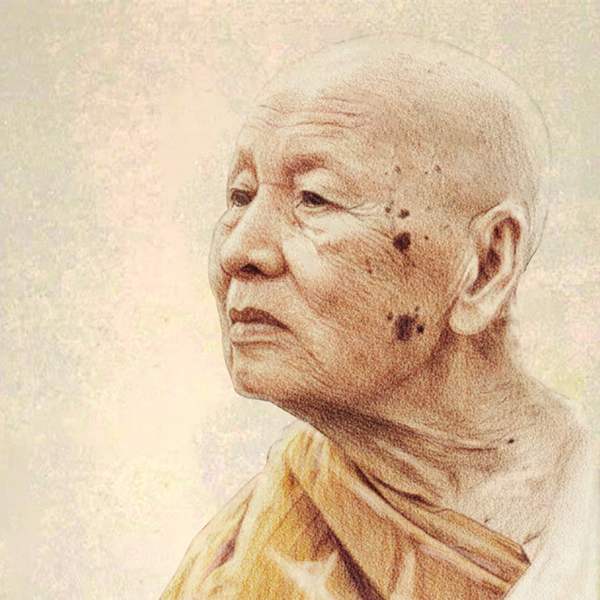
Note from the Translator
I am simply a practitioner who wishes only to preserve the teachings of Thailand’s noble monks. I have chosen a literal translation so that international readers receive the same essence and full content of every sentence as Thai readers do, without summarizing or adding personal interpretations. Regardless of whether the doctrines herein are "right" or "wrong" in your view, I kindly ask you to use your own wisdom and judgment to reflect upon them.
If you have any suggestions or find any errors where the translation does not match the original Thai text, please let me know. I would be most grateful for your feedback and will update the text to be as accurate as possible. Thank you.
A Spanish version of this article is available here: ESPAÑOL
One experiences suffering and sorrow because the mind cannot be guarded. Because one cannot guard the mind. Thinking with longing, yearning, and worry about the things one loves, one desires, one is satisfied with, until one becomes entangled and bound up in those various things. The mind goes to worry like that. One cannot guard the mind to stay put, thus it gradually becomes like that. Thus it gradually becomes suffering.
In this episode, we will take you back to May 25, 1984, at Wat Hin Mak Peng, Nong Khai Province, to listen to a Dhamma talk by Ajahn Thate Desaransi on the topic of "Guarding the Mind." We will explore why we must guard the mind, how to do it, and why doing so leads to liberation from suffering. The talk also touches upon the flip side of cleverness and foolishness.
Disclaimer: This content mentions elements of Mindfulness of the Body (Kayagatasati), which is a technique for contemplating the physical body; therefore, it may contain some graphic or sensitive language. It also includes Mindfulness of Death (Maranasati), a technique for contemplating death to help us live mindfully with every breath, recognize that death is always right beside everyone, and encourage us to urgently persist in our meditation practice. We ask listeners to please understand that these are strictly skillful means used in Dhamma practice.
Defining the Mind and the Heart
The Pali states: Cittaṃ rakkhetha medhāvī — “The wise (medhāvī) should guard the mind (citta).” That is how it is stated. Now, we will explain the matter of “guarding the mind,” because in the practice of kammaṭṭhāna, the teachers speak of the mind (citta) mostly, as the main and most important thing. The word “citta” in this context is something most people grasp incorrectly. Those who have not developed Mental development (Bhāvanā), or whose mental development is not yet proficient, do not know the mind and grasp the mind incorrectly. The mind might be understood to be the physical heart. That is, "heart" and "mind" have similar names. If one speaks about the heart, one speaks about the physical heart, which is the Heart-base (Hadayavatthu), and thus one understands that the heart is the physical heart entirely, meaning the mind or the heart are the same thing.
If speaking according to Pali terminology, the mind is the thinker and ponderer. As for the heart, "heart" is our local language that is spoken and understood to be something neutral. If speaking according to Pali, it is called Intellect (Mano). The characteristic or symptom of inclining, which has not yet reached the mind—that initial inclination is called the heart. Intellect means to incline. That is called the heart. Having inclined, it then proceeds towards thinking, pondering, concocting, and fabricating. Therefore, it is called the mind. Therefore, one should understand that the mind refers to the entity that experiences Consciousness, ponders, and thinks; this is called the mind. If one intends to train the mind, but does not yet know the mind itself, then one cannot train it correctly, not knowing exactly where to train it.
If the practitioner has successfully trained and disciplined their own mind, then one will know what the mind is. The one who sees the mind, knows the mind, and can guard their own mind, is called a Sage (Medhī), matching the Pali phrase which states, Cittaṃ rakkhetha medhāvī. As stated here, Wise person (Medhāvī) is the one with wisdom who should guard their own mind. This explains the topic of the mind to establish an understanding of the mind first, which one must collectively train and discipline.
Now regarding the mind, what kind of entity is it? That entity of the mind, it actually has no self or form. If one has trained the mind well, if one takes the mind and establishes it at the head, it stays at the head. If one establishes it on the nose, it stays right at the nose. Keeping it at the chest, or the left shoulder, or the right shoulder, it can stay in all those places. Or one can go and establish it right at the tips of the toes or the tips of the fingers entirely. The mind, wherever one inclines it to, it stays exactly there. Wherever we feel, we don't know where we are—not realizing we feel through the nerves. For instance, feeling pain at the tips of the toes or fingers, or at the chest, or on the head—wherever it may be. The nervous system of a person has nerve threads connecting and linking throughout the entire bodily anatomy, but they do not converge everywhere; they converge at the heart-base, right at the physical heart. It naturally prefers to be there, meaning the heart prefers to stay right at the physical heart, because converging there, Consciousness arises right there.
For that reason, it is said that the heart is exactly that Consciousness itself. It has no self and no physical body. Wherever Consciousness is experienced, the heart is right there. The heart is something rapid, difficult for anyone to catch. A person who has not trained and disciplined the mind at all, from the day of birth to the day of death, cannot catch their own mind. They cannot train and discipline their own mind. One does not know where it flits and flies about; one simply does not know. The mind is something that runs rapidly. Some people say they follow and know the mind, which is not knowing right in time with the mind. That is, following and knowing the mind—knowing after the fact—is not knowing concurrently; it is not knowing right at that very moment.
The term "following and knowing the mind"—the mind goes to originate Consciousness, a pain on the head, and one follows to know, "Ah, it hurts right there." It goes to hurt right at the foot, and one goes to know following right there. Or going to know way out there, on the outside. It goes to see Form (Rūpa), Sound (Sadda), Odor (Gandha), Taste (Rasa), and Tangible object (Phoṭṭhabba) on the outside. For example, going to see a form far away over there, in front, incredibly far away. Going to look and see, following to know that the mind goes to know that object. That is called following and knowing the mind, but it is not knowing the mind itself. If one knows the mind itself, knowing keeping pace with the mind itself, seeing through the mind itself, the mind has not yet gone out. In this case, it has already gone out and then one gradually follows to know. One knows, but one absolutely does not know the entity itself. One only goes to know the movements of the mind.
If a person has successfully trained and disciplined their own mind, the mind will become an entity. However, it does not appear to the physical eyes, rather it will appear to the heart. The mind and the heart come together once again. However one wishes to phrase it: the heart knows the heart, the heart sees the heart, the heart is in time with the heart. Or the mind knows the mind, the mind is in time with the mind, the mind sees the mind. This is following and knowing, following right in time, and knowing concurrently with the mind. The term “knowing concurrently” here, the meaning is already right there. That is, the knowing is exactly on the same level as the mind — it doesn’t lead, doesn’t lag, doesn’t overtake or fall short. Jussst... right there, perfectly even with the mind, matching the mind exactly. Knowing where the mind is, feeling right there. Knowing oneself right there. Therefore, it is said to know concurrently, not to know following afterwards. Knowing right in time, perfectly balanced together.
It is said that when knowing concurrently and matching perfectly like this, one will see the mind as an entity indeed. When seeing the mind as an entity, it is called knowing the mind in time. At this point, the mind has no movements. Even if there are movements, one knows. Whether it stays or goes, one knows. One knows. Whether to let it go or stay, one knows. One can do it. This is called knowing the mind concurrently and in time.
The Path to Mental Discipline
Now speaking to the matter of training, speaking to the matter of having to train the mind. The mind, why is it necessary to have to know it concurrently? Why is it necessary to know it in time? Or why is it necessary to come and train and discipline it? Can one not train the mind? If one is a person without wisdom, it is possible. If one is a person with wisdom, as in the Pali verse raised at the beginning, Cittaṃ rakkhetha medhāvī, only a person with wisdom will guard the mind, therefore one should guard the mind. The phrase "should guard the mind" here means it is truly fitting that one must guard it. A person with wisdom must see it as something truly fitting. When something exists and one does not know how to guard it, what benefit will be gained? If something exists and one does not know that it exists, then what value will it have? For that reason, a wise person should guard the mind. One should guard it for this reason. If one is not an intellectual, then one releases it according to Fate (Yathākamma). It depends on how it will proceed according to fate. For that reason, it is said to be something that should be guarded.
This speaks to the matter of intellectuals, a person with wisdom. Speaking in the position of a person with wisdom, one should set the intention to guard the mind and train and discipline the mind. Regarding the mind, if one does not see the fault of not guarding the mind, or the movement of the mind not staying put, it is a fault, meaning it brings Suffering (Dukkha). And then one will guard the mind. One will therefore train the mind. The next verse is called Cittaṃ dantaṃ sukhāvahaṃ —a mind that is well trained and disciplined brings Happiness (Sukha). Then it will align with this verse. We see the fault of a mind we cannot guard or train. It wavers and runs wildly. It leads to the arising of suffering.
Let one think like this. Think very simply. One experiences suffering and sorrow because the mind cannot be guarded. Because one cannot guard the mind. Thinking with longing, yearning, and worry about the things one loves, one desires, one is satisfied with, until one becomes entangled and bound up in those various things. The mind goes to worry like that. One cannot guard the mind to stay put, thus it gradually becomes like that. Thus it gradually becomes suffering. If the mind can be guarded, one forbids it from worrying, from having concern, from having longing, from having yearning, from sending itself out to those various places. When the mind entirely withdraws from those matters and comes to stay in a single place, it is called a trained and disciplined mind. One is comfortable; one does not have to go suffer, does not have to be sorrowful, does not have to be tormented. One sees the fault in this way and sees the virtue in this way, therefore one gradually attempts to guard the mind.
If one has not yet seen the fault and seen the virtue, one is unable to guard the mind. If one does not see the fault of the mind being chaotic, or the mind falling, then one is unable to develop various forms of Concentration (Samādhi). With absolutely any and all things, if one does not see the fault in that thing, one cannot abandon it, no matter what it is entirely. This is the major point indeed. This is the major essence. In one training the mind, there is a crucial point right here. The thing in which one sees the fault, one abandons the thing in which one sees the fault. One must attempt to deal with the thing that is a fault. Abandon it truly. If one truly sees the fault, one truly abandons it.
If one has seen the fault and seen the virtue as mentioned, yet there is still no path to be able to abandon it, it falls into the idiom of: discarding it is a regret, keeping it is detestable. Discarding it is a regret, keeping it is detestable. When doing it like this, one hesitates. Doing things with doubt and hesitation (Kathaṅkathī) yields no good results whatsoever. One can do concentration until the day of death and it will not yield results. A person who practices concentration and mental development and becomes proficient quickly, or attains it easily, does so because they truly see the fault in the matter of the chaotic mind. It brings about a mass of suffering. Therefore they can release it completely. The mind will then attain concentration quickly. A person who practices concentration becoming proficient quickly or being slow lies exactly right here.
Aside from this, in meditation practice, whatever method you use, you'll feel reluctant to let go. If one will think, will perform Preparatory meditation (Parikamma) using Awakened (Buddho), one is reluctant to let go of Death (Maraṇaṃ), which means dying. If one will establish the contemplation of death or the in-and-out breath, one goes and feels a lingering attachment to Buddho. Or if one will contemplate Mindfulness immersed in the body (Kāyagatāsati), or contemplate Loathsomeness (Asubha) and Repulsiveness (Paṭikūla), or Element (Dhātu) and Aggregate (Khandha), one is reluctant to leave behind Mindfulness of breathing (Ānāpānasati), something along those lines. Consequently, one cannot grasp a single thing at all. Like this, one cannot develop mental development either.
Dhamma and meditation methods are many—whatever you choose, just do it. Just do it truly, and leave it at that. Do that thing truly, and let that be it. Wrong or right, just let one see the truth by oneself. If one can do it like this, wisdom will be able to arise. It enters the ancient adage that says: Wrong is a teacher, right is a master. If there is no wrong, there is no teacher, there is no knowledge. A master will gradually teach. If one already knows, there is no need to have someone teach. That is, it is the wrong exactly that will be a teacher, be a master. Be a teacher to teach one. When it is wrong, and one determines that it is wrong, exactly that will then be a master. Thus a master will arise. After the teacher teaches, then one gradually has a master. After the teacher teaches one to know, then one gradually has a master. A master is the one who trains. A teacher is the one who teaches to know, to give rise to knowledge. A master is the one who trains one to be good further on.
For that reason, it is said that if one is to train and discipline mental development and practice concentration, to make it into concentration truly and seriously, one must not let there be any hesitation. Whatever one does, let one do it absolutely truly and seriously. Let one remember this.
Contemplating the Body and Death
In this context, which will explain the skillful means to further train and discipline, one will explain specifically the matter of mindfulness immersed in the body. Because mindfulness immersed in the body is something broad, but one will not let it be broad. That is, one will have one take just a single thing. For example, within this very body of ours, there are entirely numerous organs indeed. Two eyes, two nostrils, tongue, body—they are uncountable. But the organs in this physical body, counting from the hands and feet upwards, every thing and every part are entirely within the body. All these things are entirely within the body, extremely numerous. But one will not let you take many. Let one take just a single thing. This body of ours, let one take just a single thing, grasp just a single thing. For instance, if one will grasp merely: taking just one single eyeball. Just a single eyeball only, within our body.
When the eye is present, one having obtained just the single eye will guard just the single thing. One will look at the single eye. There is no need to go look at the ear. There is no need to go guard the ear anymore. Guard specifically the eye. Let one be able to guard the eye first. Master the one eyeball first. Guarding what? That is, guarding with restraint. Restrain it to stay exclusively at the eye alone. Whatever the eye will look at, let it look. Let the mind remain looking at the eye. Guard the eye. Whether it will look near or look far, look at the coarse or look at the refined. Let one see the eye looking at every moment. Experience Consciousness that the eye is looking at every moment. Once one catches up, then... the second eye... is finished. The entire nose... is finished. The entire ear... is finished. There is no need to guard them. Like this, for example. In the matter of taking a single thing within our body, which is called mindfulness immersed in the body. In this mindfulness immersed in the body, one does not let you take everything.
Contemplating just death alone is sufficient. If dead, then the eyes are entirely dead. The ears and nose are entirely dead. The shins, legs, and all organs are entirely dead. Dead. If you're not dead, then everything is still 'good'. So, Mindfulness of the Body all comes down to death. Contemplate death. If one comes to grasp our death, focusing and contemplating specifically on death alone. We people are afraid of dying. If contemplating death, it lets go of everything. If one sees death, it lets go of everything completely. If one has not yet seen death, it then fabricates at this point... becoming incredibly prolonged and vast indeed. When one comes to contemplate death: looking at the eye, the eye is something that dies. Looking at the ear, looking at the nose, they are things that die. The various organs, shins, legs, feet, and hands are things that die. That is still distant.
The contemplation of death specifically while we are sitting right now: death, it dies with every second. One second is a death. One second dropping away is a death. One minute dropping away is a death. One hour striking 'bong'.... here, it has already died. Two or three hours, it dies. Twenty-four hours, it dies. Clocks are made for the purpose of being an instrument to measure death. Their meaning, when they speak, is far too distant. That is, measuring hours, minutes, and seconds, they speak of that because they do not practice mental development. If it is a practitioner of mental development, they do not speak reaching out to there. Contemplate our own body. The seconds, minutes, and hours of death. It is completely gone. Gone, gone. As we sit looking right here, it is gone in every moment.
When one comes to focus and contemplate death specifically to this extent, seeing specifically to this extent, the mind will be able to shrink inward. The mind will not fabricate and send itself out externally. If one clearly sees death, then for all those things, there is no need to go abandon them. It abandons and releases them entirely on its own. When it abandons, when it releases them, it then remains just a single thing: which is Consciousness. The one who experiences Consciousness is the one who sees. The one who sees death is the one who experiences Consciousness that it dies. Staying in a single location.
If the mind goes in to stay in a single location, it will have power... that is courageous. Capable of... gathering the strength of the mind that possesses that courageous power, and contemplating other places with complete clarity at this point. It is compared to electricity, compared to water. Water, if it has many tributaries or has many channels and many paths it flows into, its strength is small. If one closes every channel—if there are three or four channels or many tributaries left, close them so it remains just a single tributary. The water then has strong power. Their electricity is just the same. If it has many bulbs, having many bulbs, it shines with little brightness. If it is a single bulb, it shines completely bright. The power of the heart is just the same. The path of the ear, close it. It closes on its own. The path of the nose, the path of the tongue, the path of the body, are closed. If one goes and sees clearly into the single matter of death, it will shoot down into death with absolute clarity.
Here, it has no strength, right here. The issue is, the power of the mind is small. Seeing it for just a flash, and then it disappears. Seeing it for just a flash, and then it disappears. Sending itself out along the ear, the nose. Sending itself out along the tongue, the body. Going entirely everywhere. Consequently, it is not clear in even a single thing. All Dhamma is clear. They are true in every respect. They are things of truth, of genuineness in every respect. But our heart does not have the power, sufficient to... go look at Dhamma. Dhamma therefore are not something clear. When they are not something clear, there is then no knowledge that will rise up brightly. Rapture (Pīti), Tranquility (Passaddhi).
When there is no clear and bright knowledge, doing it for a while, one becomes exhausted. Doing it for a while, one becomes lazy and annoyed. Thus, doing it over and over, one claims that all Dhamma are of no benefit to one's life. All Dhamma are unable to bring happiness. Thus one is lazy and indolent. Thus one simply does it. Doing it because one is simply doing it. Eventually, one does not do anything at all. Laziness and indolence come to dominate. Defilement (Kilesa) take total control. Consequently, a person who does it or does not do it are exactly the same. The person who practices or does not practice are exactly the same.
All those who practice and train in mental development and meditation practice, if they do not reach Dhamma, it will become a state of weariness, laziness, and indolence in applying oneself to mental development and making effort. And one desires to obtain broad knowledge. And one desires to have Knowledge (Vijjā) and ability in every aspect and every direction. There is only craving alone. But the strength of the mind sent out following that craving consequently has no power sufficient to… gather the strength inward to focus and contemplate Dhamma specifically. Or understanding that the craving to shoot over there, shoot over here, seeking breadth, seeking knowledge, seeking cleverness, shooting out to do that and do this. In the end, it’s a total mess.
The Paradox of Spiritual Foolishness
Practitioners, intellectuals of this era, train in mental development and meditation practice desiring broad knowledge. If they are to practice mental development and do concentration to make the mind into one, they are afraid of becoming a foolish person. They claim that it is foolishness. The mind being one, what knowledge will it go and have? It is only foolishness! They go in this posture entirely. For a person to make themselves a foolish person is difficult. If to be a clever person, it is easy. Acutely clever about that and this, with both wit and eloquence, thinking, pondering, reflecting. Ah... exceptionally clever. The matter of being clever is the easiest and most comfortable. There is no need to train together much at all. But to deliberately be 'foolish' like this... is the most difficult.
For people, if one does not intentionally act to make oneself a foolish person first, one will not know foolishness at all. Worldly 'cleverness' is a boundless foolishness. It's just that kind of foolishness. But our trained 'foolishness' has clear boundaries. The ultimate 'foolishness' for a practitioner is Attainment concentration (Appanā-samādhi). Attainment concentration means having no thoughts or ponderings. There is only awareness specifically of its own self. External objects vanish... completely! There is none at all in that place.
Attainment concentration, or otherwise it is called One-pointedness of mind (Ekaggatācitta). The mind has a single mental object. A single mental object right here means specifically the mental object of the mind only. It is not sent out along external mental objects, which are the six Sense base (Āyatana). Therefore it is called One-pointedness of mind. Or otherwise it is called Life-continuum consciousness (Bhavaṅgacitta). The mind that enters into the Life-continuum (Bhavaṅga) has no external Consciousness. This is the foolishness of the practitioner. Of the one training. Training to become a foolish person. Try to be 'clever' and you're in for a major headache!
Train for this 'foolishness' to the limit, and you’ll know it. The very act of training to reach that foolishness, it has cleverness residing within itself. Therefore one can gradually become a foolish person. A person who is not clever cannot train to be a foolish person. Speaking simply like this. Or speaking according to Pali terminology, it states: The one without Meditative absorption (Jhāna) has no wisdom. The one without wisdom has no meditative absorption. It is true as stated. Meditative absorption, concentration, Meditative attainment (Samāpatti). To enter into Attainment absorption (Appanā-jhāna), or One-pointedness of mind, One-pointedness of mental object (Ekaggatārammaṇa)—which is called the utmost of meditative absorption, or called the life-continuum, the utmost of meditative absorption—if one has no wisdom, one does not reach it.
What is wisdom? It is contemplating to see the fault of chaos. To see the mental objects that entirely scatter and are chaotic. Whatever it will send out to cling to and hold onto, seeing it as a fault, suffering, and danger. Seeing it as Impermanence (Anicca), Suffering (Dukkha), and Non-self (Anattā). Seeing it as Ultimate reality (Sabhāvadhamma). Whatever Form, Sound, Odor, Taste, and Tangible object it will go and stick to, seeing it as the Origin of suffering (Samudaya). Seeing it as proceeding towards the mass of suffering. Exactly that is called wisdom. When seeing like that, it therefore gradually withdraws. From the sending out, from the chaos, from all the entirely of the fabrications. It is wisdom exactly that goes to eradicate all those movements of the mind. Only then will it let go, release, and gather inward to become Attainment concentration, or Attainment absorption, or what is called One-pointedness of mental object, or called the life-continuum as mentioned here. Therefore it is said: The one without wisdom has no meditative absorption. The one without meditative absorption has no wisdom.
As for that, if the mind enters into Attainment, or enters into One-pointedness, or enters into Life-continuum consciousness, this is called meditative absorption or called concentration. Because once the mind withdraws out from that, it will be exactly like as if one enters into a certain stuffy room, where one does not see external things. One only looks and sees internal things. Examining the internal, within the things that are inside there. As soon as one opens the room, opens the compartments, opens the windows to come out, coming to look at external things, the mind and heart will be expansive and joyful.
Besides that as well, one will see external things as wondrously strange immediately. For example, when the mind goes in to be One-pointedness of mind, the mind is one. As soon as it comes out, the mind is not one anymore. Coming to look at the thing that is not one, exactly there, it will become clear immediately that, "Ah, 'one' and the thing that is 'not one' are like this. They differ like this. The one that is 'one', just how much peaceful happiness does it have? Just how much cooling serenity does it have? This one that is 'not one', just how much torment and chaos does it have?" This is called wisdom arising from concentration, arising from meditative absorption.
Exactly that is why it is said that wisdom arises later on, after foolishness. After foolishness, then at this point wisdom arises entirely. It has this kind of virtuous benefit, making oneself a foolish person. Always acting 'clever' about everything? Then nothing will be wondrous... not a bit! Like an ordinary common person who has not yet trained and disciplined the mind to enter into being a foolish person as explained here, they will be restless at all times. Having no station at all. And in the final result, one will not be able to find any true essence (Sāra) in anything whatsoever.
Wisdom of this kind, it has become foolishness in itself. That is, oneself does not even know the matters of oneself, regarding what one is thinking and pondering. It therefore has become a foolish person in itself. For that reason, it is said to practice to become a foolish person first. Let one know foolishness first. Only the knowing of foolishness is named as having already given rise to wisdom. Take the wisdom right here first.
True Wisdom and Peaceful Happiness
The Buddha, He was the Supreme Teacher who had trained and disciplined in this path already. Thus He taught us. But we, we want to be the Supreme Teacher right away. Seeing the Lord Buddha possessing expansive wisdom and acute cleverness, we therefore want to attain it like the Lord Buddha. The statement that the Lord Buddha was acutely clever, in what stage or what plane it resides, one does not know. Clever by what method, one does not know. Thus we just want to be clever like the Lord Buddha.
The Lord Buddha was clever in a way different from how an Ordinary worldling (Puthujjana) is clever. That is, the Lord Buddha could control His mind. To let it remain in absolutely any state was entirely possible. The Traditions of the Noble Ones (Ariyavaṃsa) and Abode of the Noble Ones (Ariyavāsa) of all the Noble One (Ariyapuggala)—they have demonstrated it like this. Contemplating something bad to be something good is possible. Contemplating something beautiful to be something not beautiful is possible. Contemplating something not beautiful to be something beautiful is possible. Both something beautiful and something not beautiful, to make it something not beautiful is possible.
This is His cleverness. It is not like the cleverness of an ordinary person who is said to be acutely clever. A clever person only looks to take the good angle entirely. Contemplating anything, they will not let it have baseness. If it is base, they will disdain and look down upon it. If it is good, they will praise and flatter it. To reverse it, taking that bad thing or that good thing and making it bad, they cannot do. Or making it good, they cannot do. It still differs from the Abode of the Noble Ones and the Traditions of the Noble Ones. For that reason, there is thus only the accumulation of defilements, which is the cause for disdaining and looking down upon one another. Torment and chaos. Disdaining and looking down upon is a torment and chaos, to both oneself and others. Therefore it does not proceed towards Peace (Santi), which is peaceful happiness.
Because of that, it is therefore said, let everyone contemplate this single matter of death. When one sees down into death clearly, the mind will let go and release all mental objects entirely. Thus one practices to become a foolish person as mentioned, coming to remain in One-pointedness of mind, One-pointedness of mental object. When one comes to contemplate death, seeing oneself as a dead person with every moment of the in-and-out breath. Every piece and every part of our body is already something broken, dead, and completely disintegrated. Looking at other things aside from our own body, or other people aside from ourselves, they will have the exact same condition. Seeing like that will be the cause to not be stuck and entangled in any things. For example, if we like or love anything, or are firmly bound and entangled in anything, that thing will then come to be clear in one's own heart that it is an empty matter. It has no benefit. It has no true essence. Our loving, or our liking, or our entanglement in all those things, in absolute truth it means being entangled in something that does not exist. Just things that die and break apart.
In the end, you'll see your own folly and feel instant shame. This demonstrates that one has loosened, reduced, and entirely withdrawn from all those matters. Here, training our own self to be a foolish person has this kind of supreme virtue. It makes one abandon defilement, the Unwholesome (Akusala)—which is the thing that makes the heart tarnished with various means as explained here.
The Dhamma methods demonstrated today, speaking to the matter of Cittaṃ rakkhetha medhāvī—if one is a person without wisdom, one is unable to guard the mind and heart. Where it states Medhāvī, the wise person should guard the mind, it means it is something truly fitting. Seen as something truly fitting. If a person has no wisdom, they do not see it as something fitting at all. Therefore they let go of the practice. Therefore they do not reach peaceful happiness. A wise person should guard the mind. When one can guard the mind, Cittaṃ dantaṃ sukhāvahaṃ, it will then bring happiness. Who would not desire happiness? Everyone in this world, let alone human beings, even animals desire happiness entirely.
But happiness aside from peace, where can it be found? Natthi santi paraṃ sukhaṃ. Happiness aside from peace truly does not exist. Just peace from being a 'fool' like this is plenty of happiness already. If the happiness that arises from the cleverness which arises from foolishness... just how happy will that be? That is still a portion of happiness ahead. I ask to lift that up and set it aside as another portion. I ask that one practices right now to master this first. The explanation given on the Dhamma topic raised up... is enough to grasp for now. Well, that's all for today.