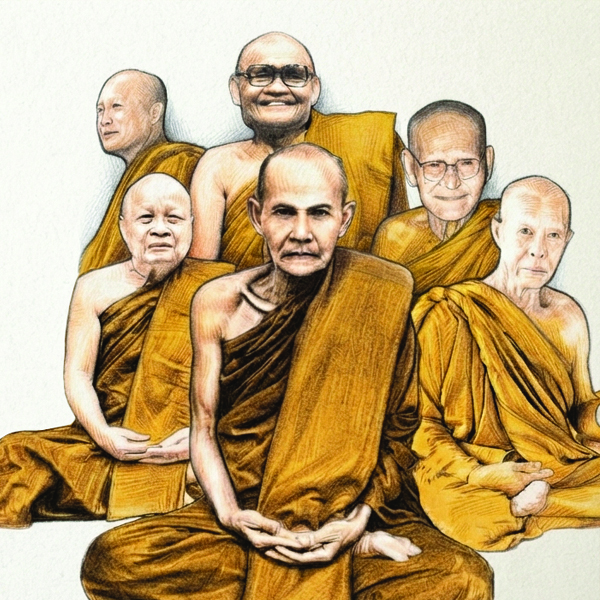
Note from the Translator
I am simply a practitioner who wishes only to preserve the teachings of Thailand’s noble monks. I have chosen a literal translation so that international readers receive the same essence and full content of every sentence as Thai readers do, without summarizing or adding personal interpretations. Regardless of whether the doctrines herein are "right" or "wrong" in your view, I kindly ask you to use your own wisdom and judgment to reflect upon them.
If you have any suggestions or find any errors where the translation does not match the original Thai text, please let me know. I would be most grateful for your feedback and will update the text to be as accurate as possible. Thank you.
A Spanish version of this article is available here: ESPAÑOL
Welcome to The Abandoned Forest Temple... a tranquil space where the timeless teachings of the forest masters of Thailand are shared with the world in English and Spanish.
We invite everyone to relax your body and mind with these lighthearted, fascinating stories from the Forest Dhamma teachers, filled with humor embedded in their skillful means. We believe they will surely bring a smile to your face. Once you are free from your daily work and activities, come join our circle and listen in a relaxed way.
Luang Pu Khao Teaches Dhamma to Luang Por Amorn
When Luang Por Chah led a group of disciples, including Venerable Sumedho, to visit teachers in the Isan region, another person who went along was Phra Maha Amorn. Originally, before Phra Maha Amorn entrusted himself as a disciple of Luang Por Chah, he was a monk with knowledge of Pali and Theoretical study (Pariyattidhamma), achieving the 6th grade of Pali studies (Pali Grade 6), becoming an Advanced Dhamma scholar (Naktham Aek), and opening a school teaching theoretical study at Wat Nong Khun for almost ten years, having hundreds and thousands of disciples.
At that time, Phra Maha Amorn was considered a senior monk, well-known in the province. Moreover, in those days, monks of the Forest-dweller (Araññavāsī) faction, or forest monks who were usually in the lineage of Luang Pu Mun, were always looked down upon as being illiterate, not knowing Pali, and not knowing The Pali Canon (Tipiṭaka). The fact that Phra Maha Amorn decided to entrust himself as a disciple of Luang Por Chah was therefore a major matter, and created dissatisfaction for many parties. Until one elder monk sent a monk to inform Phra Maha Amorn that,
"Maha Amorn, is he crazy or what? Bored of the Cycle of rebirth (Saṃsāra),
why not flee into the forest and mountains? Why submit yourself to die under Ajahn Chah at that Wat Pah
Pong !!!!!"
But he did not change his intention, merely responding back somewhat according to his
former Wrong view and conceit (Diṭṭhimāna).
In the first year of coming to stay at Wat Nong Pah Pong, on November 3, 1968, laypeople invited Luang Por Chah to pay respects to Luang Pu Khao at Wat Tham Klong Phen. Luang Por Chah therefore took Maha Amorn and Venerable Sumedho along. Arriving at Wat Tham Klong Phen at one o'clock in the afternoon, it was not yet time to receive guests; one had to wait until 14:00 hours. When two o'clock in the afternoon arrived, the Attendant (Upaṭṭhāka) opened the door for us to go in and pay respects to him. Luang Pu Khao was sitting on a bed; he was seen smiling, welcoming with a good mood.
He asked, "Hmm... who is this?"
"I come from Wat Nong Pah Pong," Luang Por Chah answered.
"Ah... is
it Venerable Chah?" Luang Pu Khao asked.
"Yes, sir," Luang Por Chah joined his hands in reverence and
answered.
"This is Maha Amorn, coming together," Luang Por Chah pointed his hand towards me, who was
sitting paired with Ajahn Sumedho.
Luang Pu Khao glanced at Phra Maha Amorn, then continued to greet
and converse with Luang Por Chah for a reasonable amount of time.
Luang Pu Khao then turned towards Phra Maha Amorn and asked, "Are you a Maha?"
Phra Maha Amorn joined
his hands in reverence, thinking of something in his mind, therefore answered him saying,
"In the
past I was, but not anymore, sir."
Luang Pu Khao laughed in amusement; Phra Maha Amorn thought in his
mind that if he admitted to being a Maha, he feared the master would take him to task, therefore he
respectfully replied to him like that.
Luang Pu Khao then asked,
"Do you know the 4 types of Rain cloud (Valāhaka)?" (Valāhaka means cloud, found in the
Tipiṭaka, Volume 21, The Basket of Discourses (Suttantapiṭaka), Volume 13, The Numerical
Discourses (Aṅguttaranikāya), The Book of the Fours (Catukkanipāta)).
Phra Maha Amorn thought that if he answered that he knew, he would not get to listen to Luang Pu Khao's
Exhortation (Ovāda), therefore answered,
"I know of them, sir, but
cannot quite remember; it depends on Luang Pu's kindness, sir."
Luang Pu Khao:
"Four types of rain clouds. Thunder rumbles over there, rumbles over here, but no rain
falls, is that good?"
"Not good, sir."
"No thunder, but rain falls, is that good?"
"Good,
sir."
"Neither thunder nor rain falls, is that good?"
"Not good, sir."
"Both thunder and rain
falls, is that good?"
"Good, sir."
Luang Pu Khao continued reciting the Dhamma, saying,
"One who ordains, having studied theoretical
study but does not Practice (Paṭipatti), is like thunder but no rain
falls. The Buddha praises the study aspect, but criticizes the practice aspect. The results gained are
very little. As for the Dhamma practitioner, having a teacher as a guide, even with little study, the
Buddha praises the practice aspect, but criticizes the study aspect. Like me here, there is still some
benefit; descendants can rely on it well enough. One who has ordained and is neither interested in the
study side nor interested in the practice side, ordaining just to feed the physical body, can be in
danger. The Buddha criticizes both the study aspect and the practice aspect, like neither thunder nor
rain falling. As for one who is ordained, interested in both studying the theory and interested in the
practice side like the Maha here, that is good. The Buddha praises both paths. As for the one who does
not practice, even if he achieves 9 Pali grades, then to hell with his mother!" (Translator's Note: "To hell with his mother" or Chang-mae-mun is a Thai idiom
meaning "Who cares!" or "Forget it!", but it literally mentions the word 'mother')"
Phra Maha Amorn was startled. That was close, wasn't it? Even though not hit directly, it probably grazed
by, because he guessed the situation correctly, thus avoiding a direct hit. When Luang Pu Khao asked,
Phra Maha Amorn answered,
"In the past, I was, but now I have ceased, sir."
That year, Luang Pu Khao was 81 years old, Luang Por Chah was exactly 50 years old, while Phra Maha Amorn
was exactly 37 years old. Having spent an appropriate amount of time, in order not to disturb his
resting time, they paid respects to take leave of Luang Pu Khao. Coming out just past the Monk's
dwelling (Kuṭi), Luang Por Chah teased saying,
"See? Luang Pu has
already cursed out your mother."
Phra Maha Amorn then replied, "Luang Pu cursed the ninth-grade Maha; I am only a sixth-grade, so it
didn't hit me, sir."
After that, Luang Por Chah led the group to travel to pay respects to Luang Ta
Maha Bua next.
Source: Mongkol Ayuwatthana 80 Years, Phra Mongkolkitithada.
Luang Pu Tue's Skillful Means
In late 1929, Luang Pu Jea Juntho got to know many senior disciple teachers of Luang Pu Mun Bhūridatto, including Luang Pu Chob Ṭhānasamo, who had just returned from Ascetic practice (Dhutaṅga) in Burma and got to know his junior disciple Luang Pu Jea for the first time at the deserted Wat Pah Daeng. Luang Pu Chob spoke in praise of Luang Pu Tue and Luang Pu Jea as follows:
"Ajahn Tue liked listening to fiery, intense Dhamma according to his Temperament (Caritanisaya), just like Venerable Jek Jea. When in Chiang Mai, if these two monks came in at the same time, the Great Ajahn Mun would constantly Preach (Desanā) with a loud voice. Today targeting Venerable Tue, today targeting Venerable Jea, alternating like this until we found it amusing. During the time Venerable Jea was a young monk coming to practice with the Great Ajahn, he was a person with an adventurous, outspoken character, speaking bluntly just like Ajahn Tue. The two of them would find a reason to cause the Great Ajahn to deliver a fiery, intense Dhamma discourse, going all out, for the monastic group to listen to as well."
Luang Pu Chob recounted, "Once, while staying at Pah Daeng (the deserted Wat Pah
Daeng), at that time Venerable Jea had come to stay and practice with the Great Ajahn Mun for
not long. Not knowing what Venerable Jea had done, the Great Ajahn did not speak to him for many days.
He felt frustrated, therefore bringing this matter to consult with me and Ajahn Tue. Venerable Jea
said,
'I do not know what wrong I have done; Father-Mother Teacher Mun, he doesn't speak to me at
all. I am very frustrated. He won't point it out, he won't scold. Could the teachers please advise on
what I should do?'
Ajahn Tue said,
"This matter is not difficult, 'Jea-Jun' (a shortened name
used by senior disciples)."
He handed a log of wood to Venerable Jea and said,
"Venerable Jea-Jun, take this log of wood and lay
it blocking the entrance to the hall. Once it gets dark, then go collect it."
Venerable Jea doubted,
"Why must I take the wood and lay it blocking the entrance to the hall?"
Ajahn Tue said,
"No need to ask me so much. I told you to lay it, so just lay it. I guarantee today
Venerable Jea-Jun will get his wish fulfilled immediately."
Venerable Jea therefore did as Ajahn Tue advised.
In the evening, after the Great Ajahn Mun had bathed, he went out walking to survey the neatness in the practice of the monks and novices within the monastery. He walked over and saw the log of wood laid blocking the entrance to the hall, therefore asking the monk guarding the hall, "Who was the person who brought the log of wood to lay blocking here?" The monk guarding the hall respectfully replied, "Kruba Jea brought it to lay here. He said not to let anyone collect it, he would come collect it himself." After that, he walked back to his dwelling.
Upon nightfall, the sound of striking the bamboo block rang out 'tock tock' coming from the direction of
the Great Ajahn Mun's dwelling. The monks and novices in the monastery knew that this was the signal
that he would deliver a Dhamma discourse for the disciples to listen to. Every monk and novice gathered
together at his dwelling. The Great Ajahn Mun asked Venerable Jea,
"Venerable Jea, were you the one
who left the wood at the entrance to the hall, yes or no?"
Venerable Jea admitted,
"Yes, sir."
After that, he delivered a "lightning strike" Dhamma discourse (Dhammakathā), rising up fiercely and intensely at Venerable Jea, causing
the monks and novices to also gain the Benefit (Ānisaṃsa) of listening to
the "lightning strike Dhamma" as well. After finishing the Dhamma discourse, the Great Ajahn
taught,
"From now on, Venerable Jea, do not do like this again. It is a disrespect to the Doctrine
and Discipline (Dhammavinaya)."
Venerable Jea said,
"Accepted with reverence, sir."
After that, he had the monks and novices separate to return to making effort.
Upon leaving the dwelling of the Great Ajahn Mun, Venerable Jea said to Ajahn Tue,
"Oh my! Kruba Ajahn
Tue's Skillful means (Upāya) is absolutely superb. Father-Mother Teacher
has spoken to me now. Today he delivered a Dhamma discourse that deeply touched my heart. Unleashing
each blow, pow pow! These Defilements (Kilesa), damn... they ran with
their tails tucked between their legs, disappearing completely into the forests and mountains."
Luang Pu Chob said, "Ajahn Tue and Venerable Jek Jea, these two monks possess a language of speech that is a unique identity specific to them; it is difficult for any monk or novice to imitate and have the meditation circle society accept it. Identity is something paired with the individual; it is difficult for anyone to imitate perfectly. Venerable Jek Jea has an adventurous character like Ajahn Tue, thus they get along well. Venerable Jea wanted the Great Ajahn Mun to speak to him, therefore acting like this. On the matter of wisdom that gets immediate results, Ajahn Tue is very skilled in this kind of skillful means method. Each of his skillful means, it is difficult for the monastic group to follow and perform. His wisdom is extraordinary and unconventional. No matter who asks what problem, he is never stuck for an answer. He helped the Great Ajahn Mun subdue the Conceit and wrong view (Mānadiṭṭhi) of stubborn monks and novices, making many of them submit fully to the Dhamma. He is a disciple of the Great Ajahn Mun whom the junior monks and novices deeply respect and stand in awe of for his Spiritual perfection (Pāramīdhamma)."
Source: The Book of Forefather Teachers, Ajahn Tue Acaladhammo
Dumber Than a Dog
Luang Pu Jea Juntho once recounted that, one time Luang Pu Mun scolded me, scolding in the most stinging
way; I have never told anyone. Luang Pu Mun walked this way; a dog had stolen my things and taken them
to eat. When it came, I chased and threw things at it, chased and threw terminalia fruits at
it.
Luang Pu Mun asked, "Well! Why do you do that, Jea?"
I then answered back, "Well! The damn dog
ate my bones."
Luang Pu Mun then said, "Ah! Then you are dumber than a dog."
He said it like this. Oh! Dumber than a dog. I remember it up until this day. Ah... the Ajahn teaches us to be smart. The teacher, well! I got scolded by him as a dog, straight out. Stubborn... I myself am so stubborn. He knew our mind, that we are extremely stubborn. No one else could tame us; he lashed out like that: "Well! Dumber than a dog."
If a person gets hit to that extent, they drop down prostrate. A knockout punch counting to ten. That right there, is when one knows that the teacher loves us. He doesn't hate us. It is just like parents hitting a child, because they are excessively stubborn; they hit to instruct. A child raised from the womb, why would they hate them? Because you are stubborn and do not learn. Teachers are the same. They warn us to be good, because we are lazy, sometimes indolent. They want us to be good, they have to speak to make it hurt. Then it will go and feel the hurt, and it will result in acting upon goodness more.
Living with Venerable Ajahn Mun, we got hit constantly from beginning to end. My head was always anticipating to catch his elbows all the time (laughs) (Translator's Note: "Catching his elbows" is a figurative expression. Luang Pu Mun did not actually physically hit his disciples; Luang Pu Jea uses this metaphor to describe being frequently scolded by him). Sometimes there was no issue at all, sometimes not involved, but still had to get scolded by him often. Sometimes tears flowed, but patiently endured.
Like sometimes, when monks came in to study with him, the monks who came, he would not dare scold them, or perhaps out of consideration for them, or something else that he knew, but I didn't know. He would just use me here as the "royal spittoon" (Translator's note: a Thai idiom referring to the one who takes all the blame and venting). He would just take me here and go chasing to scold me to pieces, scolding until shattered completely. That day at Mae Koy, at that deserted Wat Pah Daeng. Oh my! I went in to sweep the path to the toilet, sweeping until it was all perfectly clean, until there was nowhere left to sweep. There was still left only at the hole that was deep, taking the broom to scoop it, it wouldn't come up. He walked over to look, looked over there, looked over here, meaning looking everywhere entirely. There was probably no place for him to criticize. Having finished looking, he walked over to pick a fight with me. This, I knew he was 'beating the cow to affect the rake' (Translator's Note: criticizing one to teach another). Because at that time there were newly arrived monks, sitting chatting all night long. He walked over and spotted me, walking swiftly straight towards me. He asked loudly saying,
"Jea, hey! Here! Who took all the candles from here? And that spot by the water ditch beside the path to the toilet, who was it? Who swept it?"
He already knew that there were 4 newly arrived monks who came, taking the candles to light and sit chatting until almost dawn. Arriving and chatting continuously until almost dawn; not doing Mental development (Bhāvanā), but diligent in chatting. Now he couldn't scold others, he had to scold me. "Here we go again," I thought in my mind. When I respectfully informed him saying, "In the ditch, I have swept it all clean, Kruba Ajahn."
Ah... now he scolded me, scolding on and on, before I could even brace myself to receive it. It came right over the heads of Venerable Kongma (Ajahn Kongma), over the head of Venerable Lee (Tan Por Lee). "Having come here, you must do it well. If you do not do it well, then do not stay! Go! Hurry up and go. Do not come stay here. If it is like this, go! Go!" He went all out, with a loud voice. Those monks were startled and shocked, looking at each other's faces nervously, breaking apart and fleeing massively. "Oh! Venerable Jea got hit," and they scattered in a panic to flee.
In truth, he was beating the cow to affect the rake, to make those monks realize their faults. Still, no one knew. So exceedingly coarse and dense. They still came to blame and laugh at us; not seeing their own faults, seeing only the faults of others. Venerable Ajahn Mun scolded me like this often. I felt sad too. Sometimes I felt slighted thinking, "Eh! Why does he scold us like this?" But when contemplating with reason, I yielded to him, because we loved him. As for those newly arrived monks, they still didn't know the matter. They together stole candles to light all night, until 3 AM to 4 AM, and it still wasn't enough; they still together went "Oho! Oho!", criticizing only me, not knowing how to draw it inwards to apply to themselves.
This is it, Venerable Ajahn Mun couldn't hit others, so he had to hit his disciple, teaching his disciple, not to be like that, not to behave like those monks. Those monks were quite something. They took the effort to come see him. He taught them, yet they didn't know he was teaching. They didn't know how to think. They didn't know what kind of Dhamma they came seeking. It's like this; he couldn't hit others, so he had to hit his disciple, that is, hit me instead. I had to constantly anticipate to catch his elbows with my head on a regular basis.
Source: The Book of Forefather Teachers, Luang Pu Jea Juntho
Testing Luang Pu Mun
Venerable Ajahn Mun Bhūridattamahāthera was a Great elder (Mahāthera) whom
the circles of Ascetic meditation monk (Dhutaṅgakammaṭṭhāna) mutually
accepted as one possessing the highest Level of spiritual development (Phūmicittaphūmidhamma), being a Liberated one (Arahant) of the category possessing Analytical knowledge (Paṭisambhidāñāṇa), and possessing the Six higher knowledges (Cha-abhiññā), having Knowledge of others' minds (Paracittavijjā) knowing the State of mind (Cittavāra) very rapidly. When disciple monks went in to pay respects and
meet him for the first time, some disciple monks firmly believed he was an Arahant, but some were
skeptical and harbored disrespectful or dismissive thoughts (Pamāda) in
their minds. Regarding this matter, disciple monks who had once lived and practiced Dhamma with
Venerable Ajahn Mun recounted their inner thoughts, passed down continuously, serving as a skillful
means for there to be restraint of body, speech, and mind while going in to meet a teacher. The moment
Luang Pu Phrom saw Luang Pu Mun for the first time, he thought dismissively in his mind, saying:
"A
small monk like this, is it? Whom people rumor to be so exceptionally capable. Looking at him, he
doesn't seem likely to be capable of anything at all."
He merely thought it within his mind only. When an opportunity arose, he went in to pay respects. At the
first word Luang Pu Mun spoke up, Luang Pu Phrom was outright startled, because he spoke along the lines
of,
"Hastily judging the ability of a person by looking merely at the physical body cannot be done.
It would be establishing Mindfulness (Sati) in heedlessness."
This very speech of Luang Pu Mun caused amazement to arise, giving birth to immensely strong Faith (Saddhā) that one must give reverence and respect. This was merely thinking within the mind only, yet he was already able to guess the mind correctly. Luang Pu Phrom therefore settled his heart, humbly offering his body and mind as a disciple from that moment on.
The case of Venerable Ajahn Juan Kulajeṭṭho was the same. When he stayed to spend the rains retreat
together with Venerable Ajahn Mun, he was still a junior monk and a worldling monk." (Translator's Note: A "worldling monk" refers to a monk who has not yet attained
any stage of enlightenment. Despite his ordination, his mind still possesses the same defilements
and doubts as an ordinary person). He therefore thought of a skillful means to test Venerable
Ajahn Mun with respect time and time again, saying,
"Venerable Ajahn Mun, is he truly an Arahant or
not? Does he truly know the state of mind or not?"
In the end, he completely surrendered to the level of spiritual development of Venerable Ajahn Mun
unequivocally, as in the story that teachers recount passed down continuously, as follows. When
Venerable Ajahn Juan newly went to stay with Venerable Ajahn Mun at Wat Pah Ban Nong Phue, he thought of
testing his teacher saying,
"That which they rumor saying 'Our Ajahn is an Arahant,' is it true or
not, we cannot possibly know. If he is truly an Arahant, tonight may a Miracle (Pāṭihāriya) appear to be seen as well."
On that very night, once he sat
in Concentration (Samādhi) doing mental development, a Mental sign (Nimitta) appeared, seeing Venerable Ajahn Mun doing Walking meditation
(Caṅkama) in the air and displaying miracles, flying up and down all the
time. And when sleeping, he still dreamed of seeing him doing walking meditation in the air similarly.
He therefore conceded to believe, simultaneously raising his hands to pay respect to him.
When Venerable Ajahn Juan was in the monastery, he heard fellow disciple monks recount that Venerable
Ajahn Mun knew the state of mind. Whatever incorrect things disciples would think of, he would preach to
warn them immediately. Venerable Ajahn Juan wanted to think of testing again. One night, he happened to
think up again saying,
"Eh! That which they say, Venerable Ajahn Mun knows the state of mind of every
disciple, is it really true I wonder? We should test and see. If Venerable Ajahn Mun truly knows our
state of mind, let Venerable Ajahn Mun come to find us at the monk's dwelling tonight."
Once having
thought it for just a brief moment, he heard the sound of a walking stick tapping closer and closer, and
the walking stick smashed with a loud bang against the wall of his monk's dwelling, along with the voice
of Venerable Ajahn Mun shouting loudly saying, "Venerable Juan, why do you go thinking like that? That
is not the path to freedom from suffering. You are annoying me here."
That night, even though he was trembling, fearing Venerable Ajahn Mun, he still thought of testing again.
A subsequent night, a thought arose again saying,
"If Venerable Ajahn Mun is a knower of our state of
mind, when we do Alms-gathering (Piṇḍapāta) and get food, may he wait for
us every single day. May he not eat yet until we drop food into his Alms bowl (Patta) first."
Ordinarily, when disciple monks return from alms-gathering, they would select good food to drop into the
teacher's alms bowl. That morning, Venerable Ajahn Juan tried to stall for time. By the time he brought
food to put in his alms bowl, it was somewhat later than usual. Waiting until all the group of friends
had finished putting food in the alms bowl, he then dropped food into the alms bowl; Venerable Ajahn Mun
then began to eat. The situation was like this for several days, because Venerable Ajahn Mun knew the
state of mind of the disciple who thought to test him indeed. He also tended to have a reason to be slow
as well. Venerable Ajahn Juan started to get bold, tending to dawdle every day, until one morning
Venerable Ajahn Mun saw that the disciple had tested too much already. He therefore spoke up, like one
knowing the state of mind of the disciple who thought to test him, saying,
"Venerable Juan, do not do
like that again. I am annoyed, having me wait every single day. Now, I am not waiting anymore."
The teachers have compassionately recounted this story saying that Venerable Ajahn Juan was a good monk possessing virtue and having much wisdom. He therefore had skillful means to test Luang Pu Mun. His actions were not a matter of challenging or thinking of trampling on Luang Pu Mun in any way. But he did it with respectful veneration, with the hope for Luang Pu Mun to compassionately train and instruct him.
Source: The Book of Forefather Teachers, Luang Pu Phrom Jirapuñño
Luang Por Chah Wanted to Hear Luang Pu Mun's Dhamma
Ajahn Thongrat Kantasīlo was another senior disciple monk of Luang Pu Mun. When the monks in the monastery desired to listen to Luang Pu Mun's Dhamma, he therefore volunteered for the monastic group, whereby he had a skillful means for listening to Dhamma in strange ways, the kind that no one would dare to do.
Luang Por Uan recounted that Kruba Ajahn Thongrat did not merely receive the duty to oversee and take care of the monks and novices practicing together in the monastery of Luang Pu Sao and Luang Pu Mun during the period of having the opportunity to stay and practice together with both Teachers alone. But doing everything was also to control or remind the mindfulness of monks and novices who were being careless towards the doctrine and discipline, the consequence of which would be the tarnishing of the monks and novices themselves. There were frequent times when the monks and novices who entered to study and practice Dhamma with both teachers, each monk, each venerable, had the desire to receive the taste of the Dhamma to serve as a guideline for practice. But he would torment those monks and novices by not training, not preaching, until the monks and novices could not endure it, therefore going to respectfully inform the elder Kruba Ajahn Thongrat.
One time, Luang Por Chah went to tell his desire for the elder Kruba Ajahn to listen, saying what could
be done in order to finally get to hear the Dhamma from Luang Pu Mun. Kruba Ajahn Thongrat therefore
said,
"Do you really want to hear it?" When seeing the elder Kruba Ajahn speak like that, the monks
and novices saw a channel that they would get to hear a sermon, joining their hands and adding further
saying,
"We have practiced with Luang Pu Mun for a very long time already, yet we still haven't heard
him preach, sir."
"Not difficult. Later in the evening, you will get to hear him preach," Kruba Ajahn
Thongrat promised.
After that, when it was time to go out to receive alms-gathering, and
coincidentally, today there were laypeople putting cucumbers into the alms bowls. When the opportunity
arose, the elder Kruba Ajahn Thongrat, who was walking behind Luang Pu Mun, then walked along, reaching
in to take a cucumber out of the alms bowl to bite and chew on it just like that. When Luang Pu Mun
turned back to look, he closed his mouth. When he turned back around, he continued chewing. The result
turned out that in the evening there was quite a matter, because Luang Pu Mun preached for the monks and
novices to hear, fulfilling their desire.
There was another occasion recounted and passed down that there was also a cause of monks and novices wanting to hear a sermon just the same, but a different group and a different time. The elder Kruba Ajahn Thongrat also showed kindness to the monks and novices who wanted to hear Luang Pu Mun's sermon. Namely, during the daytime, the elder Kruba Ajahn went to shadowbox and throw punches in the air under the raised floor of Luang Pu Mun's monk's dwelling. Until being certain that Luang Pu Mun heard that there were monks and novices going to box under his monk's dwelling. Come the evening, it yielded results as expected, when Luang Pu Mun preached for the monks and novices to listen to completely fully. Making the monks and novices see the importance, praising the elder Kruba Ajahn Thongrat as possessing supreme courage, because no one would dare to do the aforementioned things. And especially with a Father-Mother Teacher, the monks and novices absolutely would not dare at all, because they had great respect and awe towards the teacher.
Source: The Book of Forefather Teachers, Ajahn Thongrat Kantasīlo