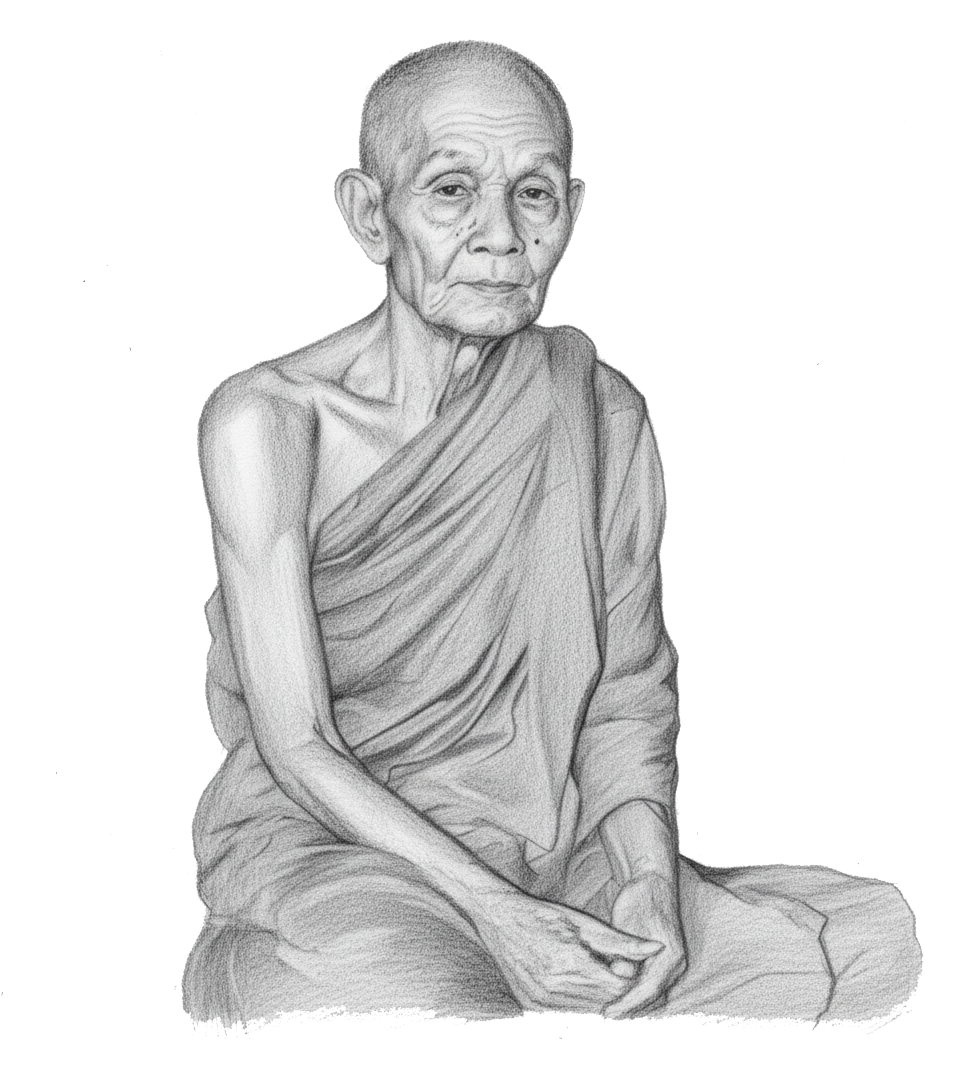
Entering the Shade of the Saffron Robe
Ajahn Dune Atulo was born into a farming family with Right View (Sammādiṭṭhi). His early life was a struggle of plowing the fields and tending to cows and water buffaloes, which forged him with a strong body and a resilient, enduring mind. As he grew up, he was a handsome young man with a flawless complexion and a melodious voice, to the point that the governor of Surin ordered him to join a traditional theatrical troupe, playing the role of the "leading lady." He dedicated himself to rehearsing until his performance was so convincing that young women ran away in embarrassment upon learning he was actually a man. Although his lay life was surrounded by fame, money, and the desire of women, through the power of the disciple's perfection of knowledge accumulated over hundreds of thousands of Eons (Kappa) constantly urging him, he did not become infatuated or intoxicated by worldly pleasures. Knowing well that worldly happiness must be exchanged for agonizing suffering, he directed his compass toward the Perfection of Renunciation (Nekkhamma-pāramī).
At the age of 22, he decided to relinquish the world, ordaining as a monk in the Maha Nikaya order. In the beginning, he sought out the practice of the meditation subject with a profound thirst for the Dhamma, placing himself under the guidance of Luang Pu Aek. He practiced lighting five candles and reciting incantations to invoke the five forms of Rapture (Pīti), and practiced tormenting the body by fasting until he walked staggeringly and became emaciated, but he found this was not the path to escape suffering. Later, he traveled arduously through jungles and forests to study the Theoretical Doctrine (Pariyattidhamma) in the scholastic center of Ubon Ratchathani Province, eventually passing the Nak Tham Tri exam in its very first batch.
The greatest turning point in the life of an Ascetic (Samaṇa) occurred when he met Venerable Ajahn Singh Khantayakhamo, a meritorious Co-religionist (Sahadhammika), and submitted himself as a disciple to Luang Pu Mun Bhuridatto, the grand master of the insight meditation subject. When he heard the decisive teaching from Luang Pu Mun that, "To ordain as a Buddhist monk, one must practice the meditation subject... as the foremost priority, because it is the true path to escape suffering," his mind turned completely towards the path of the ascetic meditation monks. He decided to abandon the study of theoretical doctrine, accepting re-ordination as a Dhammayut monk to focus on the Obligation of Insight Practice (Vipassanādhura). Taking up the 8 Monastic Requisites (Parikkhāra), slinging his alms bowl over his shoulder, and carrying his umbrella-tent, he walked into the deep jungle to wage a decisive war against the defilements and ignorance within his own mind.
The Path to Dhamma
Ajahn Dune's ascetic wandering was like a brave soldier sacrificing his life to enter the battlefield. The forests and mountains of the Isan region in that era were a "jungle university" teeming with malaria, Bengal tigers, wild elephants in musth, and the mysteries of non-human entities. He strictly upheld the Ascetic Practices (Dhutaṅgavatta), relying only on the base of trees, caves, and cliff overhangs as his dwelling place until death.
The first test of death occurred in the forest of Ban Tha Khantho, in the Phu Phan mountain range of Kalasin Province, a dense jungle swarming with Anopheles mosquitoes and the poison of malaria. His ascetic group fell severely ill, and one co-religionist monk passed away right before his eyes. Death, without any medicine to cure them, squeezed closer at every moment. When the malaria flared up severely to the point of drawing his last breath, Ajahn Dune was not terrified or shaken. He made a resolute vow of truth: "No matter what, I will surely not escape the clutches of death during this rains retreat. Even if I must die, let me die in the Development of Concentration (Samādhibhāvanā)." He abandoned his life, sitting down to establish the development of concentration by using the Mindfulness of Death (Maraṇānussatikammaṭṭhāna) as his object. When his mind sank into deep Concentration (Samādhi), a Mental Sign (Nimitta) arose, appearing as an image of a Buddha statue superimposed over his body. He used wisdom to contemplate and dissect his own physical body until he saw the bones and flesh break apart and dissolve into the Four Elements (Cattāro mahābhūtā) of earth, water, fire, and wind. The moment his mind withdrew from concentration, the severe malaria vanished completely as if plucked away. During that very rains retreat, he was able to separate the mind from defilements, destroy the Fetter (Saṃyojana), and attain the noble Dhamma state of a Stream-enterer (Sotāpanna).
His mind training was filled with majestic courage. Once, he wandered to Pha Bing Cave in Loei Province. The villagers tried to stop him from staying there because of a terrible curse; at dusk, there would be the sound of traditional musical instruments and dark smoke billowing above the cliff. But with the nature of a forest monk who did not believe in superstitions, he immediately led a novice monk to set up their umbrella-tents to prove the truth. They discovered that the sound and the dark smoke were actually hundreds of thousands of bats flying out of the cave to forage. He taught the villagers to abandon their fear, stop worshiping ghosts, and turn to rely on the Three Jewels (Tirattana).
Mortal danger never showed mercy to anyone. When he wandered deep into the Phanom Dong Rak mountain range on the Cambodian border, while walking ahead of a novice monk, a wild water buffalo suddenly panicked and charged violently into Ajahn Dune from behind. It gored and tossed his body, rolling him over several times until it was satisfied, and then bolted into the forest. The novice, who had climbed a tree to escape, came down to look in panic and found that the monk's robes were torn to shreds, with nothing left intact. Yet, his body had not sustained even the slightest injury, through the power of "The Dhamma Protects the Dhamma Practitioner (Dhammo have rakkhati dhammacāriṃ)", which he maintained perfectly in his mind.
His decisiveness was also evident in subduing the defilements of wicked people. While spending the rains retreat at Nong Samet forest, the ruthless leader of a gang of thugs, fully armed with his henchmen, barged in during the night to ask for magical amulets and invulnerability spells. Ajahn Dune was completely unfazed. He used a skillful Dhamma means, tricking the bandits into closing their eyes and reciting "Buddho" to adjust the foundation of their minds before receiving the magic. In just a few tens of minutes, the bandit leader experienced severe concentration and rapture to the point of startling violently, crying loudly as he saw mental signs of the evil karma he had committed by slaughtering people and animals. He taught them to continue meditating throughout the night. By morning, those sinful bandits had a change of heart, threw their weapons away, and undertook the Precept (Sīla) to never do evil again for the rest of their lives.
Even when facing a hitman hired to kill him at night, while the gunmen were whispering in hiding under the raised floor of his hut, his attendant monk heard them and trembled with fear. Ajahn Dune simply opened the door, cleared his throat softly, and said plainly, "Hey! Why believe anything? They might just have some business." He returned to his room and slept as usual, leaving the blinded minds of the gunmen defeated by the purity of the noble one, to the point that they later had to come bow and confess their guilt.
His conduct in teaching his disciples was extremely sharp and fierce. He would regularly declare to newly ordained monks, "I will smash you without mercy." He forbade the monks and novices from sending their minds outward, and strictly prohibited them from acting as "ghost-deceiving monks." If a monk or novice was deficient in a Training Rule (Sikkhāpada) even slightly, he would shout to warn them that a leak in the roof, even the size of a needle's point, if not quickly plugged, would surely expand until the whole roof collapses. He cornered the defilements of his disciples with silence and by acting as a living example. He tormented his own mind and those of his disciples by going on long-distance alms rounds, eating only one meal in the bowl, fasting from food and water, and walking meditation day and night, until the mind sank into Absorption (Appanā) and advanced toward developing Insight Knowledge (Vipassanāñāṇa).
At Phra Wet Cave in Nakhon Phanom Province, he practiced meditation amidst wild beasts and mysterious deities, taking the meditation subject of "All Formations and Perceptions are Non-self (Sabbe saṅkhārā sabbasaññā anattā)" given to him by Luang Pu Mun, to contemplate and uproot the sub-atomic particles of Form (Rūpa) and Consciousness (Viññāṇa), cut the chain of Dependent Origination (Paṭiccasamuppāda), and abandon the fetters of Sensual Desire (Kāmarāga) and Ill Will (Paṭigha), until he attained the noble state of a Non-returner (Anāgāmī). He was certified by Luang Pu Mun, who said, "That is correct. You have saved yourself. You will definitely not regress anymore." After that, he continuously contemplated "watching the mind" with Wisdom Developed through Meditation (Bhāvanāmayapaññā), until his mind unified and fiercely slashed to pieces the ignorance, extinguishing the Aggregate of Mental Formations (Saṅkhārakkhandha), extinguishing the Aggregate of Feeling (Vedanākkhandha), and extinguishing the aggregate of the mind, breaking through into the Great Emptiness (Mahāsuññatā). He attained the highest noble Dhamma as an arahant disciple of the buddha, completing the study of the Ultimate Truth (Saccadhamma) in absolute perfection.
The Dhamma Legacy and the Final Moment
Ajahn Dune Atulo embodied the nature of a true ascetic who lived with a pure Dwelling in the Dhamma (Vihāradhamma). Even when he received the command to settle down as the abbot of Wat Burapharam, located in the middle of Surin city and bustling with loud noises, he taught his disciples, "Why bother paying attention to those things? It is natural for light to be bright. It is natural for sound to be loud. That is simply their duty... Wherever arahants dwell, that place is a delightful sanctuary." He compared the purified mind to coconut oil that has been boiled until clear; it can never be mixed back into coconut milk again.
The Dhamma legacy he emphasized most was "watching the mind". He always taught that all the 84,000 Dhamma aggregates entirely emerge from the mind. If one wishes to escape suffering, one must stop thinking and pondering (stop the Functional Consciousness (Kiriyacitta)), and then carefully watch that Feeling and thought. He answered questions briefly and concisely, like a samurai sword severing with a single strike. When a senior elder monk asked if he still had anger, he answered immediately, "I have it, but I don't take it." Or when someone asked about sacred things, he decisively pointed out, "Sacredness has never existed; there is only the power and ability of the mind."
In the final days of his life, at the age of 96, he was severely ill and was rushed to Chulalongkorn Hospital. Even though his aggregates were breaking apart, his Mindfulness and Clear Comprehension (Satisampajañña) were exquisitely perfect. A miracle occurred in the X-ray room when the film came out completely pitch-black until the doctor respectfully bowed to ask for his permission. He was a Wakeful Person (Jāgarapuggala); he never showed signs of drowsiness or groaned for anyone to see. He taught his worried disciples, "When the time comes to die, you must know how to die."
Late in the night of October 30, 1983 (B.E. 2526), amidst the disciple monks who were attending to him, Ajahn Dune delivered his final Dhamma discourse concerning the characteristics of the Buddha's Parinibbana. He explained the entrance into the Cessation of Perception and Feeling (Saññāvedayitanirodha) and the passing away of the aggregates according to the sequence of Absorption (Jhāna), before concluding with the golden sentence, "I have practiced in order to reach this state."
At 04:43 AM, amidst the rain falling like the tears of deities, he discarded the mental formations and entered Nibbana without Remainder (Anupādisesanibbāna) with the utmost peace and absolute purity. All that remained was his Bone Relic (Aṭṭhidhātu) which transformed into multi-colored "sacred relics" resembling gemstones, serving as a witnessed testimony of his end to the Round of Rebirths (Vaṭṭasaṃsāra) and the conclusion of his long journey. He remains a flawless diamond in the meditation subject circles, shining brightly in the hearts of Buddhists for eternity.