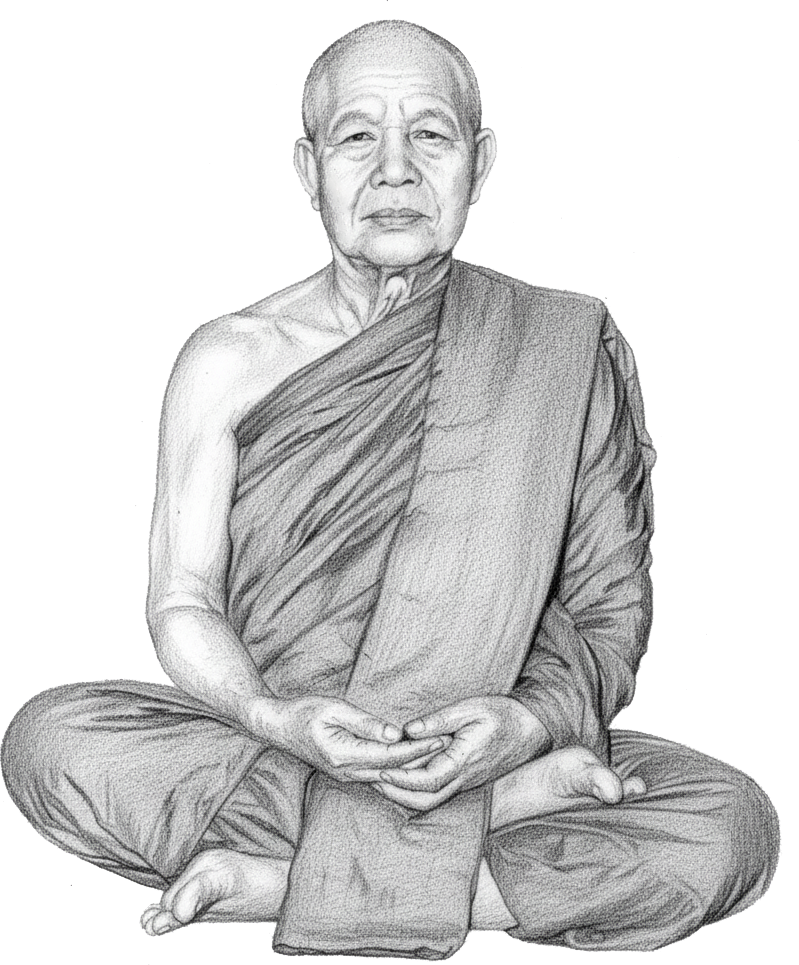
Entering the Shade of the Saffron Robe
Ajahn Funn was born into the noble "Suwanrong" family, descendants of the governors of Phanna Nikhom. In his youth, he aspired to a career in government service. However, his outlook changed when he witnessed the "impermanence" (Anicca) of worldly rank—seeing high-ranking officials and governors become prisoners or face execution. Struck by a profound sense of spiritual urgency (Saṃvega) regarding the chaotic and essence-less nature of the world, he renounced a promising administrative position. He traveled barefoot back to his hometown to dedicate his life to Buddhism, ordaining as a novice in 1918 and as a monk the following year.
He first met the Great Master Luang Pu Mun Bhuridatto in 1920 at the Muang Khai cemetery. Luang Pu Mun’s direct teachings on abandoning spirit worship and taking refuge in the Triple Gem (Ti-sarana-gamana) inspired such devotion that he offered his life to the practice. He decided to undergo re-ordination (Yatti) into the Dhammayut order in 1925 to follow Luang Pu Mun into the deep forest. The Great Master once praised his practice, noting that he used the "dog gnawing a bone" (Hma-tae-kradoog) technique to contemplate the body until his mind reached a state of supreme one-pointedness.
The Path to Dhamma
Ajahn Funn’s practice was a life-and-death wager in the heart of the jungle. He adhered to Luang Pu Mun’s exhortation: “Going alone is how one gains mental strength; train the mind to be a warrior to conquer defilements and craving (Kilesa-taṇhā).” He sought solitude in caves and cemeteries where even hunters dared not tread. His first experience at "Phra Bod Cave" involved being tested by a "cave spirit" with terrifying, crashing sounds in the middle of the night. Instead of fleeing, he used stillness to overcome the movement until his mind unified. Upon investigation, he discovered it was merely a flying lemur, gaining the wisdom that fear is a deceptive mental fabrication (Saññā). At this cave, he practiced extreme asceticism, eating only a handful of sticky rice with salt and chili for 15 consecutive days to sever his attachment to flavors.
While journeying toward "Phu Khao Khwai" in Laos, he trekked through dense forests filled with tiger tracks. He used Dhamma reflections to suppress fear, resolving that: "If the mind is the one who fears, when can a tiger ever eat the mind? It can only eat the physical form." Once, he encountered a massive tiger that leaped down to confront him at close range. He stood frozen, fixing his mind to face death; his breath faltered, but he did not turn back. The tiger eventually retreated. He taught his disciples: "One who does not fear death, does not die."
His battle against defilements through "Dhamma Medicine" (Dhamma-osot) was remarkable. In 1931, at "Phu Rangam," he was afflicted with malaria that wracked his entire body. He decided to surrender his life, declaring: "I will meditate until I am cured; if not, I accept death." He sat in a straight posture, discerning the Truth of Suffering (Dukkha-sacca) against the intense pain from dusk until 10 a.m. the next day, until his mind unified into one-pointedness (Ekaggatā), permanently curing the forest illness he had endured for a decade. At "Phu Wua," he slipped from a cliff, his head striking a rock with a sound like a smashed coconut. As his body spun toward a whirlpool abyss, he commanded his mind to make his body "light as cotton," allowing him to stand up and walk away without a single severe wound. He taught: "Nirvana lies beyond death"; if one cannot cross the fear of death, one will never see the Dhamma.
His resoluteness was also manifested through supernatural mental powers. He once contemplated a bus engine until it stalled three consecutive times to study its mechanics, or halted a trail of ants simply by a mental thought. These powers were honed atop "Tham Kham," where during his first rains retreat, he "consumed no rice at all" for four months, eating only wild bamboo shoots and fruit to prove the mind's power over the clinging to the physical body (Upādāna). He transformed Tham Kham from a dangerous tiger den into a sanctuary of liberation (Vimutti), ordering villagers to carry a Buddha image up the mountain through thorns without waiting for a road to be built, believing firmly: "If you don't do it, how can you know the result?"
In 1939, at Ban Na Sok Forest Monastery, chaos erupted when a nun named "Mae Chi Tat" claimed to be an Arahant with a divine Dhamma entity perched on her head. She manipulated a senior monk into believing she was his daughter from a past life, leading to spirit possession and frantic guards watching for "Mara" coming to kill the Master. When Ajahn Singh (Khantayākhamo) heard of this, he tasked Ajahn Funn to resolve the situation alone. After observing for a month, Ajahn Funn realized it was "Perceptual Derangement" (Saññā-vipallāsa). He decisively intervened with stern words: "An Arahant does not die and does not fear death. If the mind still trembles with paranoia, it is not free from defilements." He ordered the nun to leave immediately and exposed the "spirits" as mere delusions of the living mind, causing the cult-like atmosphere to dissolve under his absolute Dhamma authority.
During World War II in 1944, while staying in Ubon Ratchathani, Allied planes heavily bombed the Japanese base nearby. Ajahn Funn displayed precognitive powers to save his disciples and villagers. He would warn them at least two hours before the planes arrived, saying calmly: "Finish your tasks quickly and prepare to take cover; the planes are coming tonight." Even in broad daylight, he would order everyone to stop working and seek shelter just before the bombs fell. He taught everyone to recite "Buddho" (Buddho) in their hearts amidst the explosions to train the mind to remain unshakable in the face of death.
On December 28, 1972, while at Tham Kham, he displayed a miraculous crossing of dimensions. He informed the monks at dawn: "There is an incident in Bangkok today; eat and then quickly go into meditation." He entered deep Samadhi to radiate loving-kindness (Mettā) to suppress the "Black September" terrorist attack at the Israeli Embassy. When news finally reached the mountain at 10 p.m., he replied calmly that he had known for a long time, saying: "There is nothing to be alarmed about; tomorrow they will just board a plane and leave." The global crisis ended peacefully exactly as he predicted.
Due to his far-reaching fame, people flocked to him for sacred objects. When medals and photos ran out, Ajahn Funn would hand out "tooth-cleaning sticks" (Mai Si Fan)—the wood he used according to monastic discipline. He would tell the recipients: "Keep Buddho in your heart as well." Devotees found value beyond the wood, soaking the sticks in water and drinking it while praying to the Master, miraculously curing incurable diseases. These became known as "Doctor's Wood" (Mai Mor). Even ointments or oils touched by him became sacred healing agents. Professor Dr. Uay Ketusingh noted that these were not mere superstitions, but mental power infused with great compassion to lead people to rely on "Buddho" as their true refuge until their last breath.
The Dhamma Legacy and the Final Moment
The core wisdom Ajahn Funn emphasized throughout his life was "measuring the heart." He taught: "Merit and demerit reach the heart first; they are accomplished at the heart." He did not encourage ritualistic precept-taking but emphasized truly guarding the precepts (Sīla) within the body and mind. He dedicated immense resources to public works, such as the Phanna Nikhom Hospital, following the principle: "Only doing service until the day of death."
The path to his final passing began intensely on September 14, 1976. He accepted an invitation to a housewarming, climbed four flights of stairs to sprinkle holy water, and anointed seven large trucks in a single day. Upon returning, he collapsed from exhaustion and suffered a severe heart attack that night. At Sakon Nakhon Hospital, he displayed a final mental power by telling the doctor he saw a "black spot" on his heart through meditation; by morning, the spot had vanished, and the ECG confirmed the miracle.
In his final days, he was treated at Chulalongkorn Hospital at the King’s request. He agreed only to allow the Great Sovereigns a final chance to make merit. He then hurried back to Wat Pa Udom Somphon. On January 4, 1977, amid bitter cold and rain, he fought his illness with a "warrior’s blood" until the last minute. Moments before passing, he asked to be propped up to sit, straightened his body majestically, and performed the ritual of "Relinquishing Offenses" (Pang Abat) before the Sangha to ensure his final purity of precepts.
He looked up at Professor Dr. Uay Ketusingh as if to say, "It is time to stop," and his breathing ceased instantly. He passed away peacefully at 7:50 p.m., leaving behind pure relics (Dhātu) and the Dhamma legacy of "Buddho." His funeral was a historic occasion where His Majesty the King allowed the public to continue the bathing ceremony even after the royal water had been offered. This truly reflected the immeasurable spiritual merit of this "Master of Limitless Compassion."