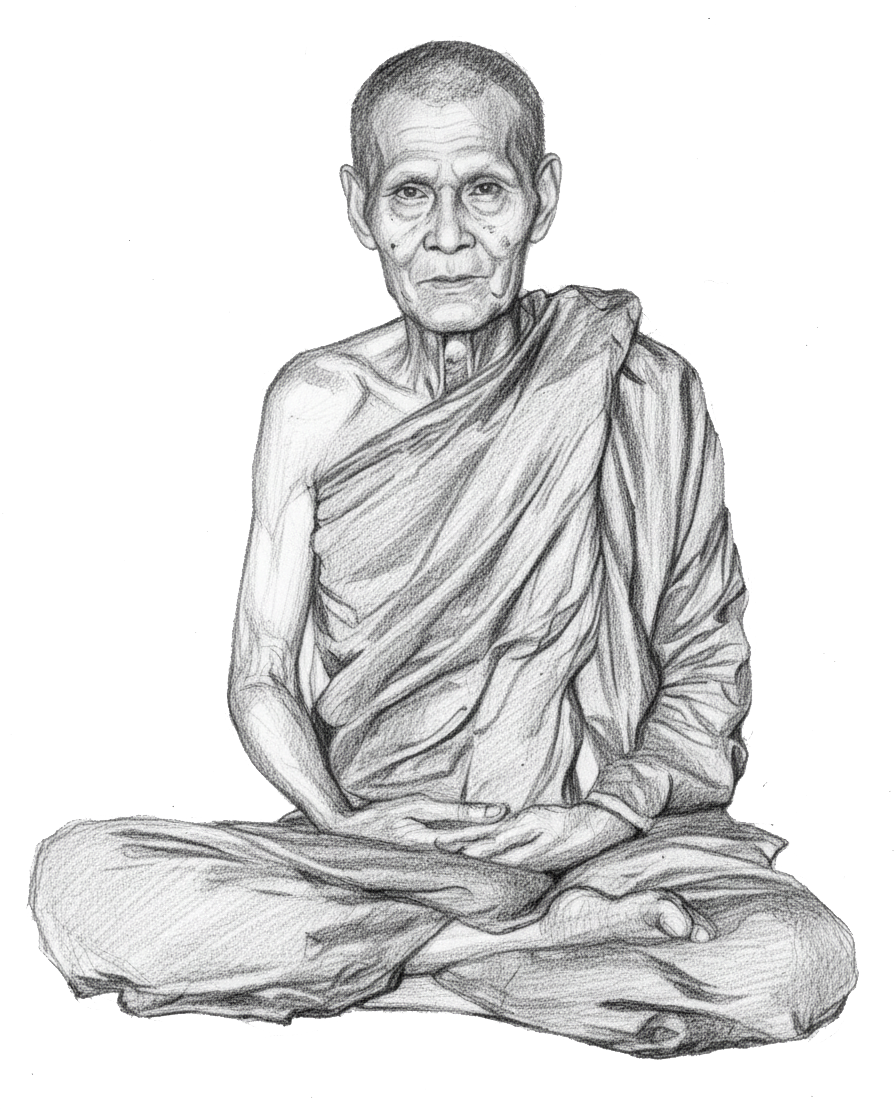
Entering the Shade of the Saffron Robe
The lay life of Luang Pu Khao proceeded with diligence in the occupations of farming and trading until the age of 31. Experienced a life storm to the point of "broken kitchen" (krua taek) when catching the wife in an act of infidelity with another man. In that critical minute, almost could not restrain the heart and raised the sword prepared to kill both people with own hands. However, the power of goodness restrained the mind in time. Decided to sacrifice the house, assets, and wife to the paramour, and entered the saffron robe from then on.
After ordaining and studying in the early years, Luang Pu Khao began to observe teachers and fellow monks practicing the Dhamma and Discipline inconsistently and erroneously. Was not impressed with the state of the monkhood at that time, especially the popularity of raising horses for racing and the competition over expensive horses. Thought that remaining in such a state would only accumulate bad kamma. Therefore, decided to go out in search of the Dhamma according to the way of a forest dhutanga monk. Even when faced with opposition from those who believed that Magga, Phala, and Nibbana were out of date, remained resolute, stating that the heart felt like it could bite a whole piece of diamond into powder in a single minute. Traveled to seek the Great Master Mun Bhuridatto until finally meeting and undergoing re-ordination (nyatti) as a Dhammayut monk in the year 1925 at Wat Phothisomphon, Udon Thani.
The Path to Dhamma
During the first rains retreat after the re-ordination at Wat Nong Nok Kok Kham, Udon Thani, Luang Pu Khao practiced in solitude. One night, while walking meditation in the late hours amidst the cold and the sounds of wild animals, fear arose. Gripped the word "bones" (athi) as a meditation object to reduce fear. As the mind calmed, a vision (nimitta) appeared of own body as a skeleton without any skin, walking back and forth. Felt spiritual urgency (samvega), contemplating that humans are truly deluded by skin; without it, even a goddess would find no admirers. This vision vanished when the mind strayed from the present, leaving a lasting lesson on the nature of the body.
While wandering in Phetchaburi, encountered a "woman-slayer" (naree pikhat) at Wat Khao Yoi. A young woman attempted to seduce him with various feminine wiles. On one day, she sat blocking the narrow path and shamelessly lifted her sarong to provoke lust. Luang Pu maintained firm mindfulness, recalling the Buddha’s exhortion to be cautious of the daughters of Mara. Gathered strength, gripped the alms bowl tightly, and leaped away like a frog escaping an explosive. Did not look back and later raised that woman as a teacher to see the danger in the cycle of rebirth, performing "abandonment-meditation" (praharn-bhavana) until lust and ill-will were extinguished from the heart.
In Chiang Mai, Luang Pu proved the power of loving-kindness (metta-dhamma) toward a large house elephant that entered the hut at night. The elephant reached its trunk into the mosquito net until its breath blew upon his head. Luang Pu sat still, reciting "Buddho" with a heart surrendered to death. Later, went out to speak to the elephant, calling it "Older Brother" (pee chai). Taught the elephant to know human customs and gave it the five precepts (sila-pancha), telling it not to steal the tamarind used for cleaning alms bowls. The elephant stood still like a stone until the sermon ended, then turned back into the forest with great understanding.
At Mae Pang, Lampang, while wandering with Luang Pu Waen Sujinno, encountered a wild elephant in the darkness. Luang Pu lit candles and placed them along the meditation path. The elephant approached within a few meters but stood still, ears flared. Luang Pu walked back and forth in meditation, reciting "Buddho" intensely until the mind and "Buddho" merged into one. Fear of death vanished, replaced by a strange courage. Saw clearly that fear is an enemy coming in the form of a friend. When the mind surrenders to the Dhamma in a crisis, the most stubborn defilements surrender and lie prostrate immediately.
The final battle occurred at Ban Long Khot, Phrao District, Chiang Mai. During the harvest season, while looking at ripe rice, a Dhamma problem arose: "Rice grows because it has a germ; the heart that keeps being reborn must have a germ of Avijja, Tanha, and Upadana." Contemplated "Avijja" (ignorance) as the target from evening until dawn. Mindfulness and wisdom turned like a gear until finally, "Avijja" was shattered and ejected from the heart. The internal world collapsed; the heart became "ripe" like cooked rice that can no longer sprout. Attained the "Enlightenment with substrate remaining" (sa-upadisesa-nibbana) at the moment the sun rose above the horizon. Ended the task in Buddhism and attained supreme bliss in every posture from then on.
The Dhamma Legacy and the Final Moment
After attaining the Dhamma, returned to the homeland in Isan and eventually settled at Wat Tham Klong Phen, Nong Bua Lamphu, in 1958. Always taught disciples about "mindfulness" (sati), emphasizing that 84,000 Dhamma units condense into this single point. Regularly warned about eating and sleeping, saying "eating much does not end craving" (kin lai bor hai yak). Taught that a monk's sleep must involve mindfulness like a mother deer, not sleeping like "selling at the market" (kai thod talad) like a dead person.
During the final nine years, Luang Pu faced paralysis and the ailments of old age. Became blind and deaf, yet never uttered a word of suffering. Remained smiling and compassionate toward all visitors. Refused cataract surgery to let the funds be used for treating younger people, stating indifferently, "being blind and deaf is good, no need to see what shouldn't be seen." Maintained a deep mental connection with His Majesty the King and Her Majesty the Queen, often saying, "the minds are connected at all times."
Luang Pu Khao Analayo relinquished the aggregates (khantha) peacefully on Monday, May 16, 1983, at 05:45 AM, at the age of 96. His departure was like a "falling leaf" (bai mai ruang) that is fully yellow and dry, dropping from the tree naturally without any prior sign or sound. Left only the legacy of purity and resolute practice for the lineage of forest meditation monks to follow forever.