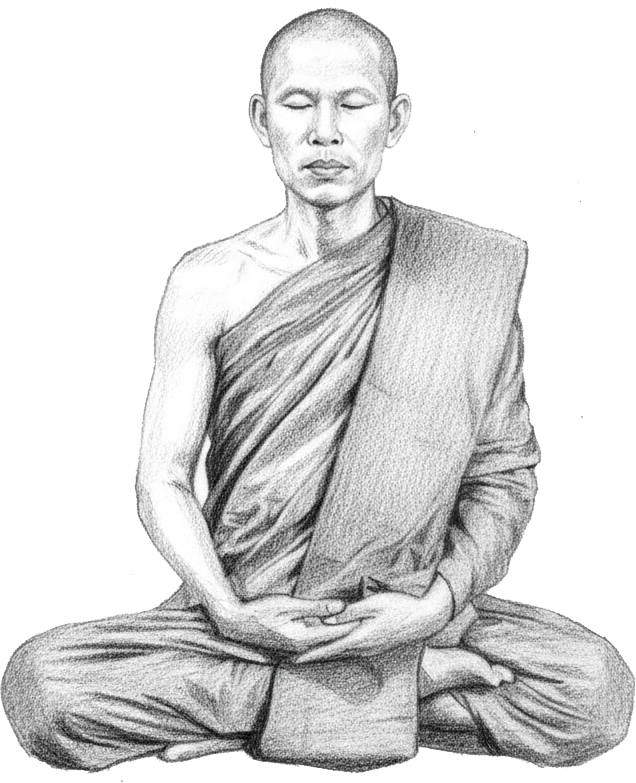
Entering the Shade of the Saffron Robe
Ajahn Lee’s early life was filled with signs of the extraordinary and the karmic retribution (Vipaka) carried over from previous lives. He recounted that at birth, he suffered severe pain in his head, which he recollected as the karmic result of having been a king who ordered the torture of prisoners with head-crushing devices.
In his youth, he had a resolute disposition, refused to bow his head to anyone, and had conflicting views with his father regarding the trading of animal lives. He abhorred and feared birth and death; especially when seeing pregnant women giving birth, he would feel a profound sense of spiritual dismay (Samvega).
A crucial turning point that turned him earnestly towards the Dhamma occurred at the age of 19, when he accidentally killed a dog in a fit of anger (Dosa). The sense of guilt gnawed at his heart until he had to seek a way to wash away the stain. Coupled with a weariness of lay life, where everywhere he looked felt burning hot, he decided to ordain at the age of 20.
However, his early life in the monkhood was filled with disappointment when he found that the monks in that society gathered for amusement, failed to perform ascetic duties, and transgressed the monastic discipline (Vinaya). He himself became tainted along with them, leading to such dismay that he considered disrobing. But due to his spiritual merit, he made a solemn vow praying to meet a righteous Dhamma master.
Eventually, he met Kammatthana monks from the lineage of Luang Pu Mun Bhuridatto, whose conduct was beautiful. He followed them until he met Luang Pu Mun at Wat Burapharam, Ubon Ratchathani Province, and received the first teaching that changed his life forever: "The word 'Bhikkhu' means 'one who punches the defilements (Kilesas)'. If you ordain and do not punch the defilements down, you are not called a Bhikkhu." He then re-ordained into the Dhammayutika Nikaya, offered himself as a disciple, and headed into the forests and mountains to make an end of suffering (Dukkha).
The Path to Dhamma
Ajahn Lee's mode of practice was trading his life for the Dhamma. He strictly observed the Dhutanga (ascetic) practices, seeking seclusion in cemeteries, caves, and mountains renowned for their powerful mystical forces. He did not merely flee from worldly chaos, but he ran toward death to prove the Ultimate Truth.
Once, he spent the rains retreat at the Klong Kung charnel ground, which was filled with graves and decomposing corpses (Asubha). He closely contemplated the funeral pyres to uproot attachment to the body. One night, he faced extreme fear upon seeing a corpse that was not completely burned, but he used Dhamma expedients (Upaya) to suppress his mind until his consciousness became calm and stilled, seeing the body merely as the four elements—earth, water, wind, and fire—breaking apart.
Confronting wild beasts was a mental test he endured extensively. In Talung District, he confronted a rogue elephant charging at him to take his life. While the villagers fled for their lives, he sat in meditation, radiating loving-kindness (Metta) directly at the fierce elephant until it halted, crouched down, and walked away.
Another time on Doi Khamo, Lamphun Province, he had to sit in meditation, his body frozen stiff all night, as a Bengal tiger prowled and roared around his glod (umbrella-tent). He resolved his mind to accept death, offering his life to the Buddhist religion, until dawn broke and the tiger departed.
An incident proving his miraculous mental power occurred when he was lost in the deep forest and utterly exhausted. While he was sleeping in his glod, a large herd of wild elephants passed by. The herd leader used its trunk to move his body and requisites out of the way, keeping him safe without him even realizing it. He only realized this later by entering Samadhi to look back at the event, seeing that even beasts of burden have Dhamma that protects those who uphold Sila (moral precepts).
His resoluteness in tormenting the defilements reached the supreme (Ukkhattha) level. Once, feeling weariness and dismay toward himself for still having lingering attachments to the taste of food and worldly conditions (Loka-dhamma), he punished himself by fasting, eating only fig leaves and cassia leaves for many consecutive days until his body became emaciated, barely surviving, in order to discipline the cravings of the tongue and stomach.
At Khao Chakan, he climbed to the highest cave and pushed the ladder away, declaring a vow of truth (Sacca) that he would not descend unless he attained high Dhamma. He abstained from food for 15 days, drinking only a single kettle of water, roasting the defilements with burning exertion until he "achieved his wish."
Ajahn Lee also possessed the destiny and spiritual merit (Vasana and Barami) connected with the spirit realm and celestial beings (Devas). During his Dhutanga wanderings to Chiang Dao Cave and Doi Khamo, he received alms from Devas who manifested themselves in physical form, and he received divine herbal medicines to cure his illness.
He could communicate with spirits seeking a share of merit, and he taught Dhamma to those ethereal beings to free them from suffering. Even "Mara" in the guise of thugs and criminals who plotted to harm him had to submit to his mental power and compassionate Metta. He was once tested with poison and weapons, but they could not even irritate his skin. He always taught: "A person who is not real fears death. A person who fears death will have to die again."
The Dhamma Legacy and the Final Moment
The precious Dhamma legacy Ajahn Lee left behind is the method of practicing "Anapanasati" (Mindfulness of Breathing) coupled with the contemplation of the four elements (earth, water, wind, and fire). He taught practitioners to turn the mind inward, refining the breath to be delicate and subtle, in order to purify the bodily elements, the Aggregates (Khandhas), and the mind.
He emphasized that, "The true Dhamma is not in books, but is at the heart." He brought the forest tradition Kammatthana monks into the capital by spending the rains retreat at Wat Boromniwat, and he taught meditation to Somdet Phra Maha Virawong (Uan Tisso), until the Somdet developed profound faith in the taste of Dhamma through actual practice.
The important monuments he established are "Wat Asokaram" in Samut Prakan Province and the "Phra Thutanga Chedi" to enshrine the Buddha's relics, which he invoked through his spiritual perfection. He was the principal organizer of the celebration of the 25th Buddhist Century, the grandest in the history of the Thai Sangha, at Wat Asokaram, an event filled with miracles and the faith of the masses.
In his final years, he suffered from an enlarged heart, but he refused life-prolonging medical treatment and instead used "Dhamma-osot" (the medicine of Dhamma) to cure his mind. He knew his own mental state and the day of his death in advance, remarking to his disciples that he would relinquish his bodily fabrications (Sankhara) at the age of 55.
He taught that, "Aging, illness, and death are the 'property' of the noble ones; they are the 'Noble Truths' (Ariya-sacca) or 'Noble Wealth' (Ariya-dhana). If aging, illness, and death were a person, I would prostrate at their feet every day. The reason I am able to remain in these yellow robes is precisely because of this illness."
He gave final instructions for his disciples not to worry over his physical body. On April 26, B.E. 2504 (1961), Ajahn Lee peacefully relinquished his bodily fabrications in the "Lion's Posture" (Sihasaiyas), leaving behind the body and laying down the Khandhas to enter supreme bliss. His physical body remains preserved according to the order of the Supreme Patriarch (Juan Utthayi), to serve as a field of merit and a reminder for future generations onwards.