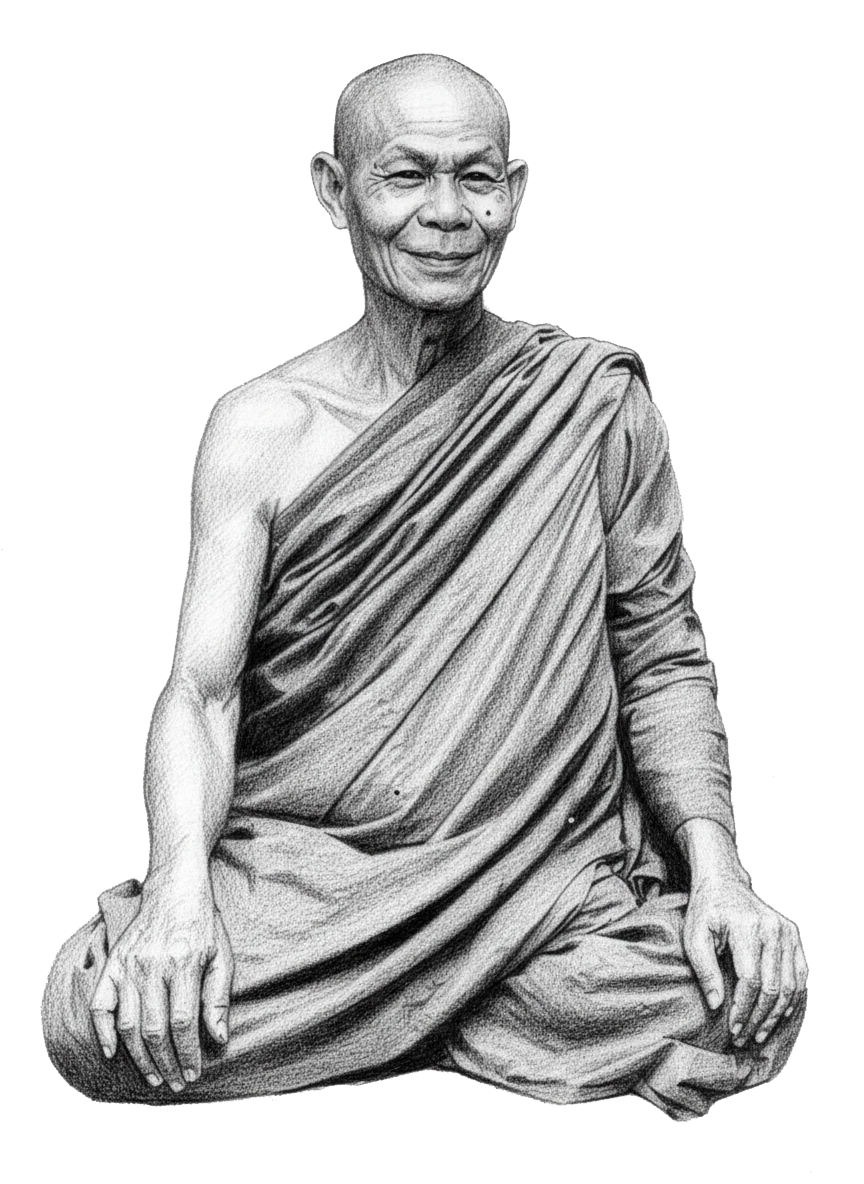
Entering the Shade of the Saffron Robe
Ajahn Phut Thaniyo was born into the (Inha) family in Saraburi Province, though his paternal lineage hailed from Ubon Ratchathani. He once spoke candidly about his background: “I was born in a den of thieves; my maternal relatives were all high-ranking outlaws.” His life took a drastic turn at the age of four when his father died of malaria and his mother lost her sanity. Consequently, he became an orphan, wandering with relatives on a journey that lasted over a month and a half, traveling on foot from Kaeng Khoi to Sakon Nakhon. “Wherever night fell, we slept—in rice fields, or under the shade of trees at the forest’s edge.”
His youth was fraught with hardship, requiring him to perform heavy labor like an adult and endure constant insults. He recalled, “Sometimes they would curse me, calling me a child with no parents to teach him.” This sense of inferiority and the suffering born of poverty and helplessness became the catalyst for his quest for liberation. He reflected on his life: “I was born alone. In my parents’ womb, there was only me; I have no siblings. If I remain a layman and have children, and if the father and mother both die, who will take them in? I am all alone—who would take responsibility for my children?” From this realization, he made a resolute vow: “I will remain a monk for life,” and “I will not allow any heir of suffering to be born from me.”
At the age of 15, after finishing primary school, he rejected a teacher’s invitation to become a government instructor. Instead, he walked into Wat Inthasuwan to request ordination as a novice. On that day, he folded his last set of secular clothes, handed them to a friend, and declared firmly: “I will never return to wear these again in this lifetime.” This marked his total renunciation of the world. Later, he was re-ordained as a novice in the Dhammayut sect (Thammayut) at Wat Burapharam in Ubon Ratchathani to fully enter the intensive practice of the Forest Tradition.
The Path to Dhamma
The journey toward meeting the “Great Master,” Luang Pu Sao Kantasilo (Kañtasīlo), began in 1937. While Ajahn Phut was a novice in Sakon Nakhon, Chao Khun Ariyakhunathan (Seng Pusso), a senior disciple of Ajahn Mun, passed through on a pilgrimage and invited him: “Come, novice, let us go together. I will take you to pay respects to Luang Pu Sao and Ajahn Mun, and I will find a place for you to study.” The journey was an intense training in itself, trekking through forests and mountains until his feet were blistered and raw. They camped wherever night found them until they reached Wat Burapharam.
There, at the age of 17, the novice Phut met Luang Pu Sao for the first time. He served the Great Master closely—massaging him, washing his robes, and tending to his spittoon. He observed the resolute character of Luang Pu Sao, who spoke little but practiced much. “If one day we thought of walking meditation to compete with the Great Master, he would continue walking without stop until we gave up; only then would he stop.” A moment of wonder occurred when the novice Phut harbored doubts about a meditative state he once experienced—where his mind had merged so deeply that an instructor kicked him, yet he felt nothing, only to be accused of lying. Without the novice even asking, Luang Pu Sao remarked: “Indeed, for one practicing Samadhi, if the mind is in refined absorption (Appanā-samādhi), even if lightning strikes, they would not know. If held underwater, they would not drown. If thrown into a fire, they would remain unaware.” This statement instantly unlocked the doubt in his heart.
Ajahn Phut’s monastic life was not without trial; he faced his greatest obstacle: illness. At only 22, he fell severely ill with tuberculosis, losing all hope and unable to sleep for seven consecutive days and nights. In that state of physical frailty and despair, his mind made a courageous vow: “Before I die, I should know exactly what death is.” He accelerated his meditation, staking his life on the practice. Ajahn Fun Ajaro (Ācaro), who resided there at the time, gave him a skillful Dhamma instruction: “You sit and meditate, and this is suffering, that is suffering. You are drawing a tiger to scare yourself. You must lie down and watch the suffering until you know the truth.” Following this, he focused his mind on observing death relentlessly. At 3 AM one night, after a night of exhaustion, his mind let go of the desire to know and merged into a profound, strange stillness.
In that state, a vivid “Vision of Death” (Marana-nimitta) appeared. He saw his breath as a long beam “like a neon light” running from his nose to his navel, before that connection snapped. His body vanished, leaving only a brilliant, luminous mind. Suddenly, the mind turned back to look at the body lying there, and the process of decay appeared in stages: the body bloated, fluids leaked, flesh rotted and fell away piece by piece until only the skeleton remained. Then, the skeleton collapsed, broke into small fragments, and disintegrated into dust, vanishing into the earth. The vision then reversed: the bones reassembled, flesh regrew until complete, and then it rotted again. This cycle repeated three times. When his mind withdrew from Samadhi, the realization of the Four Elements (Dhātu 4) arose, and miraculously, his tuberculosis subsided and eventually disappeared from that point on.
Beyond physical death, his pilgrimages involved facing deep-forest dangers and mysterious powers. Once, at “Phu Yang,” a place notorious for fierce spirits, he heard a deafening sound at midnight, like hundreds of buffaloes charging. An inhuman figure appeared, looking “like a vulture but four or five times larger,” leaping among the treetops. Initially, he was terrified, but mindfulness returned: “He sees us alone and has come to keep us company. Why be afraid?” Once his mind settled, the fear vanished, and he radiated loving-kindness (Mettā) until the spirit departed. On another occasion at Wat Koh Kaew Amphawan, he dreamed that an Arahant warned him: “If you stay longer than 10 days, it is dangerous.” He ignored it at first, but when he tried to meditate in the chapel, his body shook uncontrollably. He decided to leave immediately. On the 12th day, a lightning bolt struck the center of the chapel, incinerating the abbot where he sat.
The battle against internal defilements was equally fierce. As a young novice, he fell in love with a woman named “Prayun,” to the point where he could not meditate on “Buddho” because his mind would flicker only to her name. Instead of giving up, he used a clever device: he used her name, “Prayun,” as his meditation word instead of “Buddho.” He repeated it until his mind stilled, resulting in a vision of her. He then applied corpse meditation (Asubha-kammatthāna), visualizing her body rotting and dissolving until his attachment was severed. This was an example of using defilement as a tool to extinguish defilement. He often said of his training: “Whatever the heart wants, we will not eat it... whatever we dislike most, we will consume that,” training the mind to go against the current of desire to the ultimate degree.
This fierce path forged his spirit. His experience of the “Vision of Death” became the foundation for his profound insight into corpse meditation (Asubha), skeletal meditation (Atthika), and element meditation (Dhātu), leading his mind toward the “Insight of Non-Self” (Anattānupassanā-ñāna), which he considered confirmation that his practice was “correct according to the Path and Fruit (Magga-Phala).” Later at Wat Burapha, after recovering from another severe illness, a “Buddha Vision” (Buddha-nimitta) appeared to him—a blooming, radiant lotus with the head of a Buddha emerging from its center. He explained this state: “The lotus signifies the heart. The heart has bloomed fully. When the mind blooms fully, it becomes the Buddha-mind: the one who knows, the one who is awake, the one who is joyous.”
Regarding the experience of supreme enlightenment, he explained that it occurred while he was “teaching Dhamma.” He considered teaching to be “contemplating Dhamma” in itself because, while speaking, mindfulness (Sati) is constantly aware of every word. During this continuous contemplation, his mind reached a point he described simply yet deeply: “When it reached the right rhythm, the mind flickered for just a moment, and the defilements were gone. When success happens, the mind doesn’t stay there for long; it’s just a flash. In that flash—Ah! This thing is just this thing. The mind then becomes brilliantly clear, and defilements are finished.” He added that this occurred “without stages,” and identifying it as a specific level of realization was merely comparing the experience to scriptures or teachers' words afterward, emphasizing direct experience (Paccattaṃ) over theoretical labels.
The Dhamma Legacy and the Final Moment
The core of Ajahn Phut’s teaching was practice rooted in the monastic discipline (Vinaya). He compared practice without virtue to “rotten egg meditation”—outwardly fine, but inwardly decayed. He placed great importance on respect for seniority among monks, holding the motto “The wild rooster crows alone,” meaning that in the presence of elders, juniors should remain silent and listen to the Dhamma.
He left a method for those who cannot yet abandon defilements: “Use defilements for benefit through righteousness,” meaning to use greed, anger, or delusion as motivation for goodness and productivity within the boundary of the Five Precepts (Pañca-sīla), preventing defilement from leading to ruin.
Toward the end of his life, he was diagnosed with lymphoma in his neck, yet he faced the illness with absolute tranquility. Remarkably, a small scrap of paper was found where he had drawn a graph of his life in advance, circling the age of 78 with the note: “Prepare yourself, life must end.” During his final treatment, he told his attendant monk: “I have contemplated it; my lungs are riddled with holes, they are no longer functional,” showing total acceptance of the law of nature.
Ajahn Phut Thaniyo passed away peacefully at Maharaj Hospital, Nakhon Ratchasima, on May 15, 1999, at the age of 78 years, 3 months, and 7 days, having spent 57 years in the monkhood. On the day of his funeral bathing ceremony, Ajahn Maha Bua Nyanasampanno (Ñāṇasampanno) arrived and spoke in confirmation of his virtue: “Chao Khun Phut was one who practiced well and practiced rightly.” This marked the perfect conclusion to the life of the warrior-monk of the Dhamma Army.