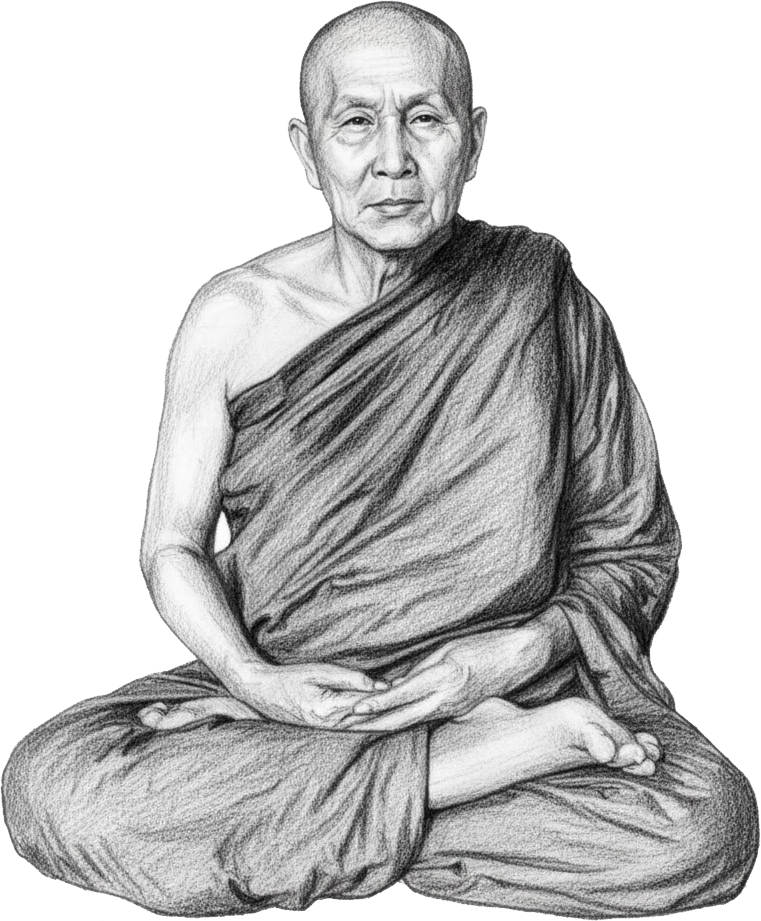
Entering the Shade of the Saffron Robe
Young Sim Wongkhemma was born into a farming family of (Phu Thai) descent. His birth was heralded by an auspicious omen: his mother dreamed of a monk with a radiant aura descending from the sky into their small hut amidst the rice fields. His connection to Buddhism began in early childhood as he followed his father, a lay steward, to the temple regularly. His intelligence was so evident that he was entrusted to assist the headmaster in teaching his fellow students after completing only the second grade.
The primary catalyst that drove him toward the monkhood was an intense "dread of death." He recounted that since childhood, seeing or hearing news of the deceased would strike fear into his heart, making him tremble with the worry that he might die before having the chance to ordain. This awareness of death became a warning signal deeply embedded in his mind. At the age of 17, he sought his father's permission to ordain as a novice (Samanera) at Wat Sri Rattanaram (Mahanikay). He displayed formidable resolve early on; during the digging of a temple well, even after others had abandoned the task at a depth of 12 fathoms without finding water, he insisted on continuing, declaring he would "dig to the very end of the earth."
A major turning point occurred in 1926 when the "Dhamma Army" of Luang Pu Mun Bhuridatto trekked to Ban Sam Phong in Nakhon Phanom. Novice Sim had the opportunity to hear the profound teachings of Luang Pu Mun, Ajahn Singh Khantiyakamo, and Ajahn Maha Pin Panyaphalo. Overwhelmed with faith, he decided to surrender himself as a disciple. He subsequently underwent re-ordination into the (Dhammayut) sect at a "Water Sima" (Udaka-sima), with Phra Dhamma Chedi (Joom Bandhulo) as his preceptor, marking the beginning of his intensive mental training as he followed the masters on foot toward Ubon Ratchathani and Khon Kaen.
The Path to Dhamma
The practice of Ajahn Sim was one that demanded his very life in exchange for the Dhamma. He described his early years residing at the Ban Lao Nga cemetery in Khon Kaen—a horrifying place filled with unclaimed corpses from the hospital, where stray dogs often unearthed and dragged human remains past the meal hall. He received a severe lesson in the "Meditation on the Impure" (Asubha-kammatthana) when Ajahn Singh led the monks to exhume a body buried only a few days prior. He recalled the sight of the bloated, greenish corpse oozing with fluids and a stench so foul it clung to the senses. Yet, he used this to teach his heart that the human body possesses no true beauty, only (Asubha-Marana)—impurity and death.
During his (Dhutanga) wanderings, he faced various wild beasts to test his mindfulness. Once, while meditating in Kalasin, a tiger approached the termite mound where he sat and used its paw to nudge his foot out of curiosity. Ajahn Sim remained still, merely flicking his foot at the tiger’s face until it roared and fled. Another time in Saraburi, a tiger roared fiercely at him and his companion, but he remained as silent as a statue, later teaching his disciples: "Tigers are afraid of humans; if we remain still, they will think we have something powerful within." He utilized the mantra (Morn Me Phawissati)—"I will surely die"—as his ultimate shield, viewing death as a natural certainty.
The place he found most conducive to practice was Chiang Mai, stating, "Nowhere feels as clear and open as Chiang Mai." In 1960, he trekked up Doi Luang Chiang Dao to find his "True Home," eventually discovering Tham Pha Plong. He remarked, "I want a cave that is wide and high up, so that defilements find it difficult to reach me." In the pioneering days of the cave, even at nearly 60 years of age, he carried heavy logs on his shoulders and rocks in his hands to build the temple steps. He made use of every second and declared himself a solitary (Rishi Bhikkhu).
His unique method of training was the "Diamond Lotus Posture" (Vajrasana). He taught that the heart must be like a diamond—unbreakable—not like a common gem that yields to defilements. This posture was used to stretch the tendons and conquer physical pain. He often sat as an example, firm and motionless, emphasizing that "meditation is not about gaining, but about letting go." He compared a mind that does not practice to "a madman carrying stones," constantly collecting emotions of love, hate, past, and future until it is crushed under its own weight.
Beyond his spiritual duties, he showed iron-willed determination in community labor, such as building the dam at Lam Nam Un. He led the work from 4 AM in the freezing cold, crushing and carrying stones until his skin was burnt dark by the sun. When disciples faltered due to gossip, he gave a sharp analogy: "Can you stop the frogs and toads from croaking? They croak 'I am here!' until they are caught and eaten. If we are not what they say we are, those words will eventually kill the one who spoke them."
He was also a master firefighter, establishing a task force to combat forest fires around the cave. He taught: "Outer fires are extinguished with limbs and strength, but the inner fire—defilement—must be extinguished with (Vajrasana)." He placed great importance on chanting as a form of meditation, specifically the (Mahasamaya Sutta) and the (Jinapanjara) Gatha, to invite devas to rejoice and ward off danger. He relentlessly pushed his disciples to fight (Thina-middha), or sloth and torpor, often telling the tale of the "Naga Novice" who slept for an entire aeon to keep his students alert in their practice.
The Dhamma Legacy and the Final Moment
The core wisdom Ajahn Sim left for his disciples was "The Mind that Knows." He taught them to distinguish between the "Concocting Mind" (Sankhara-citta), which wanders externally, and the "Original Mind," which possesses the knowing within. He urged the constant practice of "Death Meditation" (Maranasati) with every breath to realize that this world is but a "Cemetery of the Living Dead" and the body is merely "300 pieces of bone" devoid of lasting beauty.
In the final period of his life, even after being granted the royal title of Phra Nyana Sitthacharn on August 12, 1992, he remained as unshakable as the earth. He exerted his failing strength to receive the title at the Grand Palace to dedicate merit for the final time, whispering to his disciples, "The burden is over; the matter is finally finished."
Upon returning to Tham Pha Plong on the night of August 13, he led his disciples in meditation for over an hour, as if saying farewell to the sanctuary. At approximately 3 AM on August 14, 1992, Ajahn Sim passed away in the (Siha-sayasna) posture (lying on his right side) with perfect calm, at the age of 82. His final teaching was his own example: "Life is not lasting; death is certain." He instructed that his body not be kept long, requesting cremation within 7 days according to the Buddha’s tradition, so the living could see that "when the story is over, burn the ghost and grind the bones to end the matter; there is no need for worry." He left behind only his relics (Sarira-dhatu), which transformed into crystalline gems—the "Topaz of the Forest Tradition."