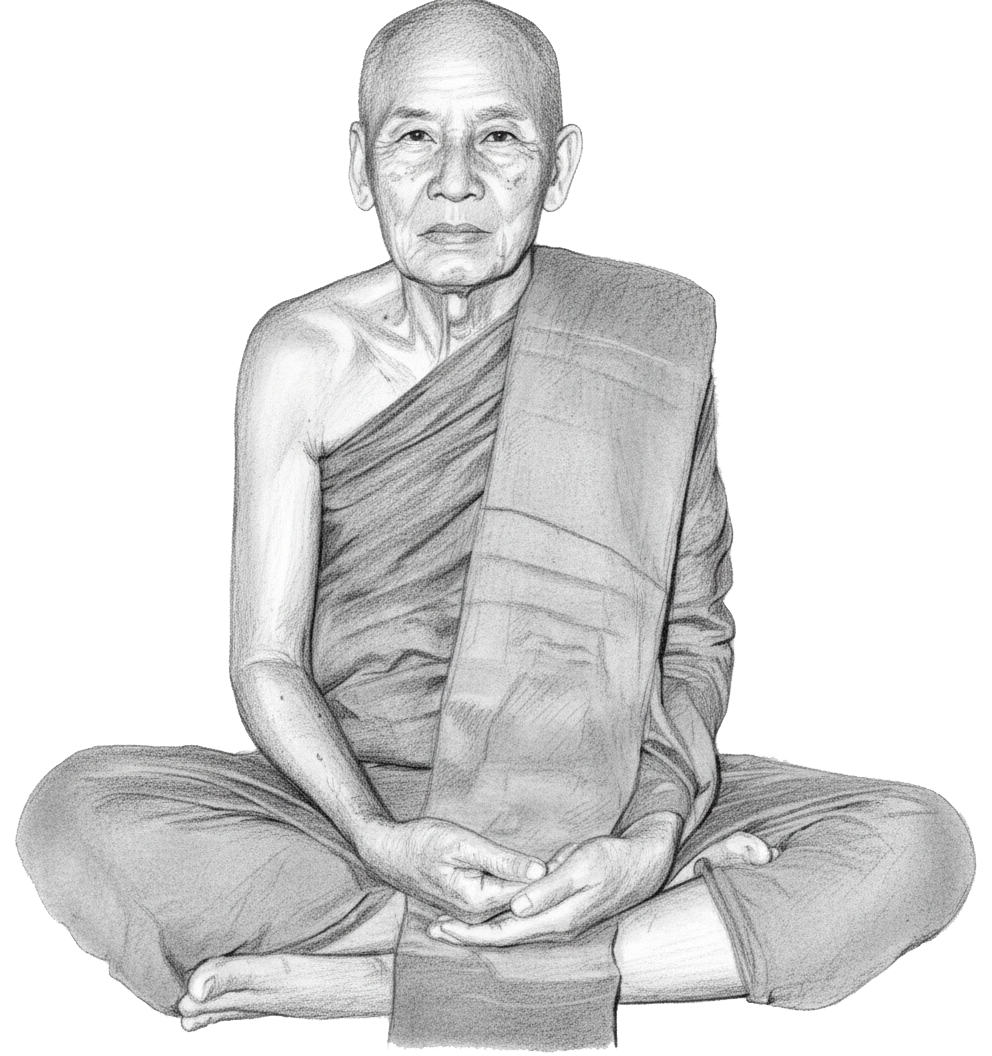
Entering the Shade of the Saffron Robe
Ajahn Thate Desaransi was born into the "Reowraeng" family on April 26, 1902. Both his father, Usah, and his mother, Krueng, were orphans who had fled starvation, plagues, and rampant banditry from their respective hometowns to build a new life in Ban Na Sida, Udon Thani province. He grew up in a farming family where food was abundant, but the environment was harsh, teeming with cattle thieves and ruthless thugs. At the age of nine, he was brought to the local monastery by his older brother, a monk, to learn to read Thai and ancient Khmer scripts. Even after his brother disrobed three years later, the young boy Thate remained at the temple as a monastic attendant (Kappiya-kāraka), filtering water, carrying food, and serving the monks for six full years. His father instilled in him a fierce masculine resolve, teaching him the motto: "A true man must strive to seek knowledge outside his hometown. Even if you must die, do not die in the village of your birth." This teaching took deep root in his heart.
His inclination toward the monastic life was triggered by three auspicious omens (Subhanimitta). First, a vivid childhood dream where an ascetic forest monk carrying an alms bowl and an umbrella-tent (Klod) chased him down and whipped him fiercely—a vision that foretold his destiny. Second, a profound sense of gratitude; witnessing his parents' immense hardship in raising ten children, he made a resolute vow never to marry so he could solely bear the burden of caring for them. Third, the clear contemplation of the Truth of Suffering (Dukkhasacca); observing the villagers endlessly toiling in the fields, trapped in the grueling cycle of the seasons just to feed their stomachs, he felt a deep dismay and pity for the worldly life, which consisted of endless, exhausting actions with no true escape.
During his teenage years, the oppressive environment of thievery briefly tempted him to seek invulnerability magic (Vijjā) to fight off the bandits. However, he was deceived by a corrupt monk who lured him far away to Sakon Nakhon only to provide no teachings at all. Filled with shame upon returning home, this fortunate failure permanently severed his belief in amulets and mystical charms. The ultimate turning point occurred in 1916 when Ajahn Singh Khantayakhamo—the foremost disciple of Luang Pu Mun Bhuridatto—arrived at Ban Na Sida on a wandering retreat. Ajahn Singh taught the young man to internally recite "Buddho." As his mind gathered into concentration (Samādhi), he tasted a profound peace he had never known. Captivated by the Dhamma, he bid a tearful farewell to his parents and followed Ajahn Singh into the deep forests without a shred of worldly attachment. He ordained as a novice at 18, and on May 16, 1923, at the age of 22, he fully ordained as a monk at Wat Suthatsanaram, Ubon Ratchathani, officially stepping onto the brutal battlefield of the forest tradition.
The Path to Dhamma
Stepping into the path of a forest meditation monk (Kammaṭṭhāna) was a literal gamble with his life. Immediately after his first rains retreat as a monk, he joined a large wandering group led by Ajahn Singh and Maha Pin Panyaphalo. They trudged through deep mud, waded through flooded fields, and faced severe storms. On one occasion, a torrential downpour flooded their sleeping areas; they had to sleep soaked in an abandoned temple, and the next morning's alms round yielded nothing but plain cooked rice and a few bananas. This was his first taste of the ascetic life.
When he escalated his practice to an extreme level, Ajahn Thate sought absolute seclusion at Tham Phuang cave on Phu Lek mountain. There, he engaged in ruthless fasting, incrementally reducing his daily food intake from thirty handfuls of sticky rice down to a mere three. He consumed only vegetarian food—eating nothing but chili powder and a ball of sticky rice the size of a bael fruit. His physical body became shockingly emaciated and pale, alarming the local villagers, yet his mind grew incredibly light, and his mindfulness (Sati) became razor-sharp. The battle against the bodily elements (Dhātu-khandha) continued relentlessly. Later, while meditating alone at Tham Phra Na Phak Hok cave, he pushed his walking meditation (Caṅkama) to such extremes that the soles of his feet blistered and bled. Stricken with severe malaria throughout the entire retreat, his unyielding resolve only hardened. He made a vow: "I surrender my life and my flesh and blood in worship of the Triple Gem." He forced his mind to remain inward, refusing to let it wander even in the moments before falling asleep.
He was forced to confront death and the mind's illusions head-on. One night, he experienced sleep paralysis—what villagers call a "ghost pressing down"—where a dark, heavy mass crushed his chest, suffocating him. Instead of panicking, he used mindfulness to watch the mind as it approached what he believed was the moment of death. He tracked his consciousness until only a sliver of awareness remained, asking himself whether he should let go and die or fight to survive. Realizing that if he lived, he could still benefit others, he fought to move his limbs until he woke. Using his wisdom, he investigated the phenomenon and realized it was not a ghost, but simply the internal wind element (Vāyo-dhātu) pushing upward.
The threats in the deep jungle were not limited to bodily pain, but included deadly beasts. While dwelling entirely alone on Doi Musoe (Pu Phaya village), a massive Bengal tiger prowled near his hut at night, roaring ferociously. His childhood phobia of tigers—a latent tendency (Anusaya)—surged violently. He shook uncontrollably, sweating profusely despite the freezing weather, entirely unable to meditate. Once he regained his mindfulness, he made a definitive choice to face death. He commanded his mind: "Both the tiger and the human are merely lumps of the four elements (Dhātu)... Who is eating whom? Who is the one who dies, and who is the one who does not die?" By willingly surrendering his attachment to the physical body and trading it for the taste of the Deathless, the tiger's roar transformed into mere wind striking an object. The fear was instantly eradicated. Later, when a tiger attacked and devoured a buffalo right next to his hut, he simply knocked on a piece of wood to scare it, watching the slaughter with absolute, unshaken calm.
However, the most lethal enemy—one that Ajahn Thate constantly warned his disciples about—was not tigers or malaria, but women (Mātugāma) and sensual defilements (Kāma-kilesa). He recorded his terrifying encounters with brutal honesty. Early in his monkhood, a familiar female lay supporter locked him inside her house late at night. Under the dim light of a torch, she crept closer, consumed by lust. Ajahn Thate was scorched by the heat of sensual desire and the terror of committing a grave sin. His mind went entirely blank. Using immense willpower, he managed to wake the temple boy who had accompanied him and fled the house at midnight, miraculously escaping the destruction of his celibacy (Brahmacariya).
Another time, his deeply buried latent defilements (Anusaya-kilesa) generated a terrifyingly vivid mental vision (Nimitta) during meditation. An image of a middle-aged female supporter from years past appeared sitting intimately beside him. The vision induced a profound, overwhelming sense of bond and affection, as if they had been husband and wife for decades, though devoid of coarse sexual lust. Shocked, he withdrew from the meditation and investigated this psychological trickery, recognizing it as the delusion of past-life connections (Bupphesannivāsa). He decisively concluded that the defilement of sensuality is merciless, and only a practitioner armed with absolute faith, extreme effort, fearless courage, and razor-sharp wisdom can drag these latent defilements from the ocean floor of the mind and execute them.
The greatest turning point in his mental training occurred when his mind became trapped in its own success. He had developed his concentration (Samādhi) to the point where his mind would drop into a state of profound, blissful stillness (Ekaggatārammaṇa) for hours. He remained stuck in this "trap of peace" for over ten years, mistakenly believing that this motionless mind was absolute purity. Yet, whenever external objects contacted his senses, his mind still wavered. He brought this dilemma to Ajahn Singh, who instructed him to contemplate the loathsomeness of the body (Asubha). Bound by his own subtle ego, Ajahn Thate internally argued, "When the mind has already let go of form and is so refined, why would I force it to grasp at coarse form again?"
To resolve this agonizing doubt, he and his fellow monk, Ajahn Ounsi Sumetho, embarked on a brutal journey on foot to the North to find the grandmaster, Luang Pu Mun Bhuridatto. They crossed the treacherous Burmese border, endured freezing temperatures, starved, lost their way in the mountains for tens of hours, and walked over sharp rocks until their knees and feet were torn open. Finally, they found Luang Pu Mun at the Pa Miang Mae Ping forest in Chiang Mai. Upon hearing Ajahn Thate's practice, Luang Pu Mun issued a devastating rebuke: "You did not follow my path. You have just been sitting stupidly for over ten years." Luang Pu Mun commanded him categorically to prevent the mind from dropping into the subconscious (Bhavaṅga), and to force it to constantly contemplate the physical body as loathsome (Asubha), as mere elements (Dhātu), or under the lens of the Three Characteristics (Ti-lakkhaṇa).
Ajahn Thate submitted entirely. He dismantled his decade-old views and started his meditation anew. He locked his mindfulness onto the contemplation of the body day and night for six continuous months. Suddenly, his mind became blindingly bright, and a profound, spontaneous wisdom (Paññā) erupted: "Everything that exists in this world is merely a collection of the four elements. It is we humans who invent conventions and then become blindly lost in the very conventions we created." This piercing Insight (Vipassanā-ñāṇa) shattered the worldly trap of tranquil absorption, propelling him authentically into the pure stream of the Dhamma.
The Dhamma Legacy and the Final Moment
Having penetrated the absolute Truth, Ajahn Thate emerged as a formidable Dhamma Heir. He formally invited Luang Pu Mun to return to the Isan region to guide the waiting disciples. Bearing the heavy responsibility of leadership, Ajahn Thate subsequently led an army of forest monks down to the Southern provinces of Phuket and Phang Nga—a region notoriously resistant to the forest tradition. There, he faced aggressive opposition from both locals and regional monks. They threw stones at him, attempted to poison his food, and burned down his monastic dwellings. Yet, armed with unshakeable peace, boundless compassion, and tactical wisdom, he endured this hostility for 15 years. He successfully rooted the Dhammayut forest tradition in the South, thoroughly repaying his debt of gratitude to the people there.
The core of his teaching emphasized True Renunciation (Nekkhamma). He taught that renunciation is not merely wearing the saffron robe, but the "internal letting go" of the five sensual cords. He categorized Buddhist practice into four layers: the scabs, the bark (generosity), the sapwood (virtue/Sīla), and the heartwood (concentration and wisdom). He fiercely warned against discarding the outer layers, noting that the heartwood cannot survive without the bark and sapwood to protect it. He taught his disciples to view reality through the lens of: "Things exist, as if they do not exist," highlighting that form, feeling, perception, mental formations, and consciousness are all Anicca, Dukkha, Anattā. Clinging to them is akin to sculpting water into a solid form. Furthermore, he constantly urged the contemplation of death (Maraṇassati), stating that death resides in every single breath, and only those who realize the value of a breath will rush to purify their minds before the body shatters.
In his later years, Ajahn Thate demonstrated absolute detachment from worldly honors. He viewed the high ecclesiastical titles bestowed upon forest monks as "putting a diamond necklace on a monkey's neck," and eventually relinquished all his administrative roles. Returning to Isan, he established Wat Hin Mak Peng on the banks of the Mekong River. Though millions of baht poured in for the construction of massive public works, hospitals, and schools, he constantly reminded his followers: "We refuse to be slaves to bricks, cement, or wood... The true core of Buddhism is not found in material objects, but entirely within the practitioner." He functioned merely as the "Treasury" for the devotees, managing vast funds without a single shred of greed ever taking root in his mind.
As old age set in, his physical vessel was ravaged by severe ailments, including brain ischemia and the blockage of his bile ducts. His body would twitch and spasm in sheer agony, yet his mental state was completely severed from the physical pain—a perfect demonstration that "the mind is one thing, the body is another." In 1993, at the age of 91, recognizing the approaching end, he deliberately abandoned the comfort and grand facilities of Wat Hin Mak Peng. He returned to Wat Tham Kham in Sakon Nakhon—the isolated, rugged cave monastery where he had achieved his ultimate realization years prior—to await his final hour.
On the full moon night of the first lunar month, Saturday, December 17, 1994, the frigid winter wind blew softly through the silent mountains. At approximately 21:00, Ajahn Thate lay peacefully on his right side, his left arm stretched out, resting his hand open for a disciple to massage. Without a single gasp, struggle, or sign of distress, the wind element simply ceased. He discarded his bodily aggregates in absolute silence, slipping away unnoticed right before the eyes of his attending disciples. He left behind a final, uncompromising command that reflected his total lack of attachment to locations or monuments: "If I die, keep the body here at Wat Tham Kham. But when it is time for the cremation, take it to be burned at Wat Hin Mak Peng." Thus ended the life of a resolute warrior of the mind, leaving behind a legacy of flawless practice to illuminate the path for future generations of the forest tradition.