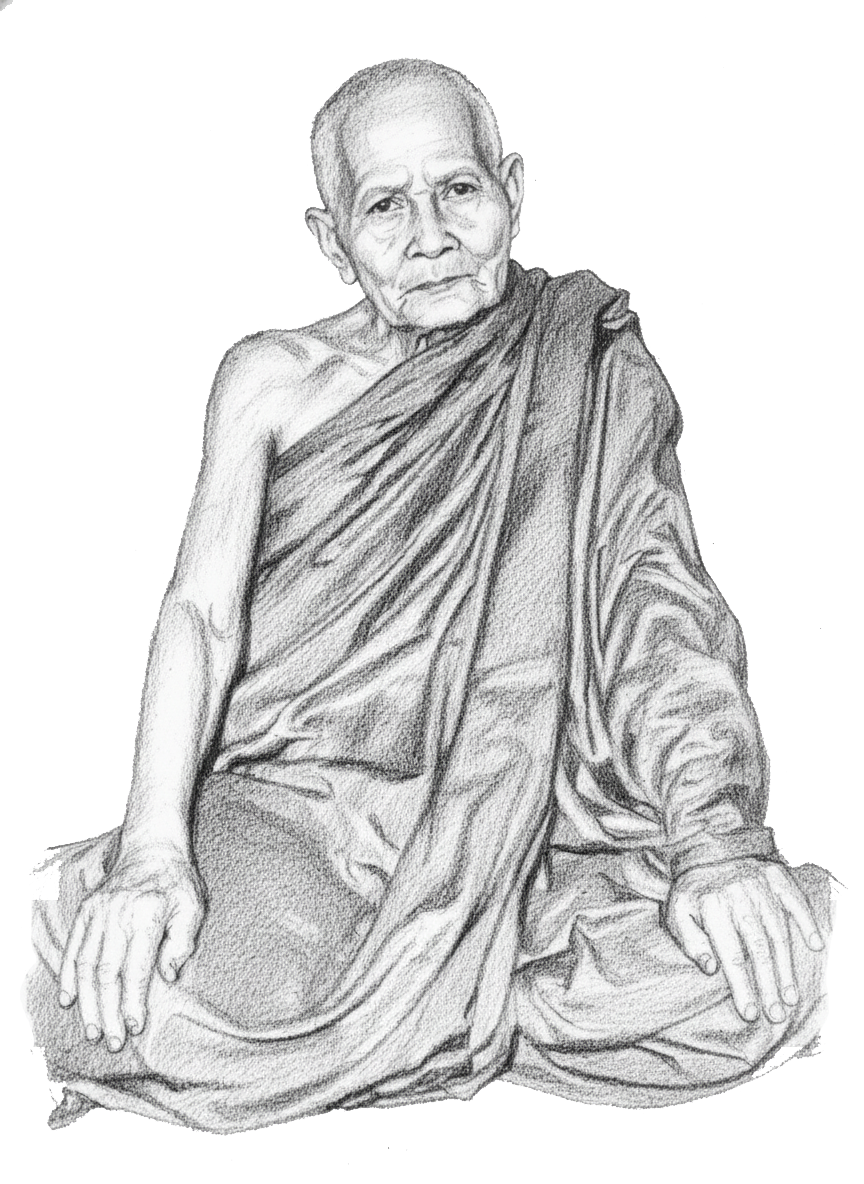
Entering the Shade of the Saffron Robe
The first chapter of Ajahn Waen Sucinno’s monastic life began with a powerful and sacred final wish from his parents. When he was only five years old, his terminally ill mother called him, held his hand firmly, and said, “I would be very happy if you ordain for me. Once you ordain, remain in the yellow robes until you die; do not disrobe to have a wife or children.” This command, coupled with his grandmother’s vision of her grandson sitting in a turmeric grove with skin glowing golden, became a divine decree that led the young boy "Yan" to enter the novicehood (Samanera) in 1896 at Wat Pho Chai, where he was renamed "Samanera Waen."
In his youth, he traveled to study the "Mula-Kaccayana" grammar in Ubon Ratchathani, the center of scholars at that time. He apprenticed under Ajahn Sing Khantiyagamo (Khantiyagamo) at Wat Ban Sang Tho. Through his meditative insight, Ajahn Sing realized that this novice was a "precious white elephant in the forest" and thus transmitted all his knowledge of Pali Dhamma and esoteric sciences to him. However, Ajahn Sing cautioned that these were merely mundane sciences that could obstruct the path to Nirvana; once he entered the forest for wandering (Tudong), he must let them go.
The turning point that led him truly into the Forest Tradition was witnessing his teachers and fellow monks suffer from "insomnia" and eventually disrobe to live worldly lives. Ajahn Waen contemplated with wisdom until he saw clearly: “Sensual desire (Kama) is the obstacle; all beings die because of desire.” He then decided to discard his books and academic maps, heading into the forest to seek the "Truth."
In 1918, he tracked down Luang Pu Mun Bhuridatto (Bhuridatto) and met him for the first time at Dong Ma Fai, Udon Thani. The Great Master’s first words were a sharp command: “From now on, meditate. Put all the knowledge you have learned in a cabinet for now.” This command transformed him from a scholar of scriptures into a spiritual warrior directly confronting his defilements.
The Path to Dhamma
During his early wanderings in Northern Thailand with Ajahn Tuer Acaladhammo (Acaladhammo), he learned about the purity of the human heart through an encounter with a Yao hill tribe man. While wandering hungry in the deep forest, he asked a man for some rice. The man, in his simple forest-dweller way, replied, "We have little rice. We don't buy; we keep it to eat and sell." He misunderstood that the monk wanted to buy rice with money and even tried to buy Ajahn Waen’s alms bowl to boil rice. Ajahn Waen recounted this with compassion, noting that these people had no guile; their hearts were so honest it was endearing. He gained a vital Dhamma lesson: "Honesty is the absence of mental proliferation (Sankhara)." Eventually, a kind Yao woman gave him all her rice, and he ate plain rice with hot water, which he described as the "most delicious food" because it came from pure faith amidst hardship.
His greatest karmic ordeal involving sensual lust occurred at Phu Khao Khwai in Laos. He encountered a young woman whom a fortune teller had predicted was his "soulmate from past lives." With just a gaze, his mind was so disturbed he almost broke his promise to his mother. He decided to fast and use "Mindfulness immersed in the body" (Kayagata-sati) to uproot the defilement. He projected his mind onto her body, dissecting the 32 parts until he saw decay and a skeleton. He challenged his mind with a repulsive question: "You say she is beautiful, but can you eat her urine and excrement?" When his mind was cornered by the foulness seen through wisdom, the lust vanished completely. He reached a state where, regardless of which woman he saw, his mind would instantly see through the skin to a "walking skeleton," dwelling in a permanent state of loathsomeness (Asupha).
While staying at Chiang Dao Cave with Luang Pu Mun, he received a crucial teaching that shifted his focus from the external to the internal world. One day, Luang Pu Mun mentioned a cave of Solitary Buddhas (Paccekabuddha) on a high peak. Driven by curiosity, Ajahn Waen and Ajahn Tuer climbed the steep cliffs, risking their lives, but found nothing. Upon their return, Luang Pu Mun pointed out: "A mind sent outward seeking miracles is merely distraction." The true reality is not in a mountain cave, but in the "internal cave of the heart." From then on, he focused solely on excavating his own mind until he found an unshakable stillness.
His resolute concentration was evidenced again while wandering alone from Phayao to Lampang. Stricken by severe jungle fever and caught in a storm, he realized that getting wet in his condition could be fatal. He sat in meditation and made a Vow of Truth (Sacca-adhitthana): "If I have enough merit to continue practicing for the end of suffering, may the rain not fall where I sit." Miraculously, a strong wind blew the rain away, leaving a dry circle around him while the surrounding area was drenched. This event clarified the "Power of Truth" and the stability of a mind unified with the Dhamma.
While wandering through the jungles of Khammouane with Ajahn Tuer, they encountered a "strange creature" about 7 cubits tall, dark-skinned, hairy, with a face like an ox and bulging eyes. It wailed, shook the earth, and smelled of rotting corpses. Ajahn Waen remained unfazed, using "Loving-kindness" (Metta) instead of spells. The creature eventually bowed in respect. In his meditation, he realized it was an Asura (Asurakaya)—a sinful spirit suffering for over a hundred years due to past violations of the 2nd and 3rd precepts. After hearing his sermon, the creature vanished, serving as a test of using compassion to conquer the fear of death.
Another brush with death occurred when they were surrounded by the "Kha Radae" tribe, a group known for cannibalism. They fired poisoned arrows at the monks' umbrellas (Glod). Instead of fleeing, the two monks immediately entered deep meditative absorption (Jhana). The arrows fell to the ground as if hitting an invisible wall. The tribesmen fled in fear but returned the next morning to apologize. They offered roasted human flesh, which Ajahn Waen declined, using patience and compassion to teach them to stop killing. This event proved that a steady mind protects life better than any weapon.
At Chiang Dao Cave, Ajahn Waen refined his mind to communicate with the unseen. He encountered a Phaya Naga (Naga) who monitored his composure, criticizing any loud movement as being "a monk as restless as a child." He also met a "modern ghost" (Peta)—a former thief who had smashed Buddha statues. This encounter led him to contemplate: "Goodness must be done in the present, not at the brink of death." He used Chiang Dao as a base for effort until his mind settled in the "Primordial Mind" (Thiti-bhuta), where the mind is firm without past or future interference.
The most direct teaching from Luang Pu Mun occurred when Ajahn Waen and two other monks argued over sewing robes. Luang Pu Mun sensed the conflict and scolded them: "Do not go stabbing each other with spears and swords." He pointed out that holding one's opinion as supreme destroys the path to fruiton. Ajahn Waen learned that true practice is "letting go of the ego" (Atta) and guarding the five senses. He stopped memorizing palm-leaf scriptures and began reading the "Scripture of the Body," realizing that all 84,000 Dhamma aggregates are found only within the present body and mind.
The ultimate proof of his mental power occurred when he needed surgery for an infected leg at Wat Pa Ban Pong after the war. Without anesthesia, the doctor had to perform the surgery "live." Ajahn Waen simply said, "Yes," and entered a state where he separated the mind from the body (Vedana-khandha). He sat motionless for an hour as the doctor cut and stitched. Upon emerging, he calmly said, "It pained a fair amount," confirming the level of an Arahant (Arahant) who has absolute control over sensation.
The Dhamma Legacy and the Final Moment
In 1962, at age 75, Ajahn Waen moved to Wat Doi Mae Pang in Chiang Mai. He vowed not to accept any administrative duties or invitations outside the temple. He lived simply in a "Kuti for Burning Defilements," treating his skin ailments with immense patience.
His constant teaching was the "Present Dhamma" (Paccuppanna-dhamma). He taught disciples to let go of the past and future, as both are illusions. He often reminded those seeking holy water or amulets: “The good thing is already within us... Morality (Sila-dhamma) is the true good thing.”
His final hours were a matter of "Karmic remnants" (Vipaka-khandha). He suffered from a chronic wound on his tailbone, which he attributed to childhood karma of cutting a buffalo's tail. Despite severe pain and a broken hip from a fall, he suppressed the sensation through Samadhi (Samadhi).
His Majesty King Rama IX held Ajahn Waen in the highest regard, visiting him frequently. Ajahn Waen accepted hospital treatment only because, as a citizen, he could not decline the King’s wish.
Ajahn Waen Sucinno passed away peacefully on July 2, 1985, at 9:53 PM, aged 98. He left behind crystal-pure relics (Sarira-dhatu) and the sharp teaching that the world has no past or future—only the Present Dhamma that extinguishes all suffering.