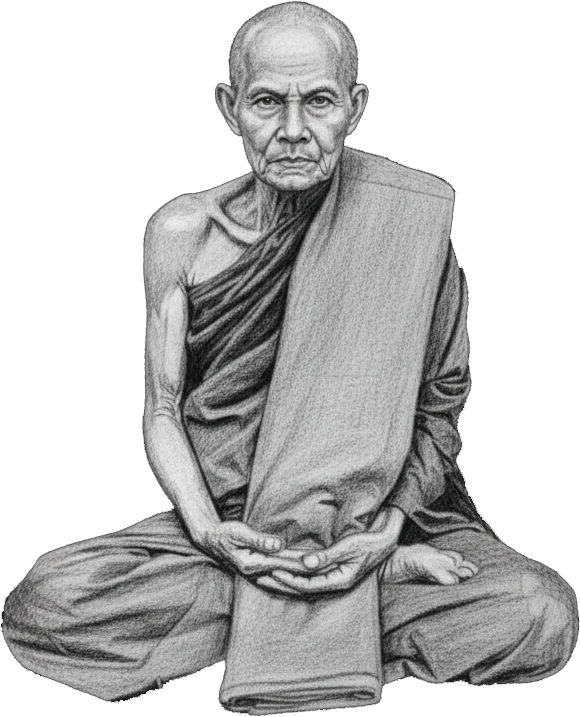
Entering the Shade of the Saffron Robe
Luang Pu Mun Bhuridatto was born in Ban Kham Bong, Khong Chiam District, Ubon Ratchathani Province, in 1870 C.E. From a young age, he showed keen interest in studying the Dhamma. He was ordained as a novice (sāmaṇera) at the age of 15 at Wat Ban Kham Bong. However, after only two years, he had to disrobe (lā sikkha) at the request of his father. Nevertheless, his heart remained steadfast in the monastic life.
At the age of 22, driven by strong faith, he was ordained as a monk (bhikkhu) at Wat Liap in Ubon Ratchathani on June 12, 1893 C.E., receiving the ordination name Bhuridatto. He commenced his insight meditation (Vipassana) practice under Luang Pu Sao Kantaseelo at Wat Liap. In the initial phase of his practice, he repeatedly recited "Buddho" as his primary meditation word. Despite some doubts about the path, he never relaxed his diligent effort.
One night, he experienced a vivid dream (subina-nimitta). He dreamt he left his village and entered a vast, thorny jungle, which he managed to navigate safely. Upon emerging, he found an expansive plain stretching as far as the eye could see. As he walked across this plain, he encountered a fallen tree trunk called a "Khon Chat" — the trunk of a "Chat" tree. This enormous log had been lying there for many years, its bark and sapwood completely decayed. He climbed and walked along the length of this fallen trunk, contemplating it deeply. An inner realization arose within him: this tree could never sprout again. He understood this as an assurance that his own birth (jati) would also come to an end in this very existence, provided he persisted in his efforts. This dream served as a firm confirmation that his practice would indeed lead to the ultimate goal of liberation from the cycle of rebirth (vaṭṭa-saṃsāra). From the very beginning of his ordination, he steadfastly observed the 7 ascetic practices (dhutaṅga), which included wearing robes made from cast-off rags (paṃsukūlikaṅga), collecting alms (piṇḍapātaṅga), eating only one meal a day (ekāsanikaṅga) in his alms bowl (pattapiṇḍapātikaṅga), and dwelling in the forest (āraññakaṅga) – practices he maintained throughout his life.
Facing Death in the Deep Forest and Intense Mind Training
Luang Pu Mun’s mind training was exceptionally rigorous. In the initial stage of his meditation, after he experienced a striking acquired image (uggaha-nimitta), first seeing a decaying corpse, which then transformed into a crystal sphere, continuously changing its forms for three months, he found his mind still agitated by external stimuli (joy, sorrow, liking, disliking). He realized this outward focus was not the correct path. He then radically shifted his method, turning his mind inward to contemplate the body (kāyagatāsati) in all its aspects – above, below, transversely, and centrally – with continuous mindfulness (sati), emphasizing walking meditation over other postures. When he sat in cross-legged posture to contemplate his body using this technique, his mind swiftly entered profound calm, and his physical body seemed to "split into two parts" along with the clear understanding that "This method is definitely correct, beyond doubt." This was a pivotal moment, establishing a stable foundation for his mind through concentration (samādhi), no longer easily swayed as before. He maintained intense effort in every activity, from alms round to cleaning, sewing, or even eating. He never allowed any moment of movement to be wasted, except during sleep. Even then, upon regaining awareness, he would immediately rise to continue his practice, preventing complacency. If drowsiness arose during sitting meditation, he would engage in walking meditation, accelerating his pace to dispel it before returning to his sitting practice.
During his early ascetic (dhutaṅga) wanderings through the forests of Northeast Thailand and Laos, most villagers neither understood nor trusted Kammatthana monks. They perceived the practice as alien. Upon seeing a dhutaṅga monk, they would panic and flee into their homes or hide in the jungle. Accounts describe women gathering vegetables and fish in the forest, upon seeing a Kammatthana monk approach, crying out with fright, "Phra Dhamma has arrived!" along with dropping their belongings and running, even abandoning small children in their haste. Gaining the trust of the populace, therefore, came not through promotion, but through his exemplary, composed conduct, which gradually fostered belief over extended periods of residence.
Though his teacher, Luang Pu Sao Kantaseelo, was consistently calm and serene, Luang Pu Mun’s mind was, as Luang Pu Sao once remarked, "exceedingly restless." He elaborated, "His mind is one that is very unbridled; whenever anything arises, it is never moderate. Sometimes it will soar into the sky, sometimes it will delve beneath the earth." Luang Pu Mun himself had previously aspired to Buddhahood (Buddhabhūmi). However, during intense practice, his mind often lingered with this past aspiration, feeling a reluctance to attain Nibbāna in this lifetime. He then contemplated that achieving Buddhahood (Buddhabhūmi) would require countless aeons (kappas) of births, deaths, and immense suffering in the cycle of rebirth (vaṭṭa-saṃsāra). He therefore resolved to abandon that aspiration and dedicate himself to realizing Nibbāna in his current existence. Once he relinquished his former aspiration, his mind felt unburdened, and his practice progressed with remarkable ease.
His experience at Tham Sarika in Nakhon Nayok Province proved a crucial test. He suffered from severe stomach pain, even passing fresh blood. Rejecting conventional medicine, he resolved to cure himself with Dhamma-medicine (Dhamma-osatha) – unwavering meditation. His mind entered a profound state of calm, and the illness completely subsided. Upon emerging from samādhi, he encountered a colossal, dark guardian spirit (Phī Luang) about 10 meters tall, wielding an iron club, who threatened to crush him. Luang Pu Mun fearlessly admonished the spirit about its delusion of power and the karmic consequences of its actions. The spirit, deeply remorseful, transformed into a gentle tree deity (Rukkhadevata), took refuge in the Triple Gem, and offered protection to Luang Pu Mun. He also possessed "animal language," understanding the speech of a large troop of monkeys foraging near the cave. The incident with "Khrua Ta," an elderly monk whose worldly thoughts Luang Pu Mun perceived, confirmed his mastery of the ability to know others' minds (paracittavijja). It was in Tham Sarika that he attained the fruit of Non-Returner (Anāgāmi) and was visited by fully enlightened ones (Arahants) who expounded the Dhamma and demonstrated various modes of Nibbāna.
Furthermore, he also had to face illnesses, especially jungle fever or malaria, which was prevalent in many forest areas. Sometimes, he even had to endure shivering cold inside his umbrella-tent (klot) throughout the night when heavy rain fell. He considered the painful sensations (dukkha-vedanā) arising in the body as a matter of truth (saccadhamma); it must be contemplated to be understood, not merely letting suffering oppress in vain. He also possessed the ability to know others' minds (paracittavijja), which was extremely swift and precise. There was one instance when he knew that a monk secretly kept photographs of boxers in his shoulder bag. He then used "meditative image (nimitta-bhāvanā)" to present a vision of boxers fighting in front of the monk. When that monk confessed and destroyed the photographs, his mind settled. In a hill tribe village, he taught the villagers to meditate on "Buddho." One hill tribe person was able to meditate until he saw the Dhamma and could know the minds of him and other monks. On one occasion, when Luang Pu Chob Thānasamo encountered a large wild elephant, Luang Pu Mun told Luang Pu Chob to speak to the elephant with loving-kindness (metta), and the elephant then moved aside.
His confrontation with death and survival in Burma during World War II was one of his most harrowing experiences. He had spent five years on ascetic wanderings (dhutaṅga) in Burma, becoming fluent in the Burmese language. When World War II broke out, vengeful British soldiers (who were angered by the Thai people) began searching for and killing Thai people in Burma. Burmese villagers who revered him helped hide him deep in the forest. Even when he was once discovered, he used his loving-kindness (metta-citta) and affirmed that he was a monk uninvolved in politics, which led the soldiers to pass him by. Later, as the situation grew more perilous, villagers guided him on a treacherous escape route back to Thailand through dense, difficult mountainous jungles. He had to walk for three consecutive days and nights without sleep or any food, only water. On the fourth day, utterly exhausted and extremely hungry, he reflected upon the deities and the Buddha's compassion. Moments later, a "gentleman" appeared, offering him miraculously fragrant and delicious food to partake of. After eating, his body felt miraculously strong and refreshed, enabling him to continue his journey safely out of the deep forest and into Thai territory. He believed that person was a celestial being who came to his aid.
Legacy of Dhamma and the Final Chapter
Luang Pu Mun emphasized rigorous and unwavering practice. He taught, "One who fears not death will diminish their states of being and birth (bhava-jati) until none remain, and such a one shall not return to bear suffering." He often expounded on the "Five Powers" (Pañca Bala)—faith (saddhā), effort (viriya), mindfulness (sati), concentration (samādhi), and wisdom (paññā)—and for lay devotees, he stressed generosity (dāna), morality (sīla), and meditation (bhāvanā). He taught the application of wisdom to contemplate painful sensations (dukkha-vedanā) as Truth (Sacca Dhamma). Luang Pu Mun possessed immense compassion (metta-citta), even when he spoke with a "spicy" tone in his teachings to stir his disciples' minds to liberation.
In March 1949 C.E., while residing at Wat Nong Pheu, at approximately 79 years of age, Luang Pu Mun fell ill with malaria. He recognized this as his final illness and refused conventional medicine, likening his physical body to a "dead tree standing upright." He summoned his disciples and informed them, "I do not wish to pass away here. If I die here, it will greatly affect and harm countless animals." He gave the reason that Wat Nong Pheu was situated deep within the forest, far from towns and markets. He foresaw that the immense number of devotees and monks who would gather for his funeral would inevitably need to procure food from the surrounding wilderness, leading to the slaughter of many animals. This, he declared, would contradict his lifelong mind of loving-kindness (metta-citta) towards all beings. He therefore requested that his body be taken to Wat Sutthawat in Sakon Nakhon Province, which had markets and sufficient food resources. His explanation of compassion towards animals and the villagers in his final moments convinced the monks and lay devotees to comply, despite their profound sorrow.
Luang Pu Mun Bhuridatto passed away at Wat Sutthawat, Sakon Nakhon Province, on November 10, 1949 C.E., at 2:23 AM. His cremation ceremony was held on a grand scale, with tens of thousands of people attending. On the night of the cremation, an extraordinary event occurred: a cloud moved in and released a gentle shower for just 15 minutes before dissipating amidst the moonlight. Four years after his passing, his bone relics (aṭṭhi) transformed into sacred relics (phra dhātu), and continued to display marvels, such as multiplying in number. Luang Pu Mun Bhuridatto Thera therefore stands as an Arahant, a profound source of Dhamma, and an invaluable spiritual legacy of contemporary Buddhism.