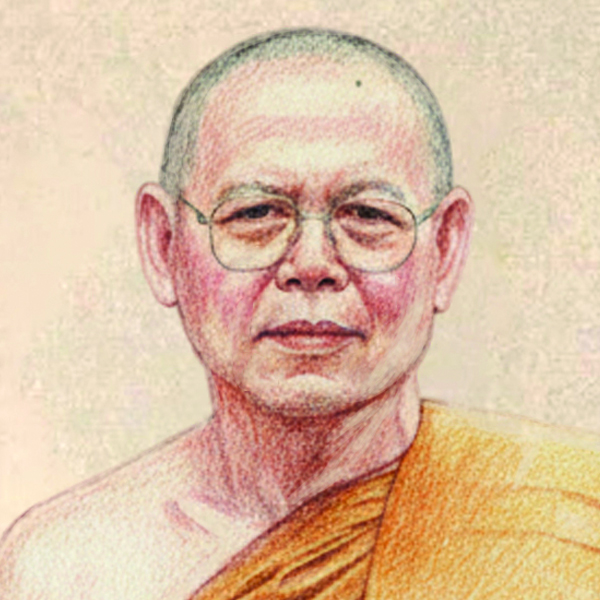
Note from the Translator
I am simply a practitioner who wishes only to preserve the teachings of Thailand’s noble monks. I have chosen a literal translation so that international readers receive the same essence and full content of every sentence as Thai readers do, without summarizing or adding personal interpretations. Regardless of whether the doctrines herein are "right" or "wrong" in your view, I kindly ask you to use your own wisdom and judgment to reflect upon them.
If you have any suggestions or find any errors where the translation does not match the original Thai text, please let me know. I would be most grateful for your feedback and will update the text to be as accurate as possible. Thank you.
A Spanish version of this article is available here: ESPAÑOL
If there is no Mindfulness, no Dhamma as a dwelling place, one will not find happiness. One struggles and scrambles. I would like to compare it to a mangy dog seeking happiness. There is no opportunity for it to find a place that does not itch. Because the itch has a cause; the itch is not in the location. It itches at the mange. The mind is just the same!!
Today, let us come together to listen to and reflect upon the Dhamma of Ajahn Baen Dhanakaro, a noble monk of Wat Doi Dhammachedi, Sakon Nakhon Province.
Inner Silence
Listening externally, it is completely silent. Listening internally, there is only the mind alone. Listening internally, there are only Fabrications (Saṅkhāra) alone. They fabricate endlessly without stopping. When all Fabrications extinguish, all concocting and fabricating extinguishes, the Origin (Samudaya) extinguishes, and all Suffering (Dukkha) extinguishes along with it. Concocting and fabricating is just concocting and fabricating. Fabrications are just Fabrications. Fabrications are things that arise and cease. Concocting and fabricating is not us. When all Fabrications extinguish, one dwells in happiness. Let one relinquish those Fabrications, because if one goes and clings to them, there is no benefit whatsoever.
All Fabrications are like foam. All Fabrications are like a mirage. Going and clinging to foam, going and clinging to a mirage, yields no benefit whatsoever. A mirage exists regularly. Foam also exists regularly. They are not absent from the world. Even the Buddha did not teach a method to go and forbid a mirage from arising, to forbid foam from arising. He merely taught that a mirage is simply a mirage. Foam is simply foam. There is no essence, substance, or self whatsoever. Yet, having gone and clung to them, one creates problems for oneself. Relinquish Fabrications. Relinquish all problems. When Fabrications can be relinquished, all problems slip away from the mind, and one dwells in happiness.
Listening externally, is there any sound? There is none. It is completely silent. Listening internally, the eyes are silent on their own. The ears are silent on their own. The nose is just a nose like this. The tongue is just a tongue like this. The body... looking anywhere, there is no confusion or turmoil to be found. Every hair of the head, since birth, stays in its old place. The hair of the body is the same. One does not see them wanting anything. One does not see them losing anything. Nails are just nails like this. They have been nails since they came to be nails. Up to right now, they are nails just the same. Whoever will cut, whoever will trim them, the nails know nothing of it. The nails do not care. Teeth are just teeth like this. They stay in their place just like that. One does not see any confusion, moving residence, moving back and forth. Even if there is swaying, loosening, detaching, falling out, or dropping, when swaying, they sway in place. Wherever they fall out, there they stay.
The mind... come to look into the mind. The mind... looking into it means knowing. When our mind is at ease, our mind knows. When our mind is not at ease, our mind knows. Suffering, it knows. Happiness, it knows. When the mind is calm, it knows it is calm. When the mind is not calm, it knows the mind is not calm. Let one keep looking at that knowing mind. Let Mindfulness (Sati) be resolute and unwavering, staying at a single point, which is the knowing that exists within us. Do not go to the left. Do not go to the right. One cannot get lost in stories. One cannot think in stories. It arises, it arises right here at the mind. All Fabrications, which are thoughts, arise at the mind. All Fabrications... when ceasing, they cease right here at this mind. Dwelling with the mind, dwelling with knowing, one sees the ripples. One sees Fabrications as they stir. If one is not resolute with one's mind, when Fabrications stir, one does not know. When Fabrications concoct and fabricate, one does not know, does not see. If one only knows when the products of Fabrications have appeared as self, as an entity, as Suffering, as happiness, as Defilements (Kilesa), Craving (Taṇhā), and Lust (Rāga)—that is the product of Fabrications resulting from one's mind lacking Mindfulness firmly attached to the mind.
Fire of Clinging
When our mind has Mindfulness firmly attached to the mind, Fabrications have no opportunity to play a role. When Fabrications begin to act, which is called stirring up, we know immediately. We know immediately. We know immediately. Knowing in whichever moment, being aware in time in whichever moment, the Fabrications that begin to stir cease in that very moment. The Fabrications that begin to stir and form up, cease. The products of Fabrications that build confusion and turmoil, build houses, build cities, build worlds, create worlds, create the Round of rebirth (Saṃsāra), create confusion and turmoil, have no opportunity to... be created into a product. Our mind fathoms into deeper and deeper peace. Our mind fathoms into the mind, firmly attached to that mind, relying on Mindfulness as the foundation for control and direction.
Therefore, it is said: Of these Pacification (Tesaṃ-Vūpasamo), the pacification of Fabrications. When all Fabrications are pacified, one dwells in happiness. Thus, seeking happiness does not require seeking far away, like worldly people do. Worldly people seeking happiness is simply seeking Suffering itself. Seeking wealth is Suffering because of wealth. Getting it is Suffering. Not getting it is Suffering. Seeking is Suffering. Getting status, seeking is Suffering. Getting it is Suffering. Not getting it is Suffering. Seeking silver, seeking gold, seeking is Suffering. Having acquired it is Suffering. Not having acquired it is Suffering. Seeking children, seeking wives. Seeking children, seeking husbands. Having acquired them is like being burned by fire, fire burning a person. Tossing and turning, burning hotly like that in matters of husbands and matters of wives.
The matter of seeking by the hungry mind is simply seeking firewood and seeking fire to burn oneself. Because being lost in concocting and fabricating, being lost in Fabrications alone, is the cause. Therefore, the term Discernment (Paññā) is given to know Fabrications, to know all around the heap of Fabrications, which is simply this heap of the mind, this heart of ours. Because when Fabrications arise, they arise at the mind. When they cease, they cease at the mind. Arising, they arise at the mind. Ceasing, they cease at the mind. Without the mind, Fabrications cannot arise. Without the mind, how could Fabrications arise? They cannot arise from a tree stump, because how could a tree stump think or concoct anything? Going to plant them to become Fabrications would not successfully turn them into Fabrications. For them to arise in the earth, taking Fabrications to plant in the earth, they cannot be planted. Fabrications do not need to be planted. When there is no Mindfulness, when the mind has no Mindfulness, Fabrications will arise on their own. Wherever they arise, it is like fire arising right there.
The Buddha therefore taught to know, and then to relinquish those Fabrications. Being freed from Suffering is simply being freed from Defilements and Craving itself. This Suffering, mostly, is Suffering because of losing belongings. Suffering because of separation. Suffering because of... wanting and not being fulfilled. Suffering because of those things. Suffering because of those people, until it becomes so abundant like this. But in truth, Suffering is because... of not keeping pace with the concocting and fabricating. Not keeping pace with the Fabrications that are the bringers of firewood and fire, the incubators of the fuel, which is the firewood and fire. It is Suffering because of this. Suffering because of Defilements and Craving. Defilements and Craving also arise from concocting and fabricating. These very Fabrications are the cause. It is Suffering because of this. When this is no longer present, getting is not Suffering. Losing is not Suffering. Having nothing is not Suffering. Having anything is not Suffering. Because for the things one has, having wealth does not cause Suffering. Having no wealth or the decline of wealth does not cause Suffering. Having status does not cause Suffering. The loss of status is not Suffering. Because the base factor that causes Suffering to arise has already been extinguished.
Therefore, let one examine extensively. Where is the confusion, the turmoil, the restlessness? Solve it right at that confusion, turmoil, and restlessness. There are diverse methods to solve it. Solve it with reason and results. Bring up the truth to make the restlessness accept it, to make the mind accept it. When the mind accepts it, the mind becomes calm. Without needing any reasons or results, one focuses Mindfulness right down onto that restlessness. One focuses Mindfulness firmly down onto that point of restlessness. Where is the restlessness? The mind is restless. The mind is not restless. There is only the mind alone. It knows how to be restless. It knows how not to be restless. At the moment it is restless, focus right down there. Have Mindfulness firmly established at the mind alone, because the mind alone is the one that can be restless. Have Mindfulness be steadfast. Do not let the concocting factor concoct anything up. Do not let the thinking factor think anything up. Merely looking, use the mind to look. Merely listening, use the mind to listen. Keep Mindfulness established. Do not allow thinking or concocting. Thinking and concocting is the matter of Fabrications. Here, force it like that.
Mind as a Tool
When forcing it not to concoct, not to think, let there be knowing and seeing the mind just like that. When the mind does not concoct, the mind does not think, then where will the restlessness come from? The concocting and fabricating factors, when they do not concoct and do not fabricate, then what will be brought up to be restless? The mind is just the mind like this. The mind is not restless. Restlessness is a matter of Defilements entirely; it is not the mind that is restless. Defilements are just Defilements like this. Restlessness is just restlessness like this. Even when the Buddha attained awakening, the world was still not entirely devoid of restlessness. Fabrications are still Fabrications just like that. But the Buddha did not cling to Fabrications. They were simply Fabrications. And he was able to use those Fabrications as a benefit in proclaiming the religion.
The Buddha used those Fabrications. He used the mind, the thinking factor, the moving factor, indeed... to be the worker in proclaiming the religion. But working, he did not work within a frame. Within what frame? Within the frame of righteousness, the frame of legitimacy, the frame of purity and justice. Within the mind of the Buddha, he used Fabrications to proclaim the religion. He used Fabrications as a means of communication.
Do not go crazy, clinging to Fabrications as a self, as an entity. If one goes and clings to Fabrications as a self, as an entity, then one is a crazy person. Crazy over one's own saliva (Translator's Note: "Crazy over one's own saliva" translates the Thai idiom "baa nam-laai", which literally means going crazy over saliva, but idiomatically refers to talking nonsense endlessly. In this Dhamma context, it refers to being deluded by and obsessing over one's own endless, nonsensical mental chatter or fabrications). Mindfulness is necessary at every level, at every stage. The more the practice progresses, the more Mindfulness becomes necessary, and Mindfulness progresses equal to the progress of the practice of that Dhamma. If Mindfulness does not step forward, it means the regression of that practice. The mind begins to regress. Endeavor to train Mindfulness, Mindfulness. Walking, have Mindfulness. Sitting, have Mindfulness. Sleeping, have Mindfulness. However one moves, have Mindfulness. Eating and excreting, have Mindfulness. Speaking and conversing, have Mindfulness. Associating with anyone, have Mindfulness. Thinking and pondering anything, have Mindfulness. If thinking and pondering lacks Mindfulness, the outcome will only destroy oneself. Where will one go to find it, finding peace? Because wherever one goes, one carries the factor of non-peace along. Wherever one goes, one carries the factor of non-peace along. Wherever one stays, one carries the non-peace along. Then how will one ever find peace? It is like sitting and clutching fire. Clutching fire in one's fist, refusing to let go. Then how could it not be hot? Staying at the monastery is hot. Going out to the forest is hot. Going anywhere is hot. It is hot because of the refusal to let go of the fire grasped in one's hand.
In this world, there is nothing hot. Look truly at it. Summarized down into the world: earth, water, wind, fire. Has one ever seen the earth be hot? Has one ever seen the water be hot? Even if the water is boiling, no matter; the water never says it is hot. Wind, fire. Fire... no matter how intensely it blazes, no matter how many degrees the heat can be measured at, that heat never burns itself. And it never says it is hot. Everything is nature in its own way. Everything is normal in its own way. Our mind is the same. Letting it be nature in its own way is dwelling in happiness. The eye is hot. Form (Rūpa) is hot. It is hot because of contact, and then the arising of liking and disliking; therefore, it is hot. Form is just form. The eye is just the eye. The ear is just the ear. Sound just remains as sound. Here! When they do not make contact, then how could it arise into firewood and fire? Even if there is contact, if there is Mindfulness knowing, Form is simply Form. The ear is simply the ear. It is merely that there is contact, nothing more. They do not generate any heat. In the Fire Exposition Discourse (Ādittapariyāya Sutta), it is expounded that the ear is hot, the eye is hot, form is hot, sound is hot, the nose is hot, odor is hot, the tongue is hot, flavor is hot. They are hot because of clinging to the contact as self, as an entity. The things contacted as self, as an entity. They are hot because of clinging to Fabrications, the concocting and fabricating factors arising from that contact, as us, as them, as the mind, the heart, as self, as an entity. It burns up right then.
Shadows of Mind
Having Dhamma as a dwelling place, one dwells in happiness. Having Mindfulness as a Dhamma dwelling place, one dwells in happiness. Having peace as a dwelling place, one dwells in happiness. If there is no Mindfulness, no Dhamma as a dwelling place, one will not find happiness. One struggles and scrambles. I would like to compare it to a mangy dog seeking happiness. There is no opportunity for it to find a place that does not itch. Because the itch has a cause; the itch is not in the location. It itches at the mange. The mind is just the same!!
Strip away the term Form. The disease of good and the disease of evil, the disease of Suffering and the disease of happiness, the disease of love and the disease of hate; strip them away. Dwell in happiness, fitting with what we all earnestly desire. If one still only pounces on shadows, it will be like the dog carrying meat in its mouth walking on a bridge. Seeing the shadow of the meat in the water, it does not think that the shadow is the very meat it is holding in its mouth. Forgetting itself, it opens its mouth. "Woof, woof," threatening the dog that is carrying the meat, which is the shadow. That meat in its mouth drops away. How did the outcome turn out? There! Pouncing on shadows is like that. That is, catching only thin air, getting only what is nothing. And then going to pounce further, pouncing further on. Where will the shadows run out? Wherever one is, there are shadows. Wherever one sits, there are shadows. Sleeping, there are still shadows. Whichever way one thinks, whichever way one thinks, it is entirely all shadows. And continuing to pounce only on shadows, what will one get?
Do not pounce. Stop and cease pouncing. Mindfulness, Mindfulness, Mindfulness. Stop, cease. Stop, cease. Do not think. Do not concoct. Do not fabricate. Do not think. Do not concoct. Do not fabricate. Do not think. Do not concoct. Do not fabricate. Dwell with the mind that is endowed with Mindfulness. Do not let it dart away. Do not let it wander off. Do not let it shift and move. The mind is the mind. The world is the world. Dhamma is Dhamma. Each stays to itself. Even when they come to associate with each other, having Mindfulness-Dhamma as the governing Dhamma does not cause confusion to arise. It is like an electrician. They are able to take electricity and use it for benefit without it being a danger. If a person is not an electrician, before the electricity becomes a benefit, having no knowledge about electricity, they will try to take the electricity to be of benefit, and the electricity will shock them. Danger arises from that electricity.
Things in this world all have benefits. Having Mindfulness in taking them to use, one only gains benefit exclusively. Lacking Mindfulness, lacking sufficient cleverness, things in the world are entirely a danger. Having eyes, our eyes are a danger to us. Having ears, ears are also a danger. Even though these things are entirely things of value, things of virtue, but they turn into things that are dangerous because of what? Because the mind lacks Dhamma. Because the mind lacks Mindfulness. The mind having Mindfulness, the mind having Dhamma, are entirely of benefit. Training the mind to have Mindfulness: the mind having Mindfulness is the mind having Dhamma. Mindfulness encompassing Concentration (Samādhi) is not wrong. To say it is Virtue (Sīla) is not wrong. To say it is Discernment is not wrong. It is gathered in the single word: Mindfulness. Lacking Mindfulness, how could Virtue exist? What would be taken as the Dhamma of restraint? Lacking Mindfulness, how could Concentration be resolute and unwavering? Lacking Mindfulness, how could Discernment be profound and sharp? There would be no Discernment; how could Discernment arise? Therefore, it is said Dhamma is Mindfulness. Cultivate it to the utmost. Cultivate it to the utmost. Cultivate it to the utmost in every moment. Sitting, it can be done. Sleeping, it can be done. It can be cultivated in all of them. Standing, it can be done. Eating, excreting, being in any posture whatsoever, cultivate Mindfulness to arise and come to be in absolutely every moment.
Timeless Peace
Therefore, it is said to be Timeless (Akāliko). At all times, in all places, being in whatever situation or event, having Mindfulness to recollect, having Mindfulness to restrain. It is the adornment of the Contemplative (Samaṇa). It is the constituent of an ordained person. A Contemplative, an ordained person, lacking Mindfulness cannot find any beauty. Hair of the head (Kesā), Hair of the body (Lomā), Nails (Nakhā), Teeth (Dantā), Skin (Taco) are dwelling places. Hair of the head is hair of the head. Cut, it is hair of the head. Shaved, it is hair of the head. Left anywhere, it is hair of the head. Uncut, unshaven, it is hair of the head. Hair of the body is the same. Uncut, unshaven, it is hair of the body. Even if cut, shaven, slipping out, or falling away, it is hair of the body. Nails are the same. Teeth are the same. Skin is the same. Peeled off, flaked off, it is skin. Remaining on the body, it is skin. Flesh is the same. Remaining on the body, it is flesh. Even if taken out anywhere, placed anywhere, it is flesh. Which strand of hair of the head, which strand of hair of the body, which nail, which tooth: they do not know what they are. Each of them does not have any Defilements or Craving whatsoever. Bones, small pieces or large pieces, liver, kidneys, intestines, stomach: they do not know what they are at all.
Here!! Therefore, it is said that having Mindfulness, Discernment is present, Discernment arises. Without Mindfulness alone, Concentration is absent, it cannot arise. And then how could Discernment arise profoundly? There is no need to go looking anywhere to find Dhamma. Mindfulness-Dhamma does not need to be looked for. It is ready to arise. It is ready to arise immediately at the moment we perform that action. Concentration-Dhamma also does not need to be looked for anywhere. It is ready to arise from our actions. Discernment-Dhamma is just the same. It does not need to be looked for anywhere. It is ready to arise. If the reasoning and causes that will make it arise are sufficient, Discernment is ready to arise. Arising from where? Arising from Mindfulness. The Buddha said that all Dhammas arise from Mindfulness alone.
Impermanence (Anicca), Suffering, Not-self (Anattā) do not need to be searched for. Hair of the head, hair of the body, nails, teeth, skin right here: Impermanence, Suffering, Not-self are right here. The physical frame, this entire body is a heap of Impermanence, Suffering, and Not-self. There is no need to go searching for Impermanence, Suffering, and Not-self anywhere else. They are right here. They are with the heap of the Three Characteristics (Tilakkhaṇa). Impermanence, Suffering, Not-self are right here. Dwelling with Impermanence, dwelling with Suffering, dwelling with Not-self, and then not clinging. And then not being lost, not liking, not disliking, in this Impermanence, Suffering, and Not-self. If there is no Mindfulness, this heap of Impermanence, Suffering, and Not-self is a heap of firewood, a heap of fire, burning our mind and the minds of all worldly beings. What is there that will be firewood and fire, burning the minds of worldly beings? There is only this heap of Impermanence, Suffering, and Not-self.
The teachings of the Buddha therefore teach one to know, teach one to contemplate, to know the truth of Impermanence, Suffering, and Not-self. Then all things in the world will not be an enemy. Because all things in the world are simply Impermanence, Suffering, and Not-self itself. Looking at Dhamma, looking at Dhamma, looking at Dhamma, is using the mind to look. Listening to Dhamma, listening to Dhamma, is using the mind to listen. Contemplating Dhamma, contemplating Dhamma, contemplating Dhamma, is using our mind to contemplate the Dhamma that we have present, which is Impermanence, Suffering, Not-self. Heaped from the head down to the feet, from the feet up to the head here, this is the heap of Aggregates (Khandha). Knowing this is called knowing. Knowing this, then one is not lost. Because in this entire world there is no difference whatsoever. Because it is a heap of birth, a heap of aging, a heap of death, a heap of Impermanence, Suffering, Not-self just the same. Not being lost in the heap of Impermanence, Suffering, Not-self that is heaped within us, then which heap would we go get lost in? Seeing a heap of Urine (Mutta), seeing a heap of Feces (Gūtha) like this, we know that this is foul-smelling already. How could we go and think that other heaps of excrement are fragrant? They are heaps of Urine, heaps of Feces just the same. Heaps of Impermanence, Suffering, Not-self just the same. In conclusion, be one who inclines the mind, inclines the heart. Having Mindfulness to incline the heart, having Mindfulness to incline the mind, coming to dwell with our heap. This heap of Suffering, heap of birth, heap of aging, heap of death, this heap of the Noble Truths (Ariyasacca).
This is the principle of practice, the principle of progression to reach the final destination, which is the Path (Magga), Fruition (Phala), and Nibbana (Nibbāna). Do not go jumping over here, jumping over there. Jumping to the left, to the right. Jumping forward, jumping backward. Having Mindfulness knowing constantly, being one who does not jump forward or jump backward. This is the correctness in the principle of practice. Alright, let us finish with just this much.
(Spoken after the teaching)
During this period the weather is beginning to get cool. The weather is cool, gnats and mosquitoes do not disturb. Sitting in Mental development (Bhāvanā) under the trees, sitting in Mental development beside the Walking meditation (Caṅkama) path is good. Having a mat, having a platform, having a raised stand to sit on; sit on the platform, sit on the stand. If there is none, take a mat or something to lay out, fold it in half, and sit comfortably. Sleeping under the shade of a tree is also fine. Sleeping beside the Walking meditation path is fine too. Do not go seeking happiness in sleeping and lying down in comfortable sleeping places and beds. Seeking comfortable sleeping places and beds, that is seeking Suffering. Suffering and happiness do not depend on having a good sleeping place or bed. They depend on the calmness or lack of calmness of the mind. Whatever will be conducive to the calmness of the mind, endeavor at it to the utmost. You will find the happiness that we all desire.