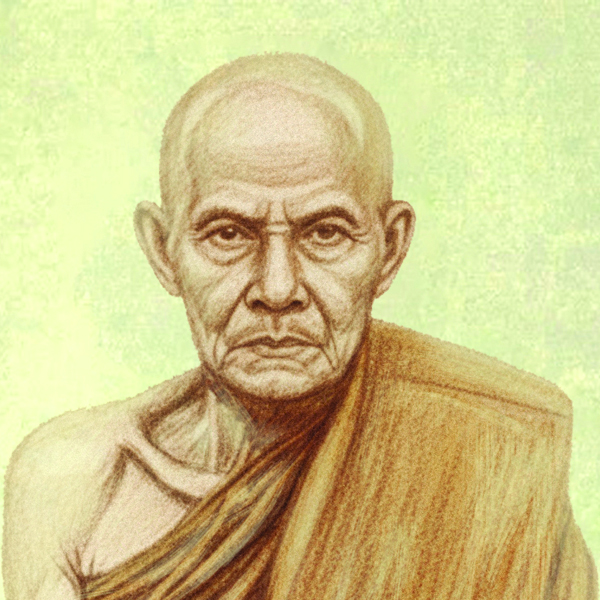
Note from the Translator
I am simply a practitioner who wishes only to preserve the teachings of Thailand’s noble monks. I have chosen a literal translation so that international readers receive the same essence and full content of every sentence as Thai readers do, without summarizing or adding personal interpretations. Regardless of whether the doctrines herein are "right" or "wrong" in your view, I kindly ask you to use your own wisdom and judgment to reflect upon them.
If you have any suggestions or find any errors where the translation does not match the original Thai text, please let me know. I would be most grateful for your feedback and will update the text to be as accurate as possible. Thank you.
A Spanish version of this article is available here: ESPAÑOL
Deliverance from the Aggregates (Khandhavimutti) and the Harmony of Dhamma (Sāmaggidhamma) is a handwritten Dhamma manuscript by Luang Pu Mun Bhūridatto, which he wrote himself while spending the rains retreat at Wat Pathum Wanaram. It is considered the only handwritten Dhamma legacy of his that exists today. It is a highly significant and invaluable document, both in its historical dimension and within Buddhism, as he used ancient poetic language to convey his experiences and Dhamma principles that penetrate the absolute core of liberation.
The content within Khandhavimuttisāmaggidhamma contains Dhamma principles related to Buddhism, especially regarding the practice guidelines of the forest monks in the lineage of Luang Pu Mun Bhūridatto. The term "Khandhavimutti" means deliverance from the Five Aggregates (Pañcakkhandha)—Corporeality (Rūpa), Feeling (Vedanā), Perception (Saññā), Mental Formations (Saṅkhāra), and Consciousness (Viññāṇa)—which is a state liberated from arising and passing away, being the ultimate goal in Buddhism. As for "Sāmaggidhamma," it conveys the oneness of Dhamma or the harmonious readiness of Dhamma. Therefore, Khandhavimuttisāmaggidhamma means the practice of Dhamma to be liberated from the Five Aggregates in a state of absolute oneness, which is a practice focused on mental tranquility and liberation from Suffering (Dukkha).
Disclaimer: In order to preserve the direct and unembellished teachings of the venerable master, our translation has not been composed in a poetic format, opting instead to convey it in a prose format that stays as close as possible to the original meaning in the Thai language.
This work has also been translated in poetic form in 'The Ballad of Liberation from the Khandhas' by Thanissaro Bhikkhu.
Practical interpretation by Ajahn Natee Phuphatham on November 4, 2019.
Ajahn Natee Phuphatham is a 4th-generation disciple in the lineage of the great forest master Luang Pu Mun Bhūridatto. He was trained rigorously as a close student of Luang Pu Baen Thanākaro, a renowned master whom Luang Ta Maha Bua highly praised and regarded as a "pure heart" of the tradition. Ajahn Natee is widely respected for his profound ability to decode the forest masters' experiential teachings into practical guidance for modern practitioners.
(Khandhavimuttisāmaggidhamma)
(Namatthu Sugatassa)
(Pañcadhamma-khandhāni)
I humbly bow to The Fortunate One (Sugata), the Supreme Teacher, the Sakyan Sage, the Fully Enlightened Buddha (Sammāsambuddha), and the Nine Supramundane States (Navalokuttaradhamma), as well as the Noble Disciples (Ariyasāvaka). Now, I shall speak of the Dhamma aggregates in brief, according to my mindfulness and Wisdom (Paññā)...
One
There was one who loved himself and feared suffering,
Seeking happiness and freedom from danger, wandering away.
Wherever told happiness exists, wanting to go,
Yet wandering back and forth for a long time.
His nature being self-loving and deeply fearing death,
Truly desiring to escape aging and death.
One day, realizing the truth, abandoning the cause of suffering, namely conditioned formations,
Thus discovering a cave of joy with endless happiness,
Just like this very body.
Meaning:
There is a person who loves himself, fears suffering, loves happiness, and hates suffering. Therefore, he wanders around seeking only happiness. Yet, no matter how he seeks, he does not find true happiness. Being born and dying, born and dying for many existences and births, he still must be born, age, and die. One day, he comes to know the truth, so he discards the cause of suffering, which are the three formations: Bodily Formation (Kāyasaṅkhāra), Verbal Formation (Vacīsaṅkhāra), and Mental Formation (Cittasaṅkhāra). The cave in this context is the body. Whenever one understands this body clearly, one will find true, enduring happiness.
Two
Peering into the cave of joy, suffering collapses.
Feeling extremely at ease, becoming aware, the fear lessens.
Feigning indifference back and forth in front of others.
Thinking of returning to proclaim it to companions,
Yet fearing they would presume one to be crazy.
Better to stay alone, seeking means of peace.
Thus ending the thoughts, continuing no further.
Better than wandering intrusively, flattering others.
Soon being praised and blamed, becoming a source of annoyance.
Meaning:
Contemplate and focus the mind to see into the body. The cave that Luang Pu Mun speaks of—one must see clearly that, in truth, there is nothing that is "us" at all. When death comes, it is merely the body that dies. The fear that fears death no longer exists, because... within this body, it is merely like a cave. This body is a temporary dwelling place. It is as if we come to play in this cave temporarily. There is no real significance or any true happiness in it. Do not go and cling to it. The matter of attaining this kind of knowing and seeing is a matter strictly for the individual. If one goes to tell others how good it is, if they do not practice to know and see for themselves, no one will understand. Turning to make the mind tranquil and firmly established is better than wandering restlessly seeking suffering, receiving only praise, gossip, the good, and the bad brought upon oneself.
Three
There was yet another man,
Fearing death, completely disheartened,
Approaching and speaking directly, pitiably,
Asking, "Having persevered for a long time,
Has the true Dhamma hoped for by the heart been seen yet?"
Ah! Why knowing my mind?
That man also wanting to stay and reside.
Saying, "Good, good, I rejoice in it,"
Offering to show the great mountain, the cave of joy without suffering,
Namely... the meditation on mindfulness of the body.
Gazing leisurely to cool the heart, ending the distress.
The traveling path of the Noble Lineage, whether going or not, coercing no one.
Not deceiving, telling the truth exactly as it is.
Meaning:
A question arises within oneself: Are we still afraid of death? Because one has practiced Mental Development (Bhāvanā) for a long time, what will be the Dhamma for liberation? One must let the mind contemplate the body and the interior of the body, which is Mindfulness of the Body. Let the mind contemplate thoroughly until the mind is tranquil and steadfast. This is the starting path for escaping suffering in the Cycle of Existence (Vaṭṭa) and the Round of Rebirth (Saṃsāra).
Four
Then posing a riddle, challenging for an answer.
The riddle being, "What is Ra-weung?"
Answering, "Fast running," meaning consciousness with its swift movements.
Walking in a row, following the line.
Perception being direct, without doubt.
The mind being within, running back and forth.
Perception clinging externally, deceiving the mind.
Causing restless thoughts, wandering and searching.
Deceiving as various dhammas, like an illusion (Māyā).
Meaning:
Within this entire body, the mind also has a specific manifestation, called consciousness—which is a functional state of the mind. It has the duty to acknowledge what arises in the body and mind. It perceives rapidly in forms, sounds, smells, tastes, bodily touches, and mental touches. When that consciousness has performed its duty of perception, there is still the perception aggregate—the memory in that perception. It causes delusion to arise and cling, due to illusion, which is Conventional Truth (Sammuti) itself. Deluding one into thinking that it is real, that it is the truth, causing a feeling of wanting to seek it out, giving rise to Defilements (Kilesa).
Five
Asking, "Who escapes all the Five Aggregates?"
Answering, "The mind alone escapes,"
Not clinging, entangled, or attached, ending the poison of possessiveness.
Ceasing all delusion, remaining singular.
Deceptive perception unable to lead one into delusion.
Meaning:
Without meditation until seen clearly through the heart, there is no way to be liberated. To ask who will be the one to escape from the body and mind—from Form, Feeling, Perception, Mental Formations, and Consciousness—the one who can escape is only this mind (citta). The mind, the "One Who Knows," stands out in singular awareness, without attachment, identification, or clinging. It does not get lost in bodily states or mental states, such as memory or recognition—the perception that deceives us into clinging to this body as a self (attā) or as belonging to us. In truth, the body exists separately from the mind.
Six
Asking, "Regarding death, who dies and where?"
Answering, "Conditioned formations die, destroying the effects."
Meaning:
What is said to die? It is the body that dies and disintegrates. What dies... is only the body. As for mental formations (citta-saṅkhāra)—the fabricator, the one who remembers and identifies, the act of concocting—even the "knower" that claims to know is also a formation that judges things as being this or that, liked or disliked, acting as both the clinger and the releaser. If these are extinguished and destroyed, it is the end... an exit from the realms of existence (bhava).
Seven
Asking, "What builds and continues the cycle?"
Answering, "The trickery of perception leads to the cycle."
Believing perception, thus mistakenly taking delight.
Leaving this realm for another, wandering to and fro.
Thus forgetting the mind, memory sealing it off seamlessly.
Even with effort to find Dhamma, seeing nothing.
Meaning:
What causes the building of existence and birth (bhava-jāti), leading to the cycle of birth and death? Remembering, then clinging to this body as this or that, as "us". Deluded by various memories in both the form side, the body, and the mentality (nāma) side, the mind. Identifications with emotions arising from contact (phassa) and received through consciousness. Perception, the act of remembering, triggers attachment, causing one to forget the mind. Getting lost in mental symptoms—the act of recognizing and remembering—which are not the mind itself, but merely its manifestations. Persisting in these symptoms, the truth will never be found; the Dhamma will not be seen, nor will there be liberation from these states, due to the misconception that those symptoms are the mind or the self.
Eight
Asking, "Who defines, who labels as Dhamma?"
Answering, "The mind defines, the mind labels, seeking that very perception."
Deeming good, grasping evil, pushing, attached, love, hate.
Meaning:
What is the one that knows and sees, the mindfulness (sati) that perceives what is Dhamma? Everything that goes out to meet perceptions and emotions is this very mind of ours. It is the mind that goes out to cling to emotions, manifesting in various states: remembering, good and evil, clinging, releasing, and being stuck in love and hate.
Nine
Asking, "Eating once, without wandering to eat?"
Answering, "Ending the desire to see, knowing without expectation."
No more clutter in further seeing, the mind sits firmly, discarding attachment.
Meaning:
The mind attains knowledge and vision (ñāṇadassana), develops disenchantment (nibbidā) and fulfillment, then all doubts (vicikicchā) cease. Knowing all and finishing with what is known and seen—this body and mind—finding peace (santi), stability, and equanimity (upekkhā).
Ten
Asking, "A square pond brimming with water?"
Answering, "Dhamma ending desire, free from doubt."
Clean, void of defilement, without danger.
Perception therein is severed.
Formations do not disturb.
The mind is thus fully brimming, never lacking.
Quietly stilled, the mind thinks no more.
Worthy of delight every night and day.
Even gaining divine treasures by the millions,
Is not like knowing truly and discarding formations.
Ending desire is the most vital matter.
Memory stays in its part, not overstepping.
The mind takes no delight at all, ceasing the struggle.
Meaning:
The Four Noble Truths (ariya-sacca) lead to seeing clearly, ending doubt, delusion (moha), defilements, suffering, and the cycle of rebirth. It extinguishes perception—the identification with conventional reality and painful feelings. It also extinguishes formations—the act of using memory to concoct thoughts or reacting to external sensory contact (sights, sounds, smells, tastes, touches, and mental objects). The phrase "Perception therein is severed, formations do not disturb" means perception and formations are detached from each other. Thus, fabrication based on conventional memory ceases. When mental formations or concocting thoughts are extinguished, memory remains merely as ordinary memory; one remembers normally but without deluded clinging (upādāna). Consequently, there is no craving
(taṇhā) or attachment, leading to the end of all desire and clinging.
Eleven
Like a mirror reflecting the face.
Cling not to perception, for it is like a shadow.
Be not intoxicated by the workings of formations.
Meaning:
Both formations — thoughts and ponderings— and perception — memory and recognition— are merely symptoms (ākāra) of the mind. They possess the characteristics of a shadow in a mirror, originating from the heart. They shift and change, not being the true essence of the mind; they are merely reflections in a mirror. Whenever mindfulness is lacking, one becomes deluded by those symptoms, misunderstanding them as one and the same until awareness is lost. However, with mindful awareness, one knows they are just symptoms, distinct from the actual heart and mind.
Twelve
Flickering subtly, catching the mind that is unmixed.
Vibrating in its own part, knowing surely through its changes.
Meaning:
Focus on the knowing heart or the one who goes to know. Do not follow symptoms; do not mix them. To speak more clearly: Let know, stay at knowing. Know that what changes and vibrates is a symptom of the heart and mind. Do not be deluded into pleasure or displeasure (abhijjhā-domanassa).
Thirteen
Mind's impermanence being its own, no need for words.
Knowing the various five aggregates as the mind stirs.
Formerly deluded by perception as the heart.
Meaning:
Know and keep up with these symptoms. The five aggregates (khandha-pañcaka) consist of the form side, which is the body, and the heart side: feeling, perception, formations, and consciousness. They constantly shift and change according to causes and conditions. In these five aggregates, the inherent state is: the body (kāya), our physical form, is suffering because it is impermanence (anicca), fluctuating between good and bad until the day of disintegration. Feeling is the sensation arising towards the body—pleasure, pain, or neither. Perception is memory and recognition. Formation is thinking—knowing knowing how to think, to ideate, to reflect, to contemplate, and to concoct. Consciousness is the awareness of everything occurring in both the body and the heart. All these are merely symptoms that arise and change according to states,
causes, and conditions.
Fourteen
Perceiving inside and outside, thus deceiving.
Meaning:
Clinging only to the body is suffering. Clinging only to the internal, as the mind or self, is suffering. Not clinging to what is external (bahiddhā); not clinging to what is internal (ajjhatta). Having neutral mindfulness. If the body moves, knowing the body. If the body suffers, knowing suffering. If the body is happy, knowing happiness (sukha). If the heart suffers, knowing suffering. If the heart is happy, knowing happiness. Seeing with mindfulness, the mind that knows it knows, seeing arising and falling (udayabbaya) with neutral mindfulness. No need to try extinguishing anything, that is good or this is bad; just knowing normally. Soon seeing that even what arises, both happiness and suffering, is not certain. Because perception, the act of remembering, is a state of mind, not wrong or right, not outside
or inside, but Dhamma that must eventually disintegrate. When the heart knows neutrally until proficient, it will see the true truth: its true nature is arising and falling within these symptoms of the mind. Not interpreting or becoming deluded into thinking of blocking external contact... sights, sounds, smells, tastes, touches, mental objects, and feelings arising in the heart. Or forcing and suppressing the mind to have no thoughts at all, having nothing in the mind, even memory. To do so shows perceiving it as "us". It is a neutral thing according to its state, not evil. But it is our clinging and fabricating according to pleasure and displeasure because of our own delusion. Deluded by the symptoms of the mind and body. Deluded by the shadow in the mirror because of not staying at the knowing heart. Being deluded in this way. This is the Path (magga), the method of meditating with a neutral heart to see the truth
(sacca-dhamma). These Dhammas can be found in the five aggregates (khandha). All this answers the stated point.
Fifteen
This time the mind is supreme, seeking no reliance.
Not clinging to any one perception, nor any perception at all.
Arising or passing away, all things,
No need to possess, no need to block the group of perceptions.
Meaning:
When training until the mind is neutral, having self-knowledge that nothing is a self (anattā) or belongs to us. Being merely awareness, then remembered and thought of, as arising and passing away. Clinging and being possessive that "this is that" or "that is this"—which truly does not exist. What can arise also passes away according to its state. Because of having the mind as the anchor, having the mind as the supreme anchor. Not being deluded by symptoms, the group of perceptions, memory, or clinging to thoughts and various emotions (dhamma-ārammaṇa). It is not us at all.
Sixteen
Like ascending a truly high peak, seeing the earth.
Seeing all living beings.
Exceedingly high, seeing one's own story from the beginning.
All being the Path, just like a ladder.
Meaning:
The highest things are the matters within one's own body and heart. Birth (jāti), aging (jarā), sickness (vyādhi), and death (maraṇa)—the Four Noble Truths. This is the practice, something that must be climbed like a ladder. When the heart is high, as if standing on a high place—meaning having high mindfulness and wisdom—one will see everything arising and passing away, rotating and changing; not "us".
Seventeen
Asking, "Is the rising and falling of water the Truth?"
Answering, "Formations change, unalterable."
Naturally, Kamma shapes it, not out of spite.
Persisting in repelling or clinging, the mind turns tarnished and evil.
Meaning:
Asking, "Does impermanence, the Three Marks of Existence (tilakkhana), arise within the Four Noble Truths ? Formations arise because of Kamma (kamma)— accumulated actions— resulting in the necessity of birth. Whether accepting or rejecting, it is perpetually suffering.
Eighteen
No need to think against nature, the state of true reality.
Good or evil according to their own course, freeing only the self.
No entanglement with formations, being coolness.
Meaning:
Do not try to think of it as good or evil, or try to modify it, because it is an uncertain state, unpredictable. Sometimes good, sometimes bad; sometimes happy, sometimes suffering. But it is only the body (rūpa-kāya). Do not cling to have it as desired or entangle the heart with it. Then the heart will be light and peacefully cool.
Nineteen
Knowing truly, must discard fluctuating formations upon seeing.
Dispassionate then releasing fluently, without forcing.
Dhamma is cool, the mind stilled, receiving symptoms.
Meaning:
Whenever seeing that this body, these five aggregates, are unstable and fluctuating, one must establish mindfulness according to the truth of impermanence. When there is happiness, know it is uncertain. When there is suffering, know it is suffering and impermanent. Do this frequently until dispassion arises. Once truly dispassionate, letting go happens, without clinging. The mind will have only stillness and peace, knowing that it is merely a symptom of formations or the body.
Twenty
Asking, "Are the five duties complete together?"
Answering, "Aggregates are distributed, split into five bases of formations."
Each group takes its duty, having its own functions.
Unable to take other tasks, complete within itself.
Meaning:
Do the five aggregates (pañca-khandha) have complete duties? The aggregates are separated into five groups or five bases (ṭhāna). Each group has its own specific duty (kicca). There are no other duties possible for each respective base.
Twenty-One
Even gain, rank, praise, and prosperity,
Blame, suffering, loss of rank, loss of gain throughout,
Merging according to the state, according to truth.
Meaning:
The Eight Worldly Conditions (lokadhamma-aṭṭha): gain (lābha), rank (yasa), praise (pasaṃsā), prosperity, and happiness. Ultimately, these things must decay and disintegrate. They all converge at the point of cessation and disintegration.
Twenty-Two
From all eight, the mind does not turn to entangle.
For the form aggregate produces illness, without exception.
Never resting for long, like a mechanical engine.
Due to receiving the results of karma performed.
Meaning:
Must escape from clinging to these eight worldly conditions. No matter how much one clings to them, aging, sickness, and death remain inescapable. Birth, aging, sickness, and death occur repeatedly, like an engine that never stops. Dying and being born again according to the power of karma which accumulates, causing this cycle of wandering through birth and death.
Twenty-Three
Good matters lead to delight, gladdening the heart.
Evil matters agitate, the mind restless, thinking without end.
Like a fire ignited, the mind dull, not clear.
Conceiving by oneself, both love and anger, whom to blame?
Meaning:
It follows Kamma as the heart thinks and fabricates all by itself. Deluded and delighted by things that bring happiness, we revel in them. When disappointed or facing unpleasant matters, we suffer. Loving happiness and hating suffering. One cannot blame anyone because it arises from Kamma— one's own actions of being deluded by happiness and suffering. Because of delighting in and being deluded by the symptoms of the mind and body.
Twenty-Four
Wanting not to age, not to die, is it possible for man?
Being beyond capacity to ever enjoy.
Like not wanting the mind to wander, think, and know.
Wanting it to stay as one, hoping to rely on stillness.
The mind is ever-changing, not certain at all.
Perception stays for a while, only occasionally.
Meaning:
Aging and death are inescapable. One cannot force the mind not to think or know, or force it to be only still and not perceive anything. The mind is non-self and cannot be coerced. It is uncertain. We must know its symptoms and see the truth in these mental symptoms instead. Even perception, the memory of the mind, lasts for varying durations; sometimes remembering, sometimes forgetting, also uncertain. Perception comes from the mind and is one of its symptoms with the specific duty of remembering various emotions.
Twenty-Five
If knowing as nature, all five aggregates,
That mind is pure, free from stains, ending the story.
Knowing like this is truly excellent,
For seeing truly, uprooted and detached at the end of the way.
Meaning:
Be aware and understand these five aggregates, seeing how natural their course is. Do not be deluded by good or evil, happiness or suffering regarding them. The mind will be peaceful, pure, and not gloomy.
Twenty-Six
No resisting nature, as it truly is.
Poor or wealthy, according to the matter of things inside and out.
Good or evil must extinguish, fading away.
Clinging to nothing as desired.
Meaning:
Cannot force the natural law—the state of the Three Marks of Existence—to not exist.
Twenty-Seven
Mind's impermanence being its own, flickering.
Observing and catching it, knowing with great ease.
Small obscures large, knowing not in time.
Aggregates completely hide Dhamma, the error here.
Obsessed with aggregates, Dhamma unseen, turning to dust.
Dhamma being greater than aggregates, yet not looking.
Meaning:
Namely, the Truth and the Four Noble Truths, which is suffering. The heart is something that vibrates and changes, having states of arising and passing away. Observing with stable mindfulness is just like a hair obscuring a mountain. Most of what we know is just the symptoms. The five aggregates prevent seeing their true nature, so wisdom does not arise. One must see where they arise for the knowing: the mind, and where they fall for the knowing. Where they arise, know they arise; where they fall, know they fall. Once they fall, who is it that knows again? What remains after falling? This is the knowing mind (citta-phū-rū) which is very important. Must see until wisdom arises. That knower is still a formation and is still ignorance (avijjā)— causing us to be deluded in knowing this or that, prone to slipping away. But then failing to see Dhamma, meaning the Three Marks,
because of being deluded by emotions (ārammaṇa) and deluded by a clinging type of knowing. Practicing to know the Three Marks, yet still clinging, not letting go.
Twenty-Eight
Asking, "Having... not having, not having... having, what is this?"
Completely stuck now, unable to solve it.
Please clarify clearly, both essence and meaning; please solve this.
Arising means having various things, through cause and reason.
Then extinguishing is not having clearly, neither being nor person.
This is the first point: "having then not having," exactly like this.
The final point: "not having then having," this is Dhamma.
Profoundly deep, across the three realms, ending the purpose.
No formations, yet having the stable Dhamma.
Meaning:
"Not having" means everything arises solely from causes (hetu), and everything naturally extinguishes without remainder according to those causes. Both in humans and animals, once born, they must die. Humans and animals can arise because there are causal factors (hetu-paccaya) fabricating and relying on one another; thus, arising occurs. Nothing is a self that arises alone without relying on other things. To exist, it still requires other components to be assembled to allow existence, but all are merely temporary. Nothing can arise by itself alone or exist by itself alone.
Twenty-Nine
That indeed is the singular Dhamma of true seclusion.
Dhamma being one, unalterable, supreme in the realm, most peaceful.
Being the object of the heart, unwavering.
Stilled, quiet, and secluded, clear to the heart.
Meaning:
Everything that extinguishes without remainder is entirely without self. Nothing remains; arising and disintegrating, both physical phenomena (rūpa-dhamma) and mental phenomena (nāma-dhamma), nothing remains. But what exists is the Truth (sacca), the Emptiness, Voidness (suññatā), and this Dhamma of Truth which is non-dual, a singular unity, and can never be otherwise.
Thirty
Mind recovers from intoxication, feverishness subsides.
Craving uprooted, all doubts dispelled.
Entanglements with the five aggregates fade away.
The driving wheel of the three realms breaks down.
Greatest cravings are discarded and freed.
Love stops, disappearing completely, ending the poison of possessiveness.
All heat disappears entirely as the heart desired.
Meaning:
The mind now is not deluded, not entangled with the five aggregates — namely the body and formations. Thus, supreme peace arises, being stilled and secluded from sensuality (kāma).
Thirty-One
Please point out another path of the mind.
Samudaya of the mind obscuring Dhamma?
Answering, "Samudaya is vast indeed."
Summarized, it is love squeezing the heart, clinging to aggregates.
If having Dhamma with the mind eternally,
Samudaya is finished, existing no more.
Meaning:
The knowing mind still has the cause of suffering (samudaya), which is the knower that remains as ignorance. This ignorance still obscures the truth. Another cause remains: this very heart still clinging to the body due to fear of death. If this mind becomes void, reaching the cessation of not-knowing—extinguishing ignorance — it will reach Dhamma, the Voidness. Void of the clinger, void of the fabricator, void of formations. Ending all causes of suffering.
Thirty-Two
Remember the mind's path in this way,
No need to think in circles until ruined.
Meaning:
Remember that practice is having mindfulness to define and know, seeing the arising (uppāda), persisting (ṭhiti), and passing away (bhaṅga). Nothing is a self anymore. Do not practice by merely thinking, thinking, and remembering 'this and that'—[as if] these are the path. Do not practice or know by fabricating according to various symptoms, [judging] 'this is good or evil,' 'this is right or wrong.'
Thirty-Three
No Dhamma exists eternally, stuck in delight.
The heart falls into Samudaya, cherishing the self.
Meaning:
The Dhamma which says nothing is stable, nothing lasts forever—this refers to various conventions which are all not eternal. If there are still feelings of being pleased or delighted by these things, one perpetually falls into the cause of suffering.
Thirty-Four
Briefly, suffering and Dhamma inhabit the mind.
Until realizing the truth, thus cooling throughout.
Meaning:
Suffering and mindfulness-clear comprehension (sati-sampajañña), or mindfulness, concentration (samādhi), and wisdom, must arise together with the mind. Perceiving suffering, the impermanence and fluctuation, being suffering and non-self. Keeping this in sight is called mindfulness, concentration, and wisdom being in balance. Then one will be peacefully cool, seeing all things according to reality (yathā-bhūta).
Thirty-Five
Regardless of happiness or suffering, having no fear.
Recovering from the obscurity of Samudaya, moving towards the good.
Knowing this much, the heat subsides and vanishes.
Resting enough to seek a way of escape.
Mind knowing Dhamma, forgetting the mind stuck in dust.
Meaning:
This time, regardless of how much happiness, satisfaction or suffering, dissatisfaction enters, mindfulness and wisdom are established. Realizing that whenever delighting, not delighting or satisfying, not satisfying occurs, mindfulness is lost immediately. Thus, there is only mindfulness and clear comprehension, defining and knowing every symptom of the mind. Seeing that these things are Dhamma (phenomena), none of which can be clung to at all. Therefore, it is peaceful and not deluded.
Thirty-Six
The mind knows the Dhamma that is happiness.
Aggregates are truly suffering, surely constant.
Dhamma remains Dhamma, aggregates remain aggregates only.
Meaning:
The Dhamma that is happiness—mindfulness, concentration, and wisdom—enables one to see the absolute truth. Thus, no clinging arises, leading to letting go and finding true peace, the real happiness. This is because one knows that in the five aggregates, there is nothing; in this body and mind, there is nothing but total suffering. The mind remains with mindfulness and wisdom (sati-paññā). "Dhamma remains Dhamma" means knowing stays with knowing. "Aggregates remain aggregates" means the impermanent aggregates, being suffering, remain in their own natural state. In summary: the heart knows separately from the aggregates. The heart (jai) is one part, the mind is one part.
Thirty-Seven
And the words "cool, comfortable, ending distress,"
Mean the mind withdrawing from the wrongness it truly clung to.
But the conditioned aggregates are devoid of happiness, being true suffering.
For they must age, sicken, and die every single day.
Meaning:
The peaceful cooling of the heart is because the mind withdraws from clinging — that this is permanent (nicca), that is permanent, that thing is a self, and must be truly permanent and certain. It is wrong thought and wrong view (micchā-diṭṭhi). The conditioned aggregates (saṅkhāra-khandha) and the body have no true happiness at all because they are not lasting; there is only suffering due to constant change, aging, sickness, and death.
Thirty-Eight
Mind knows the sublime Dhamma.
Mind withdraws from wrongness, the harmful defilements.
Wrongness being a severe harm to the heart.
Seeing Dhamma clearly, uprooting wrongness, ending heart's poison.
Meaning:
When the mind is trained until mindfulness, concentration, and wisdom arise, it clearly understands all states of Dhamma. The mind is then freed from things that provoke it to be deluded by symptoms or lead to clinging. It is freed from wrong view that fails to see the Three Marks or becomes lost in those symptoms.
Thirty-Nine
Mind sees the excellent Dhamma that transcends wrongness.
Encountering Dhamma that strips away longing.
Having mindfulness within, unentangled.
Love for the aggregates severed, delight vanished.
Ending all dust, all worries gone.
Meaning:
When Right View (sammā-diṭṭhi) arises, truly understanding the Dhamma, one will not be deluded by delight or attachment to sights, sounds, smells, tastes, and touches that spark love and liking leading to craving. All worries regarding lustful attachment (rāga) are ended.
Forty
Even if thinking, not forbidding according to its nature.
Without forbidding, it ceases agitating, escaping entanglement.
Realize that demerit arises from resisting the truth.
Meaning:
The nature of the mind is such that one cannot forbid it from thinking. But mindfulness and clear comprehension are firmly established as the knowing mind at all times. Therefore, one is not deluded by the symptoms of the mind that thinks. Thus, lustful delight and delusion following the thoughts do not arise. It simply knows with indifference, without further fabrication. Performing demerit (pāpa) or violating any precepts (sīla) thus does not occur in the heart or in action. One can remain equanimous, not resisting the Truth — that is, seeing it as suffering— and the cause of suffering is already gone.
Forty-One
Answering, demerit arises from not knowing.
Closing the door of folly, most easeful.
All evil silently vanishes, unwavering.
Every aggregate is suffering, never happy.
Meaning:
Ignorance indeed. Not knowing the Four Noble Truths causes one to commit Kamma and demerit. Once known, demerit does not arise in those who have seen the Dhamma.
Forty-Two
Formerly, I was dark and ignorant, like entering a cave.
Wanting to see Dhamma, clinging to the heart to make it still.
Meaning:
Before reaching the refined levels of mindfulness, concentration, and wisdom, one resisted their own heart, trying to stop all perception in order to stay indifferent to everything. This was due to the misconception that Dhamma meant a static mind which must have no memory and no thoughts or fabrications.
Forty-Three
Clinging to memory as the heart, labeling habitually.
Thus delighting in admiring "memory" for a long time.
Meaning:
Being deluded, misunderstanding that perception is the heart. In truth, it is merely a symptom of the mind having a specific duty: memory and recognition of all conventions.
Forty-Four
Wrong memory obscuring, hiding from sight.
Deluded in the five aggregates, truly pitiable.
Exalting the self, boasting beyond measure.
Constantly criticizing others to no avail.
Meaning:
Everything that is known is all formations, which are symptoms of memory within the five aggregates (saññā-khandha)— labeling that this is our body, this is called happiness, this is called suffering, this is called that name or this name. Remembering that that thing is named this thing, that this is "us" and that is "them." Remembering that... this belongs to us.
Forty-Five
Pleased by seeking others' faults,
Like kindling a fire to burn oneself, becoming tarnished.
Meaning:
Not defining or looking at one's own heart. Remembering and fabricating, gazing at the badness of others. Seeing external things, seeing others as suffering in this or that way, that person as not good in this or that way. Then being deluded that one is good, deludedly satisfied, without seeing the faults of one's own heart— how dirty it is.
Forty-Six
Whoever is right or wrong, good or evil, is themselves.
Our heart, diligently guard and cherish.
Let no unwholesomeness swarm around.
Should be endowed with merit for the result of ease.
Meaning:
Do not send the mind out searching only for the good, evil, right, or wrong of others. Guard and cherish our heart with mindfulness. Do not let the heart become unwholesome (akusala), such as ill-will (byāpāda), depression, anger (kodha), delusion, or fixating on others.
Forty-Seven
Seeing others as evil and oneself as good,
Is a stain of clinging to identified aggregates.
Clinging to aggregates is truly hot through aging and death,
Worse yet, defilements swarm to disturb.
Meaning:
When seeing others do wrong while oneself does right, seeing others as bad and delighting in being better or superior—this is pure defilement. Clinging to being "good" arises from the deluded thought that this body and mind are a self, the five aggregates. Not realizing that these are just formations concocted by perception and emotions (saññā-ārammaṇa), memories, and thoughts identified as "us" or "ours." This increases the thickness of defilements. Finally, remaining deluded until death, wandering within the heap of defilements.
Forty-Eight
Full of love and anger, the fault is evident.
Greatly fearing, heavy-hearted, thinking mournfully.
Moreover, the five sensual objects come to entice.
Bringing forth all manners of things.
Meaning:
There will be only love, anger, and hate, forming suffering, including the five sensual cords (kāmaguna-pañca)— the desirable objects that entice attachment and longing. There are five types: Forms seen by the eye, Sounds (sadda) heard by the ear, Smells (gandha) smelled by the nose, Tastes (rasa) tasted by the tongue, and Touches (phoṭṭhabba) felt by the body. These five sensual cords are objects that pull the heart, sparking desire, longing, love, and lust.
Forty-Nine
Because of clinging to the five aggregates as one's own,
Thus not escaping suffering and danger.
Meaning:
The reason one remains deluded by attachment and desire is because of clinging due to not knowing — not knowing that the aggregates, the body, and the mind are not a self. Instead, one thinks of them as a self, causing delusion in these five sensual cords, thus resulting only in suffering.
Fifty
If knowing one's own faults, be not indifferent.
Watching symptoms of impermanent formations repeatedly until the heart is accustomed.
Surely enjoying the Dhamma of the singularly secluded mind.
Meaning:
If considering and seeing that these formations are impermanent—including Body Formations (kāya-saṅkhāra), which is the body; Speech Formations (vacī-saṅkhāra), which are thoughts and speech; and Mind Formations, which is the knowing mind that clings and fabricates—there will arise a heart and mind stilled and secluded from sensuality and from all aforementioned defilements.
Fifty-One
Impermanence means the mind's flickering from memory.
Seeing, then watching repeatedly at that flicker.
When external objects extinguish and subside, Dhamma appears.
Meaning:
Whatever the mind perceives, it instantly remembers, then labels as convention, and further fabricates, which are symptoms of the mind that make it unpeaceful, impermanent, and fluctuating. Establish mindfulness to define and know according to the truth. See it once, then see it repeatedly, back and forth, and the Dhamma — Impermanence, Suffering, and Non-self (anicca-dukkha-anattā)— will become clear. When objects like forms, sounds, smells, tastes, and touches enter, they cause labeling and remembering as this or that. All this originates from the memory of the mind until seeing clearly that there is only arising and falling.
Fifty-Two
Seeing Dhamma, the restless mind surely vanishes.
The mind does not cling to pairs; truly this is the end of the door.
Meaning:
If seeing Dhamma according to reality, one surely perceives even the Eight Worldly Conditions, known as "pairs" (khohng-khu): having rank paired with losing rank, having gain paired with losing gain, having praise paired with blame, and having happiness paired with losing happiness.
Fifty-Three
Knowing or not knowing, such is the mind's way.
Knowing just the impermanence.
Source mind escapes initiation.
Remains as the original mind, truly constant.
Knowing the mind's source, free from all wrongs, no worries.
If going out to the mind's end, wrong immediately.
Meaning:
Having mindfulness, knowing when forgetting, and knowing when slipping away. The peak of knowing is knowing the impermanence in one's own symptoms, both physical and mental. Knowing as much as they arise, exist, change, and extinguish only. No need to negotiate, fabricate, or interpret anything. Because if it is the true knowing mind, it does not think, fabricate, give meaning, or interpret anything at all. Have mindfulness to know neutrally and remain stable toward various symptoms. Do not leave this knowing to follow the symptoms of the mind, which is called "the mind's end" (plai-jit).
Fifty-Four
The word "dark" is because the mind clings to goodness.
This clinging is the mind's end thinking outward.
Meaning:
The mind only focuses on knowing satisfaction, what is pleasing, and what is "good," all of which are conventions. Therefore, it does not yet see suffering. Even the thought of being "good"—being attached to goodness and satisfaction—is suffering, specifically at the point of clinging.
Fifty-Five
Source mind is good when Dhamma appears, all doubts gone.
Seeing Dhamma, sublime in the world.
Searching and finding restlessly as before,
Now all ceased, uprooted, and released.
Meaning:
If stable in mindfulness, staying at knowing (ñāṇa), when symptoms of good or evil appear, not clinging to those symptoms. Thus not being deluded by them, not grasping various symptoms, not doubting or fabricating by thinking further on and on that 'this is good' or 'this is bad.' Seeing them as merely symptoms coming and going, arising and falling. This is seeing the Dhamma. When slipping away into pondering and fabricating, use the power of mindfulness and clear comprehension to return to just knowing, without clinging or continuing to contemplate further.
Fifty-Six
Still having suffering, must sleep and eat,
As for the heart's matters, staying close to the source mind, thinking without lamenting.
Meaning:
Physical suffering (kāya-dukkha) is the matter of eating, sleeping, and excreting. Regarding the heart, if the source mind (mūla-citta), the heart that is the Knower, the knowing heart is attained—even if symptoms arise as thoughts—one knows they are just thoughts. Without further fabrication, suffering does not occur and can be stopped.
Fifty-Seven
Normal for the mind to think.
Sensing the source mind, escaping the lamenting.
Meaning:
The mind's duty is to think; this is its normal function. But establish awareness in knowing the thought, without staying or being deluded by the symptoms of the mind thinking and fabricating further through delusion. Know the thought at the source mind — the knowing heart that is knowing itself. This escapes from being deluded.
Fifty-Eight
Quiet and secluded from all disturbances.
Naturally, formations manifest and perish altogether.
All are decaying, none are constant.
Meaning:
The mind will be peaceful, seeing and understanding various symptoms as duties, as the normal state of Dhamma (dhamma-sabhāva) of the mind and formations that arise and will surely extinguish. Nothing is lasting at all.
Fifty-Nine
Watch the heart when memory becomes subtle,
Often nudging the mind to be stuck in indifference.
The heart is impermanent, repeat this until familiar.
Meaning:
When persevering until the mind reaches awareness and stays indifferent, one might cling to the state of equanimity — the feeling of being still or indifferent. One must also see that this very state, this indifferent and still heart, is still a feeling that is impermanent and changeable. Do not cling to it as "us" or as the heart.
Sixty
Upon reaching, if knowing for oneself the heart's song.
Just like a deceiving illusion.
They call it the defilements of insight (vipassanūpakilesa).
Disguised as the real, though it is not.
Meaning:
When reaching this state in meditation, one will see for oneself that the attachment to stillness or indifference is still just an illusion. It has not yet reached the Path, Fruition, or Nibbana (magga-phala-nibbāna).
Sixty-One
Knowing arising by itself, termed "insight".
Not like understanding from listening or questioning.
Even pondering and dissecting mind and matter,
Is not seeing for yourself; observe closely.
Meaning:
That knowing is merely a symptom of the mind's contact. It is not yet; it is still a misunderstanding to think that this "knowing" is the Path and Fruit (magga-phala) or that one has become the Knower. In truth, it is sensory contact hitting the mind. Path, Fruit, and Nibbana are not mental thoughts derived from listening or answering Dhamma questions that arise within the heart. It is not that this indifference means nothing remains and has become Nibbana. Briefly put: nothing arises without a cause (hetu) for its birth.
Sixty-Two
Knowing arising by itself is not the song of thought.
Knowing the source mind; the source mind is free from lamenting.
The source mind knows for sure that formations are a matter of fluctuation.
Not a process of going to look, or anything else.
Meaning:
To know anything, there must be something arising for the mind to know—that it arises, it extinguishes, or that nothing has come into contact or arisen. Even if the mind has nothing striking or arising to know, the mind must know itself—knowing itself as simply being indifferent. This is what is called "knowing the source mind", "the mind knowing," "knowing the mind knowing," "the Knower," "knowing the Knower." It is the original mind where no specific knowledge or notions have yet arisen.
Sixty-Three
Knowing merely because of dualities is not it.
The mind surely knows the mind itself because of the flickering song.
Mind knowing the flickers, sticking together.
Cannot truly be separated, being the same thing.
Meaning:
Do not be selective, knowing only matters of the Eight Worldly Conditions — good or bad. Know as the mind manifests its various symptoms. See the illusion of fabrication, thinking on and on. Impacts on the senses (āyatana)— eyes, ears, nose, tongue, body, and heart— trigger knowing. Physical contact goes to the heart, making it flicker. Whatever the mind is like, know the mind as it is.
Sixty-Four
Mind as two symptoms, termed "perception leads to entanglement".
Impermanence is the self, looking at whom?
Heart knows its own decay, thus escaping dark obscurity.
Heart becomes bland, flavorless, all doubts ended.
Ceasing to search and delve into inner and outer matters.
All attachment then withers away.
Meaning:
The mind that thinks originates from perception as well. The mind that experiences emotions is also because of perception. Within that perception, there is thought; within that thought, there is perception, leading to a tangled mess. These two are impermanent and uncertain, arising from one's own mind, from this single heart—the source mind. When it relaxes, seeing the decay (khaya), the cessation, and the extinction, one then sees the Dhamma. Darkness vanishes, ignorance vanishes, and suffering vanishes.
Sixty-Five
Both anger and love, the heavy burdens of the heart, depart.
The heart's desire stops, the yearning subsides.
Escaping all heart's heaviness and lamentation.
Like falling rain, the heart is cool, seen by the heart.
Meaning:
Free from suffering and free from craving, the heart is thus peacefully cool.
Sixty-Six
The heart is cool, needing not to look at others.
Knowing the present source mind, escaping fluctuation.
All good and evil, no longer worrying.
All cluttered matters must extinguish.
Meaning:
The heart is peaceful because the mind does not wander outward. Knowing the source mind is knowing with the heart that knows, perceiving, and knowing that one knows, due to reaching the Dhamma, the cessation (nirodha), and the non-self of all things.
Sixty-Seven
Staying quietly at the source mind, without thinking.
According to the mind's time, ending expectation.
No more agitation, vigilance subsided.
Sitting or lying, thinking of being free, staying at the source mind.
Meaning:
Stay at knowing. No need to analyze, dissect, or pick at it. Just know (the Knower) and watch according to how the mind manifests itself, performs its duty, and expresses itself. Do not watch its symptoms with craving — wanting it to be like this or that. Do this in every posture (iriyāpatha).
Sixty-Eight
Pointing to the Path, listening keenly.
Artfully filling out, vast and bright.
Yet another matter, the mind not freed from Samudaya.
Please point out in detail, for the better.
Answering, "Samudaya is the lingering attachment."
Greatly delighting, creating new existences, never tiring.
On a lower level, the five sensual cords are the stain.
On a higher level, Samudaya is attachment to Jhana.
Meaning:
All this is the Path, the methods and the way. But one must still see the cause of suffering occurring in the mind. One cause that results in suffering is love and attachment (ālayarak), which creates new Karma, leading to the cycle of birth and death. In the basic cause of suffering, it is being deluded by clinging to the five sensual cords — forms, tastes, smells, sounds, touches, and mental objects. These are the most intense defilements. On a subtler level of the cause of suffering, it is being attached to concentration at the level of Jhana — knowing nothing, being only silent and still.
Sixty-Nine
If catching according to the way present in the mind,
It is the matter of thinking, delighting in formations.
Delighting in all things, having done so for a long time.
Turning out to be a "good" thing, leading the mind to develop in the wrong part.
Thus branching out, greatly agitating.
Wandering delights in the wrong without shy thoughts.
Whatever is pleasing, one delights in admiring.
Delighting excessively, forgetting oneself, not fearing danger.
Meaning:
"The way" (vithī) means the path and the mental symptoms. The mind often delights in thoughts, notions, and memories until they become habitual. At this stage, one is deluded by delight in "goodness" and satisfaction with the five sensual cords, and even in concentration. Delighting in thinking that "this is good," "that is wrong," or "this is right," and clinging to them as self-identity. It becomes conceit (māna), then agitation (uddhacca); thus, wisdom does not arise.
Seventy
Delighting in looking at others' faults, abundant with evil.
Why is one's own fault not seen?
No matter how many faults others have,
They do not make us fall into hell.
Meaning:
Being deluded by looking and seeing only others who are wrong, sinful, evil, or bad. Then thinking ill, disliking their actions and symptoms. Fixating on others' faults, sending the mind outward, and not looking at one's own heart. Thinking that if we do not act as they do, we are comfortable and will not fall into hell like them— this is a misunderstanding.
Seventy-One
Our own fault is gloomy, not needing much.
Sending the resulting karma, falling into the most severe hell.
Be diligent in watching one's own faults, until the heart is accustomed.
Avoid that fault.
Surely then enjoying happiness, escaping suffering and danger.
Meaning:
It is not necessary for us to act as wrongly as they do to fall into hell. Just having a gloomy heart and unwholesomeness from external things that we are deluded by— whether clinging or hating (dosa)— this kind of mind will lead us to hell. This is because it is tarnished (mùa-mawm), an unwholesome mind (akusala-citta), causing severe suffering.
Seventy-Two
When seeing one's own faults clearly, quickly cut them out.
Loitering with overthinking, unable to let go.
Unceasing desire to be good is Samudaya.
A great fault, fearing that one will not be good, this too is intense.
Meaning:
When seeing that one's self is evil or not good, one must quickly let go and cut it out. Another thing is the desire — wanting to get, wanting to be good, wanting to have, wanting to be— which arises in the heart. Wanting happiness and fulfillment must be quickly cut out, known, and discarded. It is still the cause of suffering. Even the fear that one will not be good is still craving, desire, and clinging to oneself as a self.
Seventy-Three
Good and evil are poisoned, harmful to the heart.
Like a severe fever, catching a forbidden thing.
Disease erupts with poisoning by forbidden food.
Not knowing clearly, all because of wanting to be good from the start.
Meaning:
Meditate until seeing the heart entangled with desire— that we are "good" or "bad"— which are all conventions. One should stay at the heart that knows, without seeking to get "good" this way or that way. There will only be craving and fear. Clinging only to wanting to be good, right at the thought and fabrication toward the good. This is "wanting to get", thus abandoning the present Dhamma — which simply requires knowing in time the present mind that thinks and fabricates toward the good.
Seventy-Four
Great desire to be good often drags the mind.
Wandering and busy, the heart emboldened.
All sorts of evil and gloominess then added.
Wrongs further increase, further away from Dhamma.
Meaning:
Being enamored, craving for what the heart favors as "good," then clinging to it—misunderstanding it as "us" or "ours." The heart is then deluded into seeking that goodness as a reward, thinking "we are good." This is the very suffering that obscures wisdom and prevents the sight of Truth.
Seventy-Five
Actually, pointing out Samudaya, the heart is daunted.
Hearing the details, the way is most tangled.
When pointing to the Path, the heart listens, unwavering.
Stilled and quiet, heart at peace, finished at last.
Meaning:
Pointing out all the causes of suffering, to see ignorance and various forms of not-knowing that are Samudaya; to point it all out completely is difficult... to see. Other than telling the method of meditation practice to bring about a calm heart first, then one will see for oneself until mindfulness, concentration, and wisdom arise, until perceiving the Three Marks, until knowing that nothing is constant or a self, and seeing the Knower for oneself.
Seventy-Six
This is named Khandha-vimutti-samangī-dhamma, staying in place.
No symptom of going, no symptom of coming.
The true state of nature, only this one thing.
And no matters to wander around.
Ending the essence only here.
Right or wrong, use wisdom to reflect and know.
Meaning:
The mind freed from the cycle, reaching Dhamma and Nibbana, has only emptiness from self. There is no clinger to form or mentality. Even the Knower (the Knower) is not clung to; there is not even one who goes to cling. Thus, it is void, with no more symptoms of going or coming, arising, or falling within this emptiness. In this heart, it is completely severed from the five aggregates, and ignorance within the Knower's heart is no more. No place or location serves as a foundation for anything ever again.